
Let’s Suppose
Suppose you awoke this morning, deciding to compare your new digital back to a friends 8×10. Just suppose that you did the test, then, thinking others may be interested, posted the results to a high traffic website. What do you suppose might happen?
- People would thank you for your effort. (The naive primitive in me wanted this to be the case.)
- People would divide into two camps, each one disagreeing with the other, while also complaining, that you are incompetent, a stooge, or both. (The realist in me thought this likely.)
- People would announce victory for their equipment, while also claiming your tests were false. Then, they would demand that you apologize, do the work over, thereby giving them the proof they need to feel full and complete. (Outlandish. Nope, this is the one. This is where we live now. )
Markus Zuber did the test. I suspect that he regrets publishing them.
– and I have to live with the comments now. — Zuber
Markus wanted to know that his new digital back was up to the task of making his images. He doesn’t detail the factors he seeks in an image, although from the criteria he used to evaluate the images, we should guess that it is image detail, resolution across the image plane, and sharpness of focus. He asked an 8×10 film shooter to participate.
It was a simple test. Shoot the same image using two different camera configurations. It was apparent, to me, that this was a casual test. It was conducted under uncontrolled lighting. Yet it was real world. It was conducted as if two people were taking pictures of the same scene, each using different cameras, lenses, and approaches they thought suited them and the test situation.
Then something went wrong. The digital camera won.
Big Film Mists Over
The 8×10 image failed. Those users of film cried foul loudly and across most of the boards. They also announced victory when Markus agreed to redo the test. You’d think they won an election that had been rigged against them after their squeals of delight at this. They were delighted. Their appeal had been won, a midnight stay had come through. Film could live.
To me, this group is the oddest. Their reactions seem easy to understand, but the test makes no difference to whether film is made or not. A test proving, beyond any doubt, that film is better than digital will not stop the change to digital. Kodak, Ilford, Fuji, whoever, will stop making film when they must. That day is closer now than it was a decade ago.
The group at LFF, although they use film, it seems more an afterthought to their quest for others in a leaky boat. They aren’s brave, not as brave as the Jumblies setting to sea in sieve. Instead of taking on their image making confidently, they look over their shoulder, as if someone is about ot overtake them, replace them as king.
As I re-entered the photographer’s waters, I stopped by LFF island. While there, I realized that these were people who photographed rarely. They used large film as protection from having to produce images. Instead, large meant slow. Large means “take few images, await inspiration.” Hell, what it means is doing something on vacation, while spending the year making plans, not photographs. They also want all of this to mean better. In most of their hands, it just means more, but, unfortunately for the film companies, not more film sales.
Even Pixel People Doubt
Digital to digital, digital wins, yet even then, the pixel people have doubts. Pixel count may not count, but it certainly matters and is counted.
As pixel count has increased to a point where point-and-shoots have a pixel count rivaling those of current DSLRs, and two generation old MFD, those of the MFD (medium format digital) world proclaim that pixel count isn’t what matters, it is wafer size. And they are correct. It matters to them. The MFD users tell us that it isn’t just pixels that make pictures. The larger chip, better lens, slower working method of a tec camera, these are the things that produce better images. Images these MFDrs produce are smoother toned, better controlled, have better color fidelity. And these peple are correct. Yet they find themselves int the LFF camp, if only in slogans and rationale.
What Pixels Peepers Can’t Explain:
Why are the images so excruciatingly banal? Is it, perhaps, because the cost is so high that only commercial photographers use it?
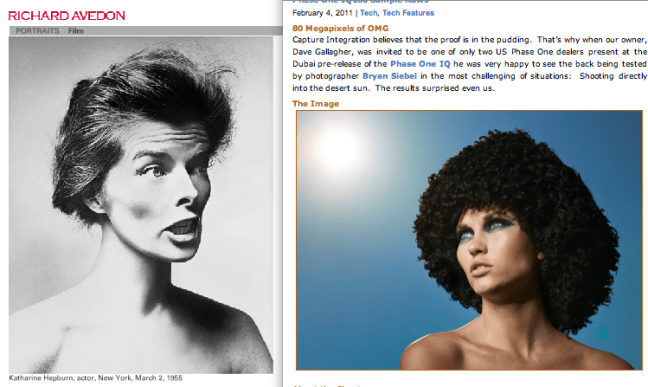
via: http://www.captureintegration.com/2011/02/04/phase-one-iq180-sample-raws/
and : http://www.richardavedon.com/#mi=2&pt=1&pi=10000&s=5&p=4&a=0&at=0
on: 9/26/11
——————————————–
Then why is it that Avedon did such great work. Perhaps he wasn’t commercial enough. The sample from the IQ180 isn’t made by some daytime dentist, it is a professional image, yet it is so overlit, so under realized, that it hurts me to put it next to a photograph 60 years its junior.
Most of the commercial work seen has a uniformity that makes it nearly uselss.
——————————————————————————————————–
see[GD] : http://forum.getdpi.com/forum/showthread.php?t=30514
see[LFF] : http://www.largeformatphotography.info/forum/showthread.php?t=80963
see[LuLa]:http://www.luminous-landscape.com/forum/index.php?topic=58020.0
see : http://www.markuszuber.com/8by10.html
——————————————————————————————————-
So Then
Millions of people have made many millions of images for over a century. These images have ranged from the banal, thru the useful to the astounding, shocking, beautiful. Rarely do those that have lasted the full century live up to the technical standard available at the time of their making. I doubt that those people who maintain their pixel addiction will ever satisfy the eye of the beholder.
Comparing Mythologies
comparing mythologies, you and I
out in the night, under darkened sky
stayed too late to learn the answer,
why

You must be logged in to post a comment.