
this is meant as a caution to those of you considering a Canon 9500 printer. Skip it. I will not waste the web space, nor the amount of my time it would take to list the problems encountered in using this printer, the printer driver, the media failures… yikes, just thinking about it causes me more regret. Anyhow, I have nothing good to say about the Canon 9500 printer. I can not even say it looks good.
Category: Prints
Stained Finger
Agfa/Ansco 113
Water (125 degrees F) . . . . . . . . . . . . 750 ml
Sodium Sulfite (Anhydrous) . . . . . . . . . 44 g
Potassium Bromide . . . . . . . . . . . . . . . .55 g
Amidol . . . . . . . . . . . . . . . . . . . . . . . . . . 6.6 g
Cold Water to make . . . . . . . . . . . . . . . . . 1 liter
Use full strength. Add the amidol only after the solution of the first two chemicals has cooled to below 80 degrees.
I used this formula and a “spoonful” modification while at the San Francisco Art Institute. My favorite papers were Agfa Brovira and Portiga. Using this old formula I could save almost any negative. This saved many 35mm shots. Those papers, this formula and Selenium toning produced gorgeous rich tone prints. The Brovira was cold, with ranges of color that tinged blue or green, depending upon the time in the developer. The Portriga was my favorite B&W paper. It had been intended as a warm tone portrait paper, but its creamy paper and brown tone worked wonders on my Obelisks. I never used it with people or nudes, but many of my fellow students sure did. I may have brought it into the studio but many were those who took it up.
Start At The End
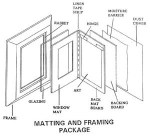 Showing work, not in the studio on a table or pinned to the looksee wall, but in a gallery or a collection means the work is matted. In the fine art world this matting is assumed to be archival. To get a sense of the process and the reasoning behind the process see this link on preservation from the Library of Congress.

You must be logged in to post a comment.