Meaning Beyond Method

Is the title of a book a promise? It isn’t a contract; maybe only an expectation.

  • Photography Beyond Technique
  • The Mind’s Eye
  • Looking at Pictures


richard.L7383
books from my shelf

is photography ever beyond technique 

Of course the work exceeds the method used to produce it.

Hope From The Title

The book that purports to be “Beyond Technique” spends more space on words than on pictures. Words about technique more so than about imagery. I bought the book hoping that it would be more than that. Just a hope. This book is the result of the burst power of the internet; able to propel small boats far out into the stream.

richard.L4599
2009, Un-met Challenge

There is only one chapter worth a flip through, just as the 2009 conference was so controlled, and confining that the group that I attended with left before lunch. The venue was SF State, a college that once had one of the best photography programs. During the Silver Expansion, the Visual Dialogue Foundation held frequent meetings outside the buildings so that we wouldn’t disturb the ‘standards’ of instruction expected of a State School.

The “Alt Photographers” of the 21st Century would have been well suited to uphold those educational standards. “Beyond Technique” isn’t beyond technique. It doesn’t take itself further, and only one author seems aware of what taking themself beyond technique entails. The editor has the correct aphorisms, but doesn’t understand them, I think, because he can’t get himself beyond Technique — his world began with an F-Stop, and ended there.

aphorism
reproduction isn’t understanding

Elsewhere

The other two books are composed of short, finely tuned responses to the circumstance of artist and photographer. The Bresson book (The Mind’s Eye), offers mostly memories. With one stand-out that provides the opportunity for Bresson to enlarge his reflection on art; he does this using the Sarah Moon movie as prompt and plinth.

sarah moon
worth a dog ear

“The segregation of photography, the ghetto into which this world of specialists has placed it, really shocks me. Photographers, artists, sculptors…You either have a feel for the plastic, or else a conceptual thought.”– Henri Cartier-Bresson

Getting to Meaning

Looking At Pictures – Robert Walser

The third book satisfies enough, just enough, to be worth the disappointment of the “Beyond Technique” book. I am particularly drawn to the chapters translated by Lydia Davis. The key chapter is “A Painter” —

“Great art resides in great goings-astray.”

Writers write less, but mean more. The better responses encompass what is there, what the pictures contains and what contains the picture. They are merely looking at pictures.

How do we get to meaning; is it possible to work beyond technique in what most consider a technical art? We get there by working harder; by ignoring more; by directing our attention toward one thing — and away from the easy things .. music, not scales.
Steps along a path: no knowledge, knowledge that is misunderstood, knowledge that diminishes, then knowledge that expands, and finally that which frees us from our teachers

Like Any Other Day

breathing film

Most days, it comes in, and goes out.
Digital9185prankserDigital9206prankser
the process is the same, but the volume is very different from years ago — when I started, we used to get film and paper by the pallet. Just a few years ago I was shooting more than 600 sheets of 8×10 a year — not anymore.

Film is comfortable, but not essential. Hell, I am sitting in a house with canvas drying, film & prints drying, and on a workbench another electronic imaging project is ready for an enclosure…

times change, if you let them — you are the compass or the anchor…

Linda Barry: Biblio

Barry Biblio

  • Girls and Boys (Real Comet Press 1981) ISBN 0-941104-00-1
  • Big Ideas (Real Comet Press, 1983) ISBN 0-941104-07-9)
  • Everything in the World (HarperCollins 1986) ISBN 978-0060961077
  • Down the Street (HarperCollins 1988) ISBN 978-0060963040
  • The Fun House (HarperCollins 1988) ISBN 0-06-096228-3
  • The Good Times Are Killing Me (Perennial/HarperCollins, 1988) ISBN 0-941104-22-2
  • Come Over, Come Over (HarperCollins 1990) ISBN 0-06-096504-5
  • My Perfect Life (Perennial/HarperCollins 1992) ISBN 978-0060965051
  • The Lynda Barry Experience (spoken word cassette tape/CD 1993) ISBN 1-882543-17-3
  • It’s So Magic (Perennial/HarperCollins 1994) ISBN 978-0060950460
  • The Freddie Stories (Sasquatch Books 1999) ISBN 978-1570611063
  • Cruddy (Simon & Schuster hardcover 1999; paperback 2000) ISBN 978-0684838465
  • The Greatest of Marlys (Sasquatch Books 2000) ISBN 1-57061-260-9
  • One! Hundred! Demons! (Sasquatch Books 2002) ISBN 9781570613371
  • The Two Questions
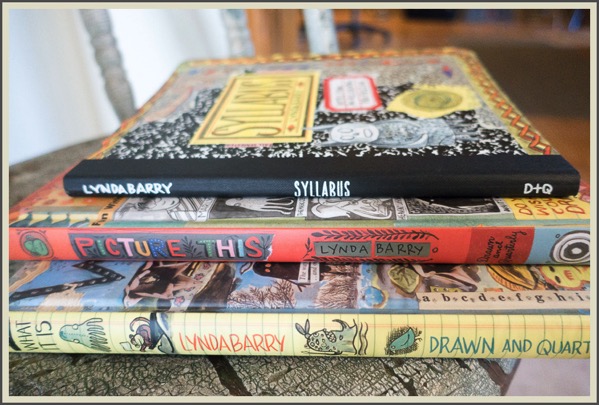
  • What It Is (Drawn and Quarterly 2008) ISBN 978-1897299357
  • Picture This: The Near-Sighted Monkey Book (Drawn and Quarterly 2010) ISBN 1-897299-64-8
  • Blabber Blabber Blabber: Volume 1 of Everything (Drawn and Quarterly 2011) ISBN 978-1770460522
  • Syllabus: Notes from an Accidental Professor (Drawn and Quarterly 2014) ISBN 978-1770461611

First Reads

  1. What It Is (Drawn and Quarterly 2008) ISBN 978-1897299357
  2. Picture This: The Near-Sighted Monkey Book (Drawn and Quarterly 2010) ISBN 1-897299-64-8
  3. Syllabus: Notes from an Accidental Professor (Drawn and Quarterly 2014) ISBN 978-1770461611

Her well known book is The Good Times Are Killing Me, but the books for an early art effort, or as an item of restart, that pat or kick you need, read the “First Reads” list. She is on tumblr, so you’ll find her if you are interested.

Jump Start: Restart

Digital03954prankser
at least one way to get yourself doing/working/playing/making again