

Reading to read again builds a muscle. Memory among others, even distant, is an extension of time.
Essays by Lydia Davis is a ready source of ways toward an open table awaiting stacks from around the house. Today she directed me toward a book I rarely read. I promise to read.
Lydia writing about lists and order: “You may have the elements you want in a list, within a sentence, but in an order that is arbitrary or a bit jumbled. The reader receives the content that you have offered, but doesn’t receive it in the best possible order …” She proceeds to suggest Tufte’s “Artful Sentences” and a Jefferson sentence.
Immediately pulled out Tufte… added it to a table by a chair with readings about AI. Bam. What you have is a reference set instead of a compelling sentence. I am easily distracted by interesting people. May be the bird-eye mind reaction.
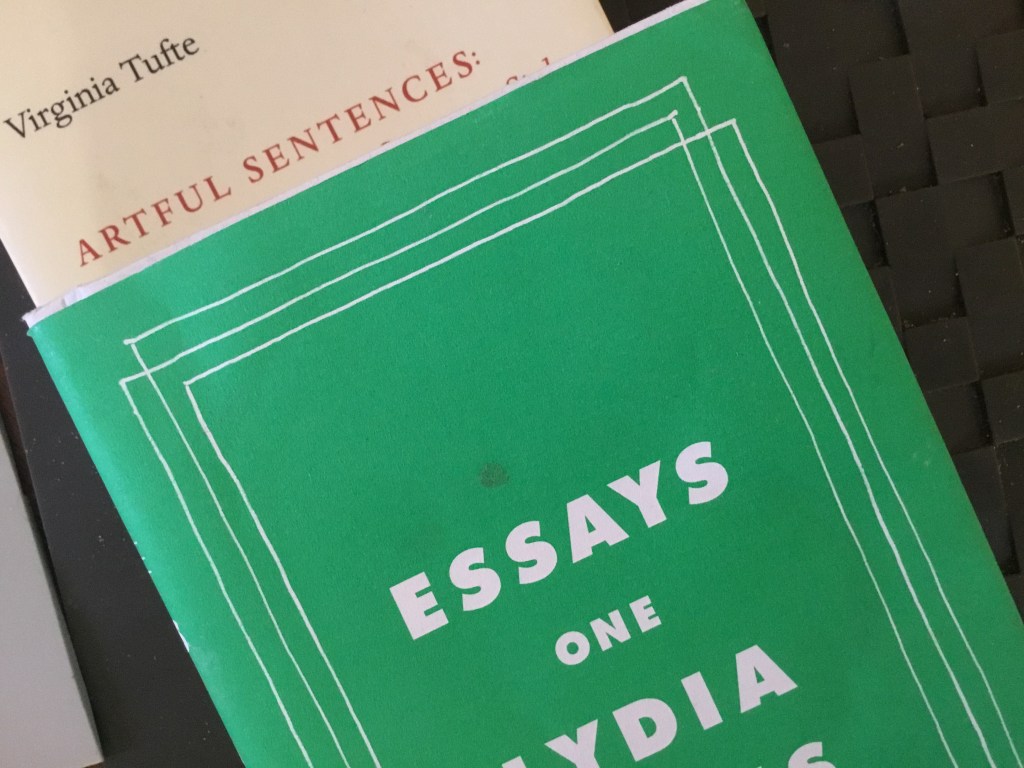
… Lydia Davis calls to Virginia Tufte…
Okay. Today, I will flip through it. I begin, but stop, since on the floor I find a text on cognition. It is stuffed with stickies, unfinished notepapers. Better writing will have to wait. Instead, a collection of references from the book on the floor …
References of a time: Brain. Cognition.
- Bechtel, W., and Graham, G. (1998). A Companion to Cognitive Science. Oxford, England:
- Blackwell. (Encyclopedia-style entries on all the important topics, with a useful historical introduction by Bechtel, Abrahamsen, and Graham.)
- Boden, M. (1990). The Philosophy of Artificial Intelligence. Oxford, England: Oxford University Press. (Seminal papers by Turing, Searle, Newell and Simon, and Marr, with some newer contributions by Dennett, Dreyfus and Dreyfus, P.M. Churchland, and others.)
- Boden, M. (1996). The Philosophy of Artificial Life. Oxford, England: Oxford University Press. (Nice introductory essay by Langton, and a useful window on some early debates in this area.)
- Haugeland, J. (1997). Mind Design II. Cambridge, MA: MIT Press. (Fantastic collection, including a fine introduction by Haugeland; seminal papers by Turing, Dennett, Newell and Simon, Minsky, Dreyfus, and Searle; a comprehensive introduction to connectionism in papers by Rumelhart, Smolensky, Churchland, Rosenberg, and Clark, seminal critiques by Fodor and Pylyshyn, Ramsey, Stich, and Garon; and a hint of new frontiers from Brooks and Van Gelder. Quite indispensable.)
- Lycan, W. (1990). Mind and Cognition: A Reader. Cambridge, MA: Blackwell. (Great value-a large and well-chosen collection concentrating on the earlier debates over functionalism, instrumentalism, eliminativism, and the language of thought, with a useful section on consciousness and qualia.)
- MacDonald, C., and MacDonald, G. (1995). Connectionism: Debates on Psychological Explanation. Oxford, England: Blackwell. (A comprehensive sampling of the debates between connectionism and classicism, with contributions by Smolensky, Fodor and Pylyshyn (and replies by each), Ramsey et al., Stich and Warfield, and many others.)
- Braddon-Mitchel, D., and Jackson, F. (1996). Philosophy of Mind and Cognition. Oxford, England: Blackwell. (Excellent introductory text covering the more traditionally philosophical territory of identity theory, functionalism, and debates about content.
- Kim, J. (1996). Philosophy of Mind. Boulder, CO: Westview. ( text, covering behaviorism, identity theory, machine functionalism, and debates about consciousness and content.)
Don’t be distracted by AI things. Read until nine-eyes dies.

You must be logged in to post a comment.