

The real and the spiel.
The Joycean eyepatch–of AI. What finds we find when the word becomes the key. What hides behind the unopened doors. My searches begin closed, become openings. Sadly, the googs and googlers have reached an end state: commerce.
All travel makes more connections than we are prepared to take. Words become phrases which, in turn produce more phrases. In early periods of a field more variety is brought in as possible sets for the new setting.
Camera Lucida was one set. Visual Studies Workshop was a fertile ground. Consider the words chosen as totems for that new place in Rochester. Visual. Studies. Workshop. It could have been called: SUNY Buffalo Extension. No sauce. Nathan got it right. From that place came people. They maintained contacts as is the case in most fields. In new fields, those connections are stronger than in old fields.
Camera Lucida, a device, book, journal. The camera lucida was a drawing aid with which Talbot failed. This failure became the path of photography. The book by Barthe became the errant irritant in criticism, producing more puss than pearl. Nevertheless, it was productive of thought when it was needed.
Barthes’s Work: Barthes’s “Camera Lucida” explores the nature of photography, the relationship between the photographer and the spectator, and the concept of the “punctum” (a specific detail in a photograph that evokes a strong emotional response).
Further:
- https://en.wikipedia.org/wiki/Camera_Lucida_(book)
- https://garagemca.org/en/programs/publishing/roland-barthes-roland-barthes-camera-lucida-reflections-on-photography
- https://www.theguardian.com/books/2011/mar/26/roland-barthes-camera-lucida-rereading
- https://media-studies.com/studium-and-punctum/
Talbot –dated his efforts to invent photography to his disappointing results using a Camera Lucida as a drawing aid at Lake Como in Italy in 1833?
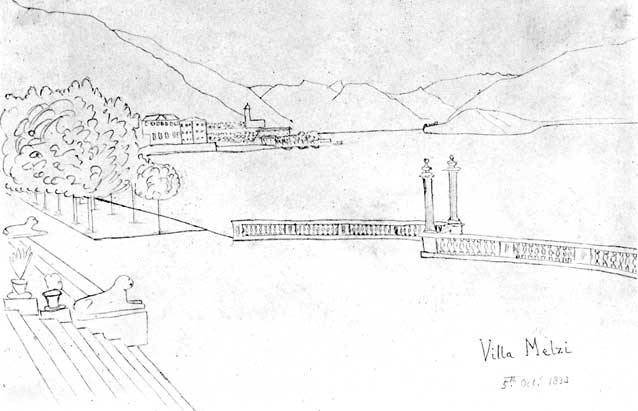
But alas, it only seemed simple, he later recalled, “for when the eye was removed from the prism—in which all looked beautiful—I found that the faithless pencil had only left traces on the paper melancholy to behold.” The would-be artist was William Henry Fox Talbot (1800–1877)
Bringing me to my searched items. The Journal of… I have the volumes. They’ve lived in boxes of similar sized publications.
MUFFOLETTO, ROBERT, EDITOR Milwaukee: Camera Lucida, 1979. Milwaukee.
Ceased publishing after Number 7, 1983
A complete set (Nos. 1-7) of the influential early journal of photographic criticism. Contributors include A. D. Coleman, Claudia Wolz, Bill Jorden, and Michael Simon, and topics include photography and therapy, an anthropology of photography, perception and photography, and more. The last issue is a double number written by Arnold Gassan, a photography instructor turned psychiatrist and student/devotee of White. It is titled, “Report: Minor White Workshops and a Dialogue Failed.” Date: 1979. Baumgartner [US]

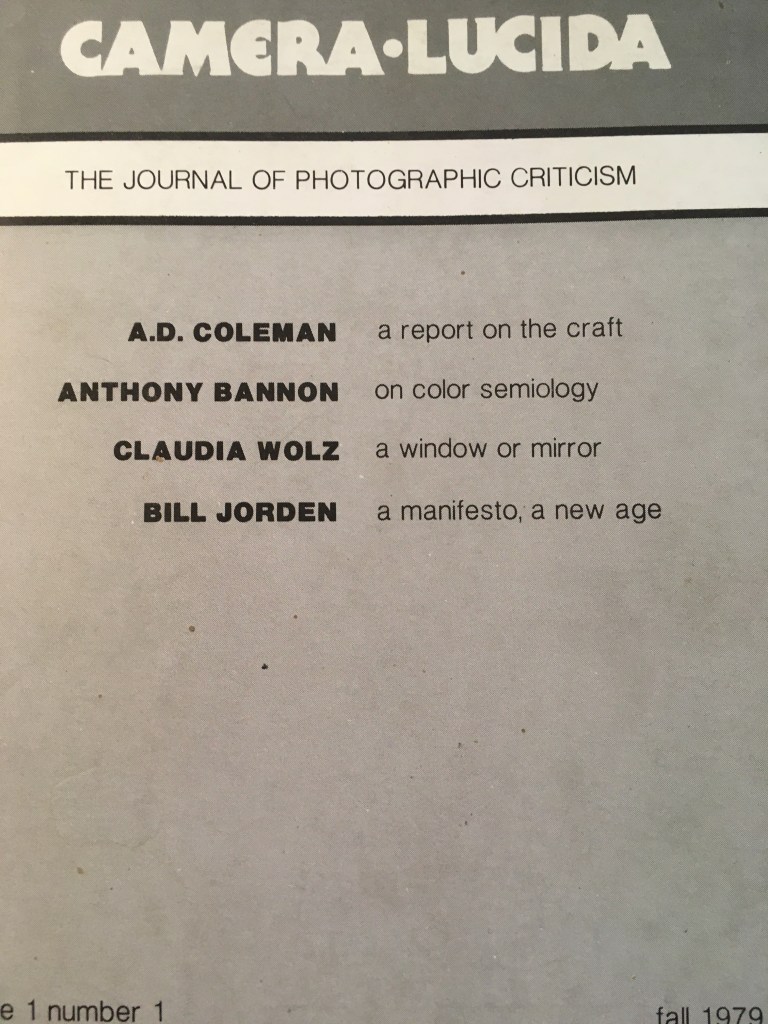


The box traveled on its own.. Buying from dead critics photographers estates and the oughts of this century I both discover and re-discover influences if not on me directly on the world around me the immediate world of art of the dark-room entering the white room…
phrases I uttered that others published.. The world that lasts is always the world that someone else collects you need a collector an editor a publisher.. so that what you say and what you have selected is preserved by someone on some shelf…
Two parts to an ides:
- inspriation, first idea, an initial question which may come as a doubt.
- next, the reason for re-examination and the resulting drive
“Is history not simply that time when we were not born?” writes Roland Barthes in the very beginning of the second chapter of his book — Camera Lucida. I

You must be logged in to post a comment.