A Painter’s Kitchen: Recipes from the Kitchen of Georgia O’Keeffe Paperback use pre formatted date that complies with legal requirement from media matrix – August 16, 2009 by Margaret Wood
O’Keefe on cooking is one of the funniest ‘cook books’ ever. Not intentionally, I think, but it is in its content. The recipes are spartan, and often leaving much more to the imagination and ingenuity of the cook than most cookbooks. This is certainly not an escoffier, nor a Betty Crocker mannered book. None of the books of my previous post on artist cookbooks is as open ended. I suspect this is a revelation of lifestyle as well as art ages. Perhaps it is a revelation of the mind of this particular artist.
A Recipe (of Life?)
choose several fresh leaves, those of best size. season to taste.
And So
I think that all actions of a creative person have pathways in common with their aesthetic path.
Many paths up the same mountain.
The recipe replaces the ingredients. The fewer ingredients the better they must be, to satisfy the diner. Most seasonings are elements that consume the ingredient, the main content of the dish, covering its taste with reciped flavor – taste made standard.
This kitchen book, I choose to call it that instead of ‘cookbook,’ leaves much to the kitchen of the reader-preparer, as does the best of art- art that lives within your aesthetic life.
Is the title of a book a promise? It isn’t a contract; maybe only an expectation.
Photography Beyond Technique
The Mind’s Eye
Looking at Pictures
books from my shelf
is photography ever beyond technique
Of course the work exceeds the method used to produce it.
Hope From The Title
The book that purports to be “Beyond Technique” spends more space on words than on pictures. Words about technique more so than about imagery. I bought the book hoping that it would be more than that. Just a hope. This book is the result of the burst power of the internet; able to propel small boats far out into the stream.
2009, Un-met Challenge
There is only one chapter worth a flip through, just as the 2009 conference was so controlled, and confining that the group that I attended with left before lunch. The venue was SF State, a college that once had one of the best photography programs. During the Silver Expansion, the Visual Dialogue Foundation held frequent meetings outside the buildings so that we wouldn’t disturb the ‘standards’ of instruction expected of a State School.
The “Alt Photographers” of the 21st Century would have been well suited to uphold those educational standards. “Beyond Technique” isn’t beyond technique. It doesn’t take itself further, and only one author seems aware of what taking themself beyond technique entails. The editor has the correct aphorisms, but doesn’t understand them, I think, because he can’t get himself beyond Technique — his world began with an F-Stop, and ended there.
reproduction isn’t understanding
Elsewhere
The other two books are composed of short, finely tuned responses to the circumstance of artist and photographer. The Bresson book (The Mind’s Eye), offers mostly memories. With one stand-out that provides the opportunity for Bresson to enlarge his reflection on art; he does this using the Sarah Moon movie as prompt and plinth.
worth a dog ear
“The segregation of photography, the ghetto into which this world of specialists has placed it, really shocks me. Photographers, artists, sculptors…You either have a feel for the plastic, or else a conceptual thought.”– Henri Cartier-Bresson
Getting to Meaning
Looking At Pictures – Robert Walser
The third book satisfies enough, just enough, to be worth the disappointment of the “Beyond Technique” book. I am particularly drawn to the chapters translated by Lydia Davis. The key chapter is “A Painter” —
“Great art resides in great goings-astray.”
Writers write less, but mean more. The better responses encompass what is there, what the pictures contains and what contains the picture. They are merely looking at pictures.
How do we get to meaning; is it possible to work beyond technique in what most consider a technical art? We get there by working harder; by ignoring more; by directing our attention toward one thing — and away from the easy things .. music, not scales.
Steps along a path: no knowledge, knowledge that is misunderstood, knowledge that diminishes, then knowledge that expands, and finally that which frees us from our teachers

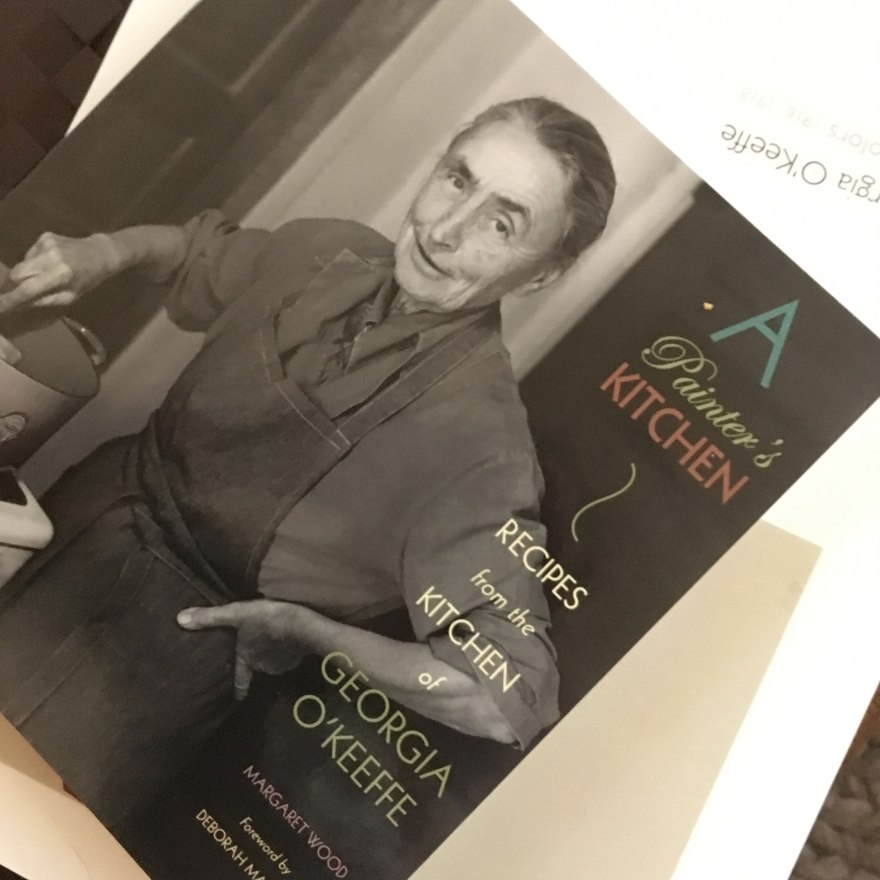 A Painter’s Kitchen: Recipes from the Kitchen of Georgia O’Keeffe Paperback use pre formatted date that complies with legal requirement from media matrix – August 16, 2009 by Margaret Wood


You must be logged in to post a comment.