What is a box book?
Mike Mandel’s newest project (ISBN 9780989531146), the first in many years, is, essentially, a reprint effort. Work he did during the 70s — the exploration decade of photography. Most of you reading this weren’t artistically alive then, but most of the faculty at art schools was. Those old ducks wandering the halls were young ducks in search of a pond. Some call those 70s the silver decade… the rush for a place at the faculty lounge, or the gallery wall. We have a place at both.
The 70s meant opportunity to explore, to claim a first, to announce to a very small audience that you did something — to provide evidence of your existence. And it was a time to be in school — away from the blood — at least until 1973, then it was olly olly in free.
A collection or an accumulation — what is the difference?
continued…
<!–nextpage–>
What Made Mike
What made Mike? Why did he pick these items from 40 years ago to publish — what is he refreshing? Why Mike? Why these? Questions I ask, but can’t fully answer; wish I did. Maybe I can’t even honestly try since the last time I talked to Mike was in 1973 — he was bent over a sculpture I had submitted as part of my “graduation exercise.” I don’t remember what he or I said. I do know that he was the only one in the room who spent enough time with the “darkroom” to almost make it trigger…
Mike was curious, and seemingly very interested in what others were doing — leaving them room. He was a publisher — self-published was rare, and he used the booklet well.
SFAI was a small program so we all saw most of what was being done. Saw, but rarely talked about. Most grad students did their own stuff, meeting irregularly except for the weekly ‘seminar’ in which a teacher struggled to express opinion. There were at least 3 standout students. None of whom became a name. They finished and vanished.
Mike made books. He had a sense of the absurd and was very open to comment. He absorbed, but didn’t use others. At some point I realized he had the talent — wondered if he knew. Larry Sultan was outgoing — a quick responder to presented ideas. You could see him take it in, and roll it into his own phrasing. Larry was necessary for Mike & Larry, yet I believe that without Mike’s perception and drive Mike & Larry would have burned out on the pad.
Mike is put on podiums and asked to remember Larry Sultan. This Brovira box is Mike’s chance to remember himself — and it reminds me of how much better (more interesting) Mike was than Larry.
Proof or evidence
How many ideas do you need? A school with someone marking photographs with a rubber stamp:
- “proof, not evidence”
- photographing billboards — front and back
- posting photographs of street signs on the wrong streets
- posting false front pages on the papers outside brokerage firms
- working as collectives of photographers — all using same name
- replacing the ads on buses
- blueprints of weston peppers (with circles & arrows)
Whose Chronology
We aren’t historians, we are biographers. Each of us telling stories about others, those we have met, those we remember, but not the way, nor for the reasons that they met us, nor as they remember us.
The chronology provides Mike’s appreciation of his past, and is our only update of that time; his perspective in short summary paragraphs. Little elaboration, even after these years.
we’ve all met our jealous monk
According To Mike
Included in the Box is a “Chronology” — his choice:
- 1970 People in Cars
- 1971 Myself: Timed Exposures
- 1973- 1990 Billboards
- 1974 Seven Never Before Published Portraits of Edward Weston
- 1974 How to Read Music in One Evening
- 1974 Motels
- 1974 Mrs. Kilpatric
- 1975 The Baseball-Photographer Trading Cards
- 1977 Evidence
- 1979 SF Giants: An Oral History
This slideshow requires JavaScript.
conceptual or performance
mike was performing conceptual work before either became collectable; became big enough to warrant a pantheon of stars; before the Art Forum had a center stage.
continued…
<!–nextpage–>
Letters from Sandra
The unexpected prize in the box was the “Letters From Sandra” packet. I didn’t know Sandra; had never heard of her, having to use google to fill in the ‘about’ of her. After learning where she had gotten, I re-read the letters. And have given them one final close read. Not because they are so insightful, or finely crafted. In fact they are neither, yet they are revealing, and I suspect that is the reason for Mike including them. (I doubt he is merely name-dropping them into the box.)
These letters are a monologue over years. We aren’t shown Mike’s words, only these letters from Sandra answering few questions, but always offering something. I see Sandra inserting herself into Mike’s life. Making herself available like all good gatekeepers…(as if saying) I have a rolodex, just keep me updated with your plans.
Each is structured the same; following a protocol, following the same schematic of conversation. In them she explains why she doesn’t make art: someone gets in her way. An important someone, nevertheless, she can easily set down her Art in service to some other.
How does one become a curator? By giving up being an artist– that’s the first thing to do. The excuse must be credible to others, but mostly to yourself — others, probably don’t care. They won’t examine your motive deeply; they are occupied with their own social frames and barriers.
After The 70’s
Where to after the gold rush — what else but aging. His work alone was his best work. After his solo show he became famous, or at least as famous as photographers become, then … maybe that was enough. Oh, right, public art and politics — keeping Walmart out of town.
The 70’s ended a long time ago — Art has changed. Politics has changed. The whole wide way of wondering has changed.
None of this box of memories will reveal those changes. For some of us, they may prompt thoughts, memories – fond and fragile.

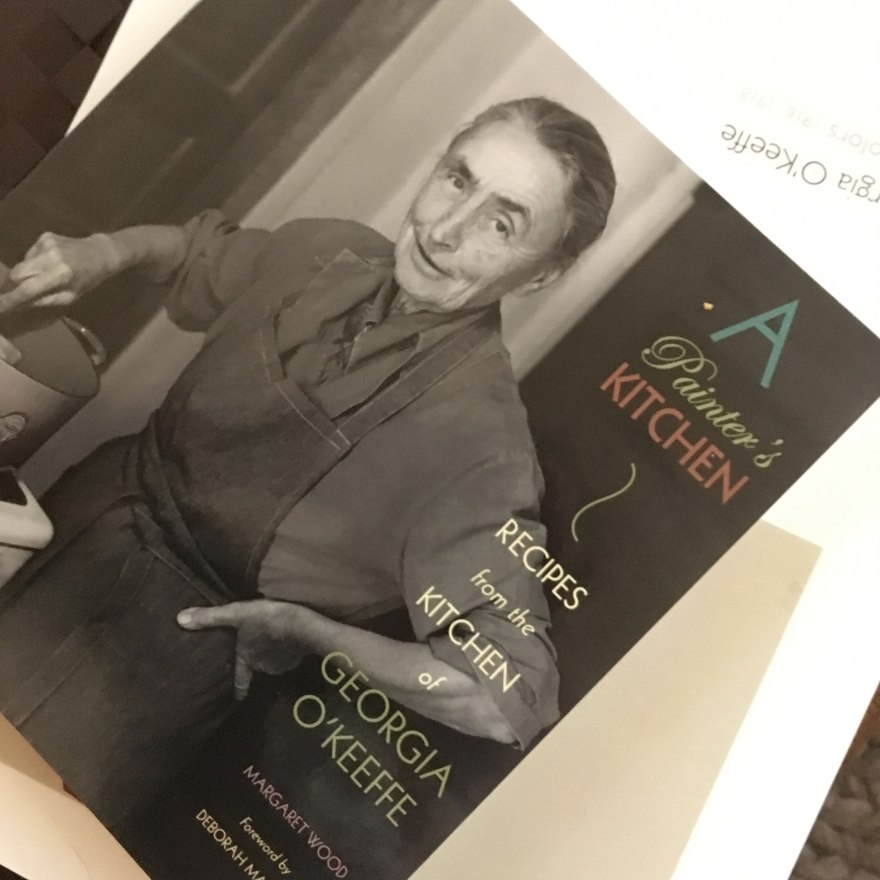 A Painter’s Kitchen: Recipes from the Kitchen of Georgia O’Keeffe Paperback use pre formatted date that complies with legal requirement from media matrix – August 16, 2009 by Margaret Wood


You must be logged in to post a comment.