Between Threads

Reading to read again builds a muscle. Memory among others, even distant, is an extension of time.

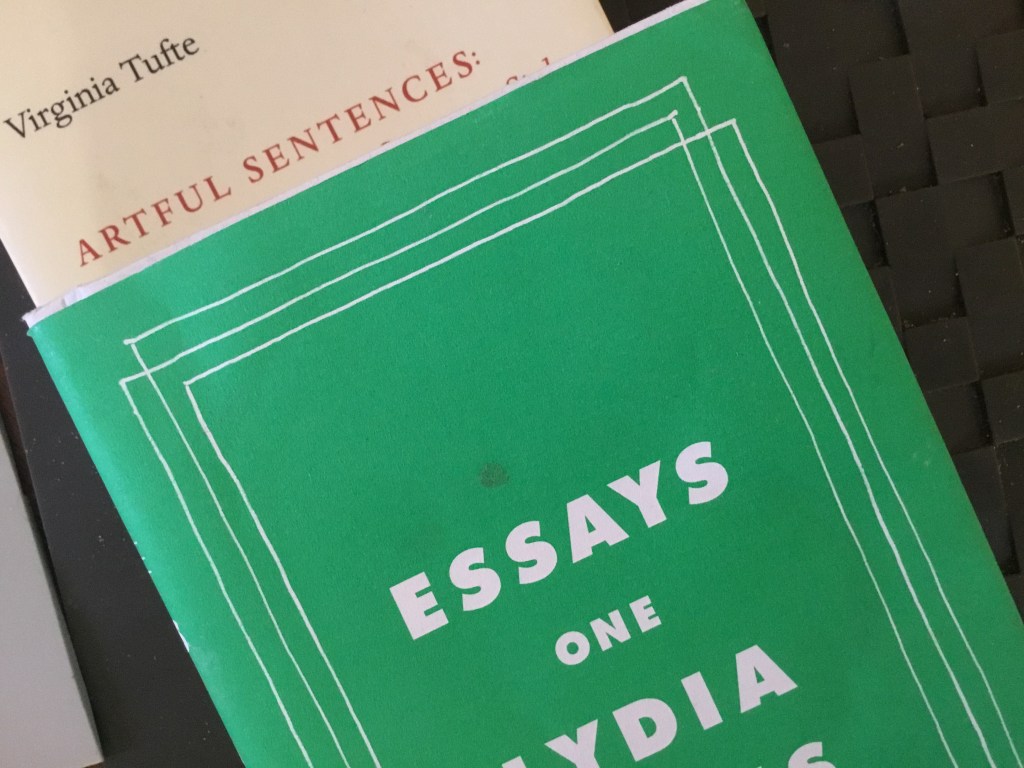
Essays by Lydia Davis is a ready source of ways toward an open table awaiting stacks from around the house. Today she directed me toward a book I rarely read. I promise to read.

Lydia writing about lists and order: “You may have the elements you want in a list, within a sentence, but in an order that is arbitrary or a bit jumbled. The reader receives the content that you have offered, but doesn’t receive it in the best possible order …” She proceeds to suggest Tufte’s “Artful Sentences” and a Jefferson sentence.

Immediately pulled out Tufte… added it to a table by a chair with readings about AI. Bam. What you have is a reference set instead of a compelling sentence. I am easily distracted by interesting people. May be the bird-eye mind reaction.

… Lydia Davis calls to Virginia Tufte…

Okay. Today, I will flip through it. I begin, but stop, since on the floor I find a text on cognition. It is stuffed with stickies, unfinished notepapers. Better writing will have to wait. Instead, a collection of references from the book on the floor …

References of a time: Brain. Cognition.

  • Bechtel, W., and Graham, G. (1998). A Companion to Cognitive Science. Oxford, England:
  • Blackwell. (Encyclopedia-style entries on all the important topics, with a useful historical introduction by Bechtel, Abrahamsen, and Graham.)
  • Boden, M. (1990). The Philosophy of Artificial Intelligence. Oxford, England: Oxford University Press. (Seminal papers by Turing, Searle, Newell and Simon, and Marr, with some newer contributions by Dennett, Dreyfus and Dreyfus, P.M. Churchland, and others.)
  • Boden, M. (1996). The Philosophy of Artificial Life. Oxford, England: Oxford University Press. (Nice introductory essay by Langton, and a useful window on some early debates in this area.)
  • Haugeland, J. (1997). Mind Design II. Cambridge, MA: MIT Press. (Fantastic collection, including a fine introduction by Haugeland; seminal papers by Turing, Dennett, Newell and Simon, Minsky, Dreyfus, and Searle; a comprehensive introduction to connectionism in papers by Rumelhart, Smolensky, Churchland, Rosenberg, and Clark, seminal critiques by Fodor and Pylyshyn, Ramsey, Stich, and Garon; and a hint of new frontiers from Brooks and Van Gelder. Quite indispensable.)
  • Lycan, W. (1990). Mind and Cognition: A Reader. Cambridge, MA: Blackwell. (Great value-a large and well-chosen collection concentrating on the earlier debates over functionalism, instrumentalism, eliminativism, and the language of thought, with a useful section on consciousness and qualia.)
  • MacDonald, C., and MacDonald, G. (1995). Connectionism: Debates on Psychological Explanation. Oxford, England: Blackwell. (A comprehensive sampling of the debates between connectionism and classicism, with contributions by Smolensky, Fodor and Pylyshyn (and replies by each), Ramsey et al., Stich and Warfield, and many others.)
  • Braddon-Mitchel, D., and Jackson, F. (1996). Philosophy of Mind and Cognition. Oxford, England: Blackwell. (Excellent introductory text covering the more traditionally philosophical territory of identity theory, functionalism, and debates about content.
  • Kim, J. (1996). Philosophy of Mind. Boulder, CO: Westview. ( text, covering behaviorism, identity theory, machine functionalism, and debates about consciousness and content.)

Don’t be distracted by AI things. Read until nine-eyes dies.

Picture Post: Feb6

from my drives. Distinct manners. Made within 90 days but over 1800 miles.

Picture is a surface rendered. The picture on the left, the yellow one, is greater transformation than what made the source scene. The righter one, foliage and fence, closer to expectation of the “photograph” — it is realistic. As a projection on your screen it isn’t a real object. Your eye is the printout.

Either of these could have been a result of darkroom work, neither was. In terms from the 70s, the solarization would have been the easier. The “fence” would have needed masking, two types of film, taking a day, because of dry time for the sheets of film. Drying was often the time user. Batch up, and have multiple drying cabinets was the answer as your lab gained clients.