The Dragon Flames Out

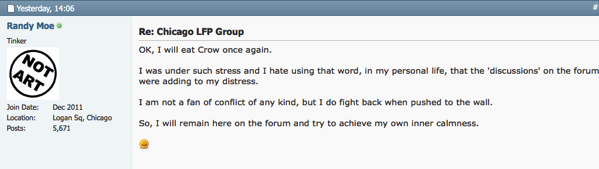
randy (no) moe announced his return to the forums, even though he hadn’t left them, only announcing his upcoming leaving… MoeBacksOut

The Large Drama

little things, but dependent things. People in need of something outside themself, something more than what they can make; more than what they have.

the dragon flames out, dragging his tail in a wagon, back to the forum of fellow pretenders

He pretended he was there; he pretended that he was gone. Pretending to be…what/who?

They Can’t Leave

They cannot leave, because they have no place to go. They can’t start a place, they have nothing to offer others, so they stay clustered, fucked though it may be, addicts live best among other addicts — the Forum Flop House, where they prey upon each other, and pray to empty phrases.

Masking: What Covers What

If at first steps you hesitate, will you ever make the journey? Making color prints is easy, but not trivial. It can be used simply or taken to extreme complexity. This is by design.

Masks are made to alter the color response. Usually they are made to correct for deficiency of colorants used in the practical printing. What was once a labor intensive procedure was made simpler, more automatic over several decades. By the 1950s theory and practice had become teachable in trade-schools to people never intending to go to college to learn linear algebra so they could make color prints.

Alexander Murray, of Eastman Kodak Research Laboratories, co-developer of the Murray-Davies equation was the early pioneer. His goal “eliminate retouching by the masking process” with as few masks as possible. “

Photo-trichromatic printing, in theory and practice by Zander, C. G., author

was an early text about ink on paper. It is a small booklet written by an ink maker and it should be read by everyone new to printing; the coverage of the first solutions to the common problems that remain today will highlight how far we have come.


Some references keyed to printing; the CMYK model.

Austin AC. Photo-Lithography: Suggestions for the Lithographers Which Should Prove Beneficial to the Trade. The National Lithographer. 1923;30(11):25-26.
Albert E. Photographisches Farbendruck-Verhahren. Published online 1899
Albert E. Photographisches Mehrfarbendruckverfahren. Published online 1900.
Bassist E. Retouching for Offset Lithography in Colors. Inland Printer. 1925;74:756.
Bultz SW. New Method of Copying Paintings: To the Editor of the Photographic Journal. Journal of the Photographic Society of London. 1856;3(40):15
Gamble W. The Future of Letterpress Printing. Inland Printer. 1925;74:757
Horgan SH. Process Engraving: A Three-Color Pessimist. Inland Printer. 1922;69:239.
Horgan SH. Offset Printing: Offset Printing’s Future. Inland Printer. 1922;69:368.
Horgan SH. Notes on Offset Printing: Color Correction on Offset Plates. Inland Printer. 1922;69:872
Mertle JS, Monsen GL. Photomechanics and Printing; Practical Information on Platemaking and Presswork by Recognized Procedures. Mertle Publishing Co. ; 1957.	
Murray A. The Masking Method of Color Correction Applied to Three- and Four-Color Reproduction. The Photo-Engravers Bulletin. Published online January 1934:13-21.
Yule JAC. The Theory of Subtractive Color Photography I. The Conditions for Perfect Color Rendering. Journal of the Optical Society of America. 1938;28:419-430
Yule JAC, Field GG. Principles of Color Reproduction. 2nd ed. GATFPress; 2001.
Field JAC. Color and Its Reproduction. 2nd ed. GATFPress; 1999.
An Improvement Process: Photo-Lithography in Color by an Ideal Method with Accurate Tonal Values. The National Lithographer. 1923;39:44. Accessed November 26, 2020. https://www.google.com/books/edition/_/ZTAyAQAAMAAJ?hl=en&gbpv=0