
The biggest detour is the detail. Paper clips and pencil sharpeners are the enemy of good writing; so too the enemy of good photography is the search for a better developer, lens, film, or, worst of all, opportunity.
Opportunity doesn’t knock, it hides right behind you.
Students teach their delays to their teachers. In teaching adult learners, while also teaching full time students, I noticed a significant differences. Those people who had to use the picture made better pictures earlier. The just followed the notes on the wall; used the chemicals provided; bought the student pack from the local store. At the end of a month they were making prints and talking about elements other than the ‘how do I’ of photography.
There were some who took to the process quickly, effortlessly absorbing details of the process, while also shooting. Shooting a lot. In fact, that was the secret of the successful student — they advanced themself — dedicated effort. They took the assignment: ‘a roll a day for a month’ in earnest, even extending it to the entire first year.
Basic Silver

…. In the chemical age, in every age of commerce, we move among choices; are moved, actually, thinking we have choices, so there is the belief that we can be better, newer, improved with only another mixture. Rarely is that true.
These developers are my at hand mixture. LPD, Dektol, & D-76. I keep them mixed because they are useful, and are delivered as a powder. These days, LPD is also sold as a a liquid. I always suggest to the novitiate that they buy liquid, even though you are paying for water, you are getting freedom from air borne chemical dust. This is as close to magic as we get.
Basic Bullets
My key point is that those who pursue a better developer/film/camera/ .. anything such as that, lose sight of the image; what it is, where it is, and why. To cover the lack of understanding of the power of an image, or in being lost to understanding aesthetic growth, or “shock,” those folks cover their lack with a homily about being after the process or the print. They are only lost, and covering their tracks. They are only addicts, not artists.
The magic bullet isn’t something you will buy; it isn’t something outside you that is missing. You lack the magic.
Besides, silver bullets always go bad, and actually carry little impact.
The Magic Beans, as exchanged in the halls of the camera cult, are Amidol, Pyro, and Glycin. I have posted about Amidol; while Pyro has so many vocal advocates, just ask ‘google’ … however, Glycin is do some airing out.
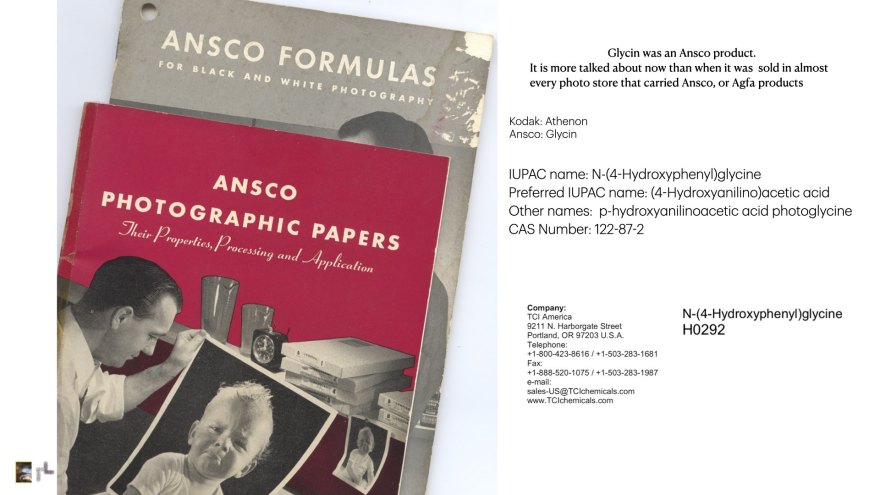
GLYCIN
In the beginning there were several beginnings — however, the history of the Camera Crafters is drawn across the landscape in the Zone Shades of Ansel Adams.
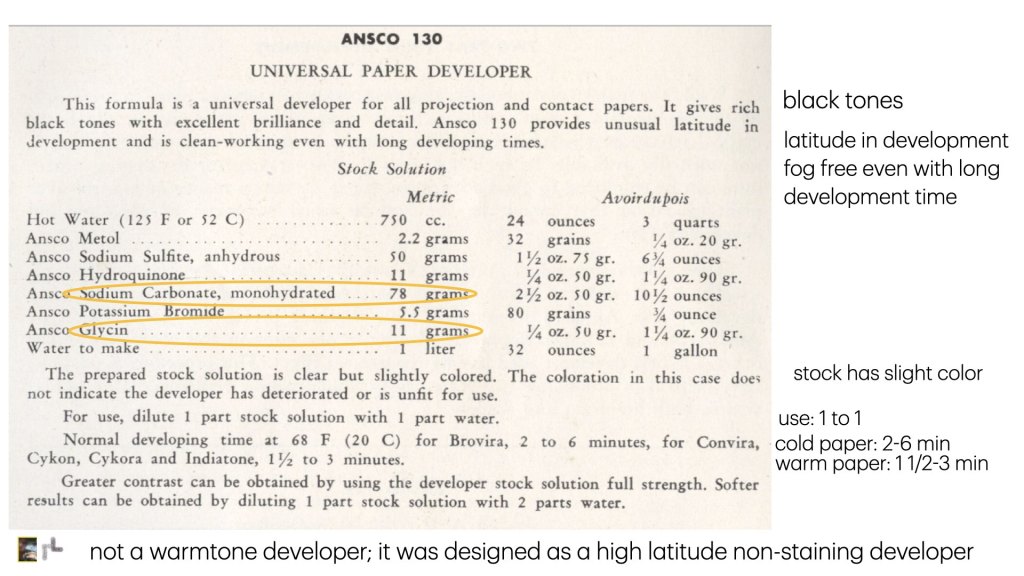
This: “With some papers glycin gives a light “stain” to the very high values and this appears as a “glow” which I have found rewarding at times. Usually a slow-working developer, glycin is sometimes preferred when a considerable number of prints are to be developed together.” Ansel Adams, The Print
His first series of technical articles was published in Camera Craft in 1934, and his first widely distributed book, Making a Photograph, appeared in 1935. Most important, in 1936 Stieglitz gave Adams a one-man show at An American Place.
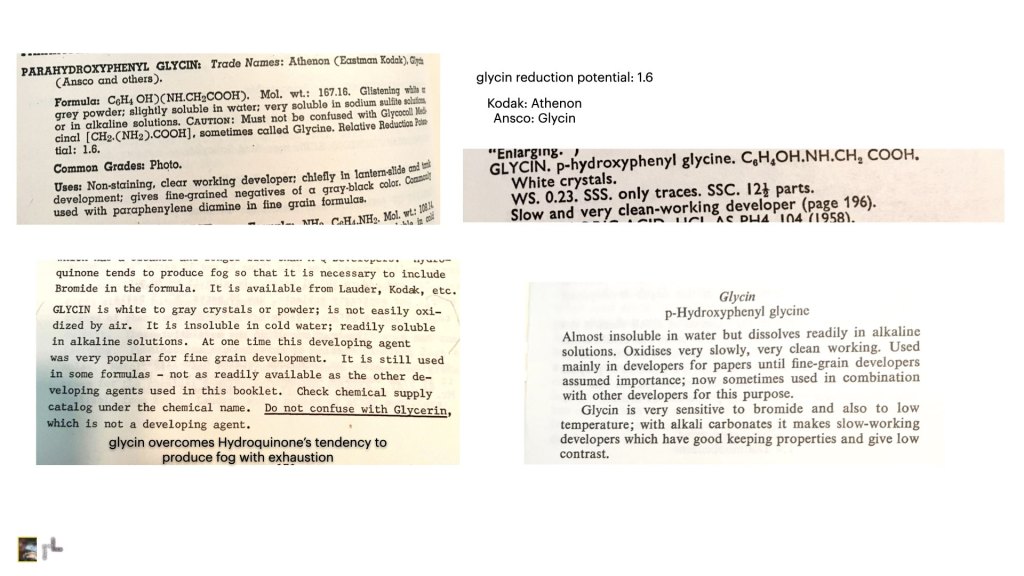
So, Glycin — a trademark, which is close enough to ‘glycerin’ which was used in the darkrooms of dye-transfer printers, but definitely not the same stuff.
/// BACKFILL CHEMISTRY NOTES
Haist: 174, Catechol (1,2-Dihydroxybenzend) ; Pyrogallol (1,2,3-Trihydroxybenzene)
catechol has been reported to be capable of image development even in the presence of considerable amounts of silver halide solvents, making this developin agent suitable for combined developing and fixing solutions.
Pyrogallol.. in developers containing low concentrtions of preservative, the oxidation products of pyrogallol development produce a residual yellowish-brown stain. This stain reinforces the silver image and is expecialy effective in obtaining maximum emulsion sensitivity and fine grain from the photographic material
the possibility of providing developers that improve both the graininess and sharpness was the objective of a study by Alman and Henn. [Effect of developer composition on the structure of photographic igmages. Phot. Sci. and eng.,5:129 1961
converting a developing agent into better surfactant will improve it electron-transfer capability and, hence, its ability to serve as a developing agent. [haist, 170]
developing agents
- glafkides [69] photographic chemistry, vol1, 1958, 112-131.
- mees [70] the theory of the photographic process, 1942, pp 331-373
- henny and dudley: [71] developers and theory of development, handbook of photography, 1939,ch. xi.
- Lambert, Pyrcocatechin, Anthongy’s Phot. byull, 33:74 (1902)
- Archer, 1851
- William Evan, New Ways with Pyro, Am. Phot., 39(5) May 1945
- Behrens, A Versatile Developer: Pyro, Am. Phot., 43(7) 1949

1948: Kodak lists SD-1 for pyro stain. SD means special developer; little use. Kodak needed a tanning developer (they had one) but they didn’t want stain.

You must be logged in to post a comment.