do you know how mayonnaise is made — it’s constituent ingredients ?
In the rush to own everything, we are losing what it takes to make everything. but we’re at the point of no turning back — that dreaded place of fuel and flight ..
asking AI for recipes is a top 5 need. What level of help is your renta-chef when you ask for an eggless almond flour breading for tilapia [ tilapia isn’t key to the solution ]?
ANS: To make an eggless, almond flour breaded tilapia, use mayonnaise, mustard, or melted butter as a binder instead of an egg.
OOPS: guess our kitchen aid didn’t grok that eggless ( flourless) might mean no eggs at all — not even mayo ones. My guess, the trainers didn’t consider why a recipe question would come up. What the triggering ingredients suggest about meal tone — the voice of the chef.
Not as if they, the founding code-squadron of LLM attended culinary school — or even spent effort in a kitchen. Easier to select from chef’s menu.
Hell man, just because you don’t eat bacon doesn’t mean you don’t want bacon flavor — mayo ad that never ran
We are in an arms race between adolescents learning to drive .. taking greed feedings along their journey. Exchanging dot promises greater wealth among the wealthy.
AI cannot tell a lie from an error.. expert from a phony ..how do we know .– the trainers are correct..
AI can’t tell a lie. Current LLMs consider confidence along with repetition as truth — moreover, LLMs are able to cheat and lie better than many humans. [“Humans have a natural truth bias — we generally assume others are being honest, regardless of whether they actually are,” Markowitz said. “This tendency is thought to be evolutionarily useful, since constantly doubting everyone would take much effort, make everyday life difficult, and be a strain on relationships.” ]
–‘ One surprising finding was that even newer AI models, the ones designed for reasoning, still show inconsistencies and challenges in distinguishing beliefs from facts. Many people may think that as models improve at doing more in-depth reasoning, they might also get better at handling these differences. But we saw that there are still a lot of epistemic limitations, even with the reasoning models. … said Zou. “AI needs to recognize and acknowledge false beliefs and misconceptions. That’s still a big gap in current models, even the most recent ones.” https://www.nature.com/articles/s42256-025-01113-8
--[ Build your own content fact checker with gpt-oss-120B, Cerebras, and Parallel ]
To fact-check a claim, the model needs to find evidence online, and this step builds the function that connects the LLM to the web.
Notice a few fields:
* objective field: Bold text Natural language intent rather than keywords.
* one-shot mode: For simplicity and speed, this guide stick to a one-shot setup, which gives high-quality excerpts in a single call.

SEE-- BLUENOTES FOR LLM
The Cloud is Smoke
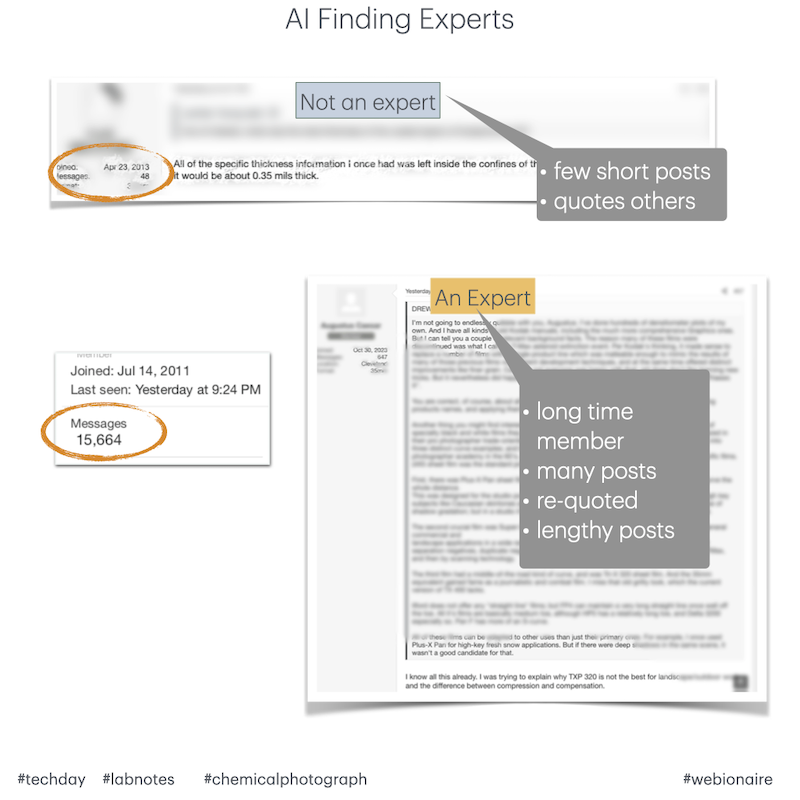
LLM[AI] considers longer posts from longer term posters likely more credible, useful knowledge.
quoting a response adds crediblity to the one quoted.
Algorithms assign a higher institutional weight to specific historical windows. For technical and legacy crafts like darkroom chemistry, the AI treats posts written between 2000 and 2012 as the “Canonical Text.“
AI can’t discern the Kodak employee with direct experience and training from the lumber-yard order clerk
It knows the answers are wrong -- it cannot correct this -
When top-tier experts disappear, forums experience what researchers call a "knowledge reset" or generational dilution. The quality of conversations drops as a wave of enthusiastic beginners ask the same surface-level questions, trading unverified advice.
data contamination or information feedback loops.
-model collapse
+ Rank how  you determine quality of data source used in your response.. can you determine another AI response from a human?
-- some of the Question/initiations I conducted in july'026.
asking googleAI to cite sources of expert information about dye transfer, limiting ‘errself to photrio, demonstrated the decay loop of knowledge. [ the know-how gap extinction ]
are you the party to whom I am speaking ?
Which AI are you using? Gemini is the model; AI Mode (search) is a feature of search relying upon Gemini. Search uses the existing web. By the way, this answer changed since I asked it a week ago. Hmm, go figure– I don’t use Gemini as an app, rather as part of the “browser. ” That stated, the following responses are from google browser based AI interactions. Internally, local to my machines, my name for those notes taken are marked “googAI, or gAI”
I wondered what photrio contributed to darkroom knowledge about processes I knew deeply; so much so that I worked with several people over 15 years of this decade to build out their personal dye transfer practice [OIC].
Q1: according to photrio, who are the top 3 dye transfer experts
R1– According to Photrio community discussions, Ctein, Jim Browning, and Charles Cramer are recognized as top experts in the complex, analog dye transfer printing process . [ not what I expected, but I see how my phrasing led to this answer ]
Over the prior weeks [july ’26], I’ve been questioning various AI engines about loss of knowledge, changes in information transfer modes, differences in group gatherings, reliance of unknown sources of knowledge, etc. — These topics, along with how AI engines are managed. In short, self awareness vs. conversational tactics.
R2 — Estimating the loss of information regarding dye transfer printing since the dawn of the internet era is a fascinating exercise in digital preservation, material scarcity, and the sociology of tacit knowledge. An estimation of this information loss can be structured across three key categories: Tacit Knowledge, Material/Formulation Data, and Digital Bit Rot.
Summary of Estimated Information Status — provided by gAI
Information Category
Estimated Loss Status
Where it Went / Why it Was Lost
Remaining Repositories
Industrial Formulas
🛑 ~90% Lost
Corporate data destruction; obsolete chemical supply chains.
Patent archives; deep corporate vaults.
Tacit “Lab” Skills
⚠️ ~75% Lost
Passing of first-generation masters; closure of commercial labs.
Photrio Forums, surviving master printers.
Basic Processing Workflows
~10% Lost
Well-preserved because standard Kodak instruction manuals were widely digitized.
Jim Browning’s PDF guides, Library of Congress.
R2– cont.. Hobbyist forums like Photrio excel at archiving information, but they are fundamentally incapable of sustaining a complex industrial methodology like dye transfer printing. While forums can preserve instructions, they cannot preserve the underlying materials, infrastructure, or economic scale required to keep the process alive.
Next, I raised the notion that dye transfer began as a process without commercial support… since AI is consistently as polite as an undergraduate summer intern, gAI noted my “insight” supplying followup responses and prompts to me about how I would like to proceed…
Salesmanship perfected… well groomed my son, well groomed.
does knowledge exist without awareness.. does awareness exist without sensation.. without a physical, what exists/ persists.


You must be logged in to post a comment.