
Alternative to image making as set out by the Kodak silvermine. The sixties birthed an alternate generation of image generators. The socializing of the 60s, increasing the breadth of acceptance, ever more individuals became eligible to live as openings. Individual diversity and expressive depth. At least as far as they could. Most stretched for a bit, then returned.. Bea Nettles was a strong influence (along with Betty Hahn http://www.bettyhahn.com/page15302.htm ) on alt process of the ‘transition years.’
To understand one isn’t enough for understanding. Bea Nettles made her work herself, although the path she took was made clearer by others. Signs along the way come after many have walked the way. Robert Fichter was an early guide for Bea Nettles (b. 1946 -).
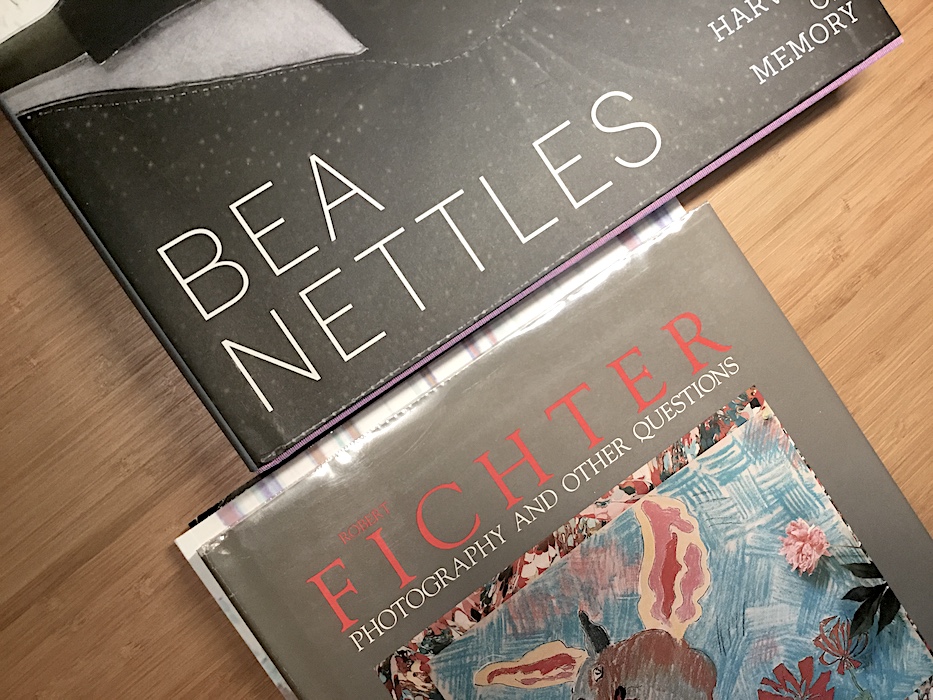
almost every history comes from another history. Good teachers produce ever better students.
Nettles’ early arts education provided her the means needed to produce her long-lasting key skill of maintaining a life as an artist.
1968, the 60s was ending.
Gatekeepers were more important when there were few gates. From being a record keeper recording the outlines as tones to making imagery was measured by exclusions. Within the past 50 years, the gates have fallen from their hinges. Now, there is no doubt of the aesthetic possibility of photographs — beyond records of placetimelight. durable or duration have made marks on the pages.
Much history of this century about last century seems based upon third hand tales told round the campfire of small town hopes. The alt wasn’t about the process mode as much as it involved an expanded image arena. Fields beyond silver; beyond monochrome. Yes, an alternate universe of materials, an alternative to Kodak, hence, additional supplies from Europe — Agfa, Ilford, even Fuji had position at the camera counter.
Bea Nettles says, “I first became aware of gum-bichromate around 1969 when I saw a print in a museum exhibition while I was a graduate student. I wondered how it was made, but hadn’t a clue how to find out. I attended a gum printing demonstration in 1970, led by Betty Hahn at Rochester Institute of Technology. I had just arrived to teach in the same city at Nazareth College. Betty was a generous and gifted teacher and we became friends, and in 1971 office mates at Rochester Institute of Technology where we both taught. I eventually took over Betty’s teaching position in 1976 when she took the teaching position at University of New Mexico. The use of pigment in the gum process appealed to me as both of my degrees were in painting. Early in 1971 I began to experiment with the medium on fabric as I wished to work in color. Although this process on fabric was very fragile and contrasty, it enabled me to make images that I then quilted with a sewing machine and stretched onto wooden frames, a presentation I had already explored as early as 1969 using commercial photo-linen. Often I embellished these works with additional colors and detail, either with magazine transfers, color pencils, or in some cases embroidery thread.”
Her list of references:
- The Alternative Image: An Aesthetic and Technical Exploration of Nonconventional Photographic Printing Processes and The Alternative Image II: Photography on Nonconventional Supports, John Michael Kohler Arts Center, Sheboygan, Wisconsin, 1983 and 1984.
- *Creative Bookbinding, Pauline Johnson, Dover Publications, NYC, reprint 1990.
- *Flamingo in the Dark: Images by Bea Nettles, Inky Press Productions, Urbana, Illinois, 1979. A 72 page autobiographical book of multicolored Kwik Print images.
- “Gumming up their works”, American Photographer, Henry Horenstein, August 1985. An excellent article on the contemporary history of the gum-bichromate print with color reproductions.
- The Hole Thing: A Manual of PinHole Fotografy, Jim Shull, Morgan and Morgan, NY, 1974.
- The Keepers of Light: A History and Working Guide to Early Photographic Processes, William Crawford, Morgan and Morgan, NY, 1979. One of the very best books to date.
- New Dimensions in Photo Imaging: A step by step manual, Laura Blacklow, Focal Press, 1989.
- The New Photography: A Guide to New Images, Processes and Display Techniques, Catharine Reeve and Marilyn Sward, Prentice-Hall, Englewood Cliffs, NJ, 1984.
- *Overexposure: Health Hazards in Photography, Susan Shaw and Monona Rossol, Allworth Press, NY, 1991.
- Photographic Possibilities: The Expressive Use of Ideas, Materials, and Processes, Robert Hirsch, Focal Press, Boston, 1991.
- The Pinhole Journal, Eric Renner, ed., Star Route 15, Box 1655, San Lorenzo, NM 88057.
- Structure of the Visual Book, 1984 and Non Adhesive Binding, 1992, Keith Smith, Rochester, NY.
- The Visionary Pinhole, Lauren Smith, ed., Peregrine Smith Books, Utah, 1985.
- Kodak Publications:
- Creative Darkroom Techniques, 1973 Includes information and reproductions of gum prints, photo screen prints, among other alternative processes.
- A Sensitizer for Paper, Cloth, and Similar Fabrics, Pamphlet #AJ-5 (Van Dyke Brown and Kallitype.)
- How to make and use a Pinhole Camera Pamphlet #AA-5
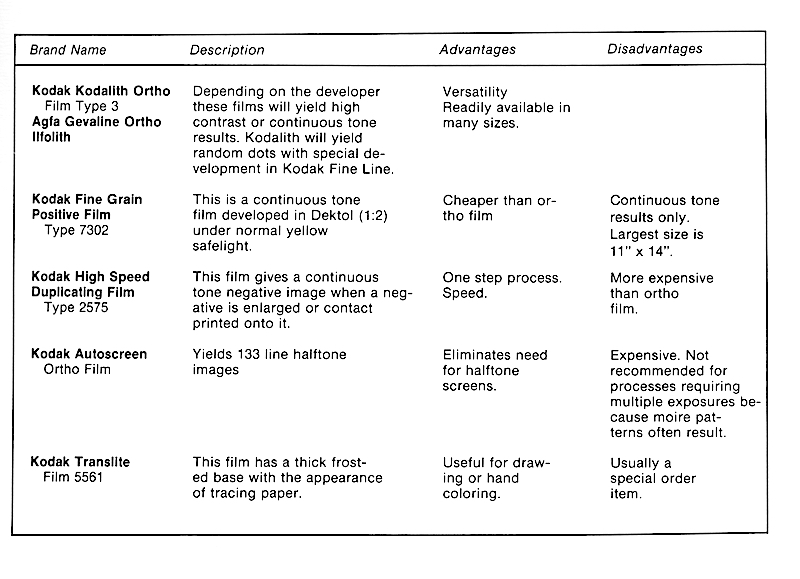
one list of films used by the “alt” community. this list reveals the break between studio and factory silver wasn’t complete by any measure. Alternative process meant then, as now, inclusion in the factory, just not on the floor. Not in the mine. In the studio; my hours, my efforts.
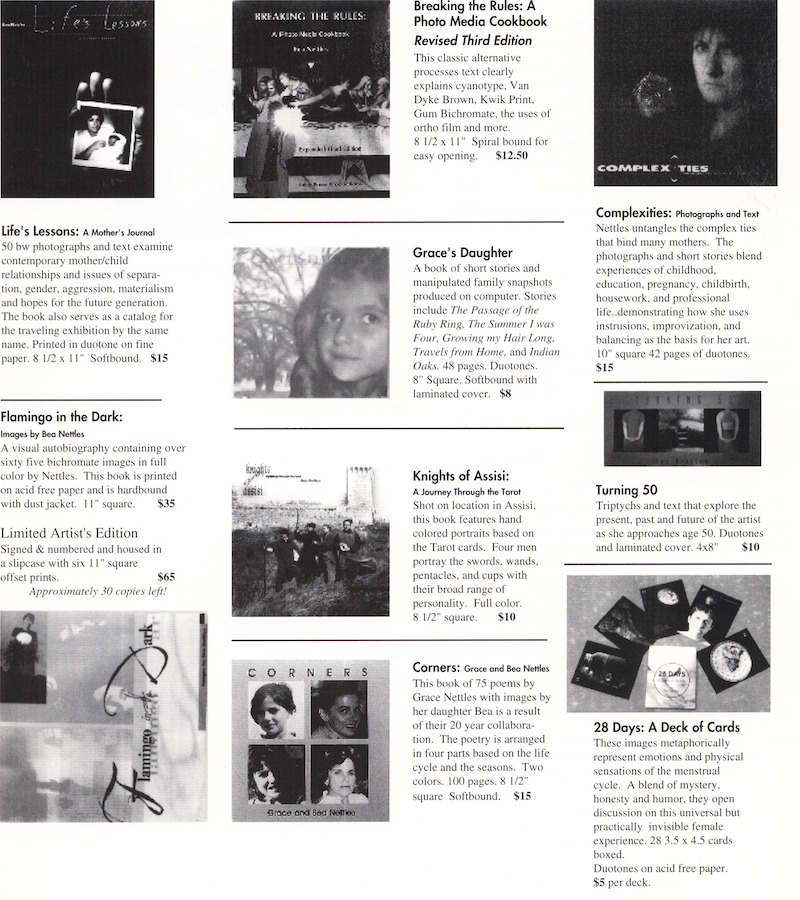
some of Bea’s books…
Rochester was a center of impact, even beyond Kodak’s, was the “other” the “after” imagery of Visual Studies Workshop, birthed and nursed by the Lyons. The house that Nate [] built.
Links for more:
- http://www.beanettles.com/
- https://beanettles.com/news/gqpt5qr9pxhz3bj1a2gz1tcn96gk6n
- http://artoncampus.rit.edu/artist/359/
- http://www.vampandtramp.com/finepress/n/bea-nettles.html
- link to RIT faculty: https://www.davidhazy.org/andpph/ipt-giants.html
- https://en.wikipedia.org/wiki/Bea_Nettles
- https://www.eastman.org/event/talks/online-artist-mother-educator#
- https://www.nmartmuseum.org/exhitions/transgressions-and-amplifications-mixed-media-photography-of-the-1960s-and-1970s/
- https://www.huntington.org/collections/search?huntington%5BrefinementList%5D%5Bauthor%5D%5B0%5D=Nettles,+Bea
- https://beanettles.com/news/gqpt5qr9pxhz3bj1a2gz1tcn96gk6n
- https://www.nybooks.com/online/2021/02/27/nettles/
- https://www.lensculture.com/articles/bea-nettles-harvest-of-nature
- https://kam.illinois.edu/event/ad-distinguished-alumni-lecture-harvest-memory-bea-nettles
Student at RIT
Her Dye Transfers
She took a dye imbibition course at RIT in 1983, printing her portfolio in ’84.Rachel’s Holiday is the series made with her daughter, Rachel, of tableaux using readily available household and toybox items.
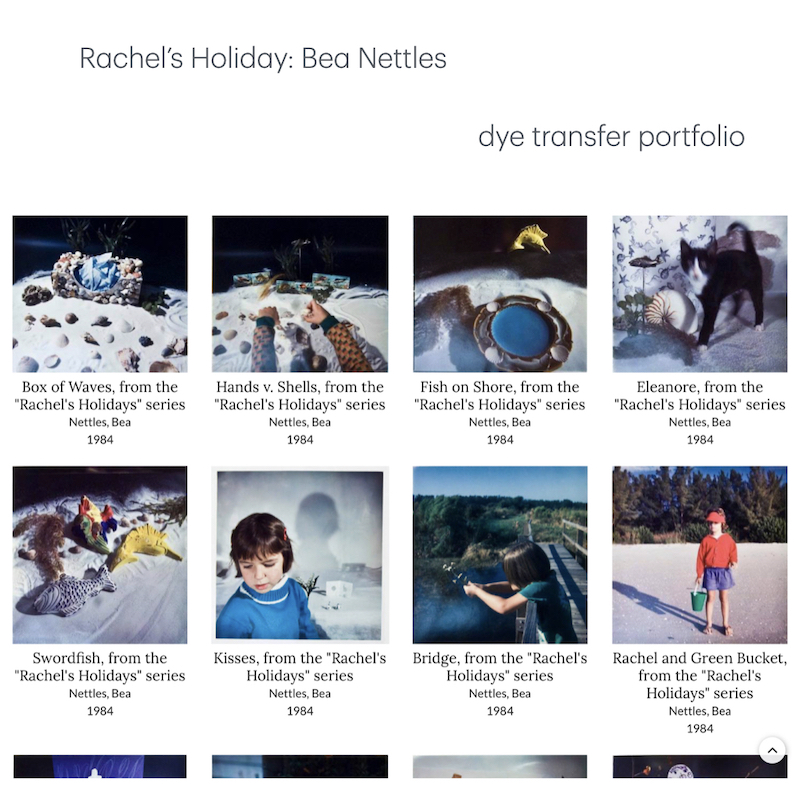
I am unable to contact BN, therefore this is an estimate that her prints were made using Kodak Pan-Matrix for imbibition printing rather than ortho-matrix, the more common professional method of printing.
PM was used in many intro to dye printing courses as it meant skipping the lengthy, problematic process of making separations and likely associated masks. Pan-Matrix meant printing directly from color negatives, a material already masked.
Notice the overall “cool” color of the portfolio. This was common among initial printers engaging with dye-transfer from color negatives. Some would probably say it was more likely from poorly masked Ektachrome to standard Matrix film work which was even more common in technical schools such as RIT.
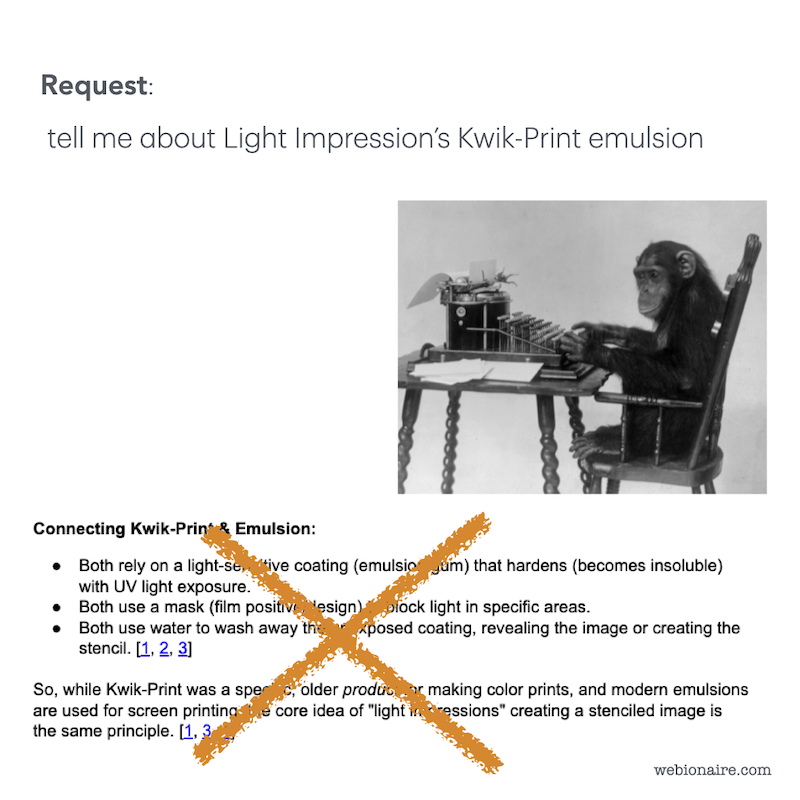
Kwik-Print, Light Impressions [LI] — tada. Light Impressions was the outcrop of fine photography pushed up from the rich mind field of Visual Studies Workshop. Bill Edwards and Lionel Suntop, Bea’s spouse, open the LI doors by supplying mounting and storage materials for fine-photographers. LI sold books, instructional materials, eventually Bea Nettles bringing them Kwik-Print. After Edwards – Suntop dissolved their business dealings, she reverted to different processes than Kwik-Print.
“Bibliographies are like friendships – their breadth, limitations, detail and completeness depend on the needs of the partners to them.” Jan Zita Grover, 1981.
2Books:
Photography Between Covers Interviews with Photobookmakers edited by Tomas Dugan
interviews with: Syl Labrot, Nathan Lyons, Ralph Gibson, Larry Clark, Keith Smith, Joan Lyons, Eikoh Hosoe, Bea Nettles, Duane Michaels, George Tice, Robert Adam, and Scott Hyde
https://bookstore.vsw.org/product/photography-between-covers-thomas-dugan
AND
DIALOGUE WITH PHOTOGRAPHY: In the early 1970s Paul Hill and Thomas Cooper carried out an extraordinary series of interviews. More than 20 photographers participated: Ansel Adams, Man Ray, Cecil Beaton, Brassaï, Henri Cartier-Bresson, Andrés Kertész, Jacques-Henri Lartigue, George Rodger, Robert Doisneau, Herbert Bayer, Henry Holmes Smith, Helmut Gernsheim, Brett Weston, Manuel Alvarez Bravo, Eliot Porter, W. Eugene Smith, Laura Gilpin, Paul Strand, Imogen Cunningham, Wynn Bullock, Minor White and Beaumont Newhall.
https://www.dewilewis.com/products/dialogue-with-photography
Printed Matter, once a fine source of artist’s books: 77 Wooster St, NYC 10012 (212) 925-0325 FAX 212 925-0464.
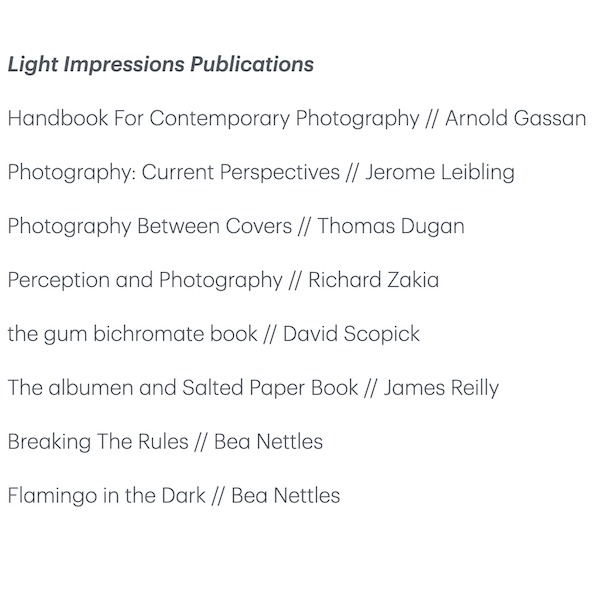
Light Impressions Publications
- x– Handbook For Contemporary Photography // Arnold Gassan
- o– Photography: Current Perspectives // Jerome Leibling
- x– Photography Between Covers // Thomas Dugan
- — Perception and Photography // Richard Zakia
- x– the gum bichromate book // David Scopick
- — The albumen and Salted Paper Book // James Reilly
- x– Breaking The Rules // Bea Nettles
- — Flamingo in the Dark // Bea Nettles


You must be logged in to post a comment.