Joe Deal:

Joe Deal — by, about

  • Wise, Kelly, ed. Photographers’ Choice: A Book of Portfolios and Critical Opinion. Danbury, N.H.: Addison House, 1975.
  • Hajicek, James and Jay, Bill, eds. “Joe Deal: New Topographics.” Northlight 4. Tempe: Arizona State University, 1977.
  • Glenn, Constance W. and Bledsoe, Jane K., eds. Long Beach: A Photography Survey. Joe Deal, Judy Fiskin, Anthony Hernandez, Kenneth McGowan, Grant Mudford, Leland Rice. Exhibition catalogue. Long Beach, CA: The Art Museum and Galleries, California State University, Long Beach, 1980.
  • Joe Deal: Southern California Photographs, 1976-86. Foreword by J.B. Jackson; essays by Mark Johnstone and Edward Leffingwell. Albuquerque: University of New Mexico Press in association with the Los Angeles Municipal Art Gallery, 1992.
  • Deal, Joe; Mark Johnstone, Richard Meier, Weston Naef. Between Nature and Culture: Photographs of the Getty Center by Joe Deal. Los Angeles: The J. Paul Getty Center, 1999.
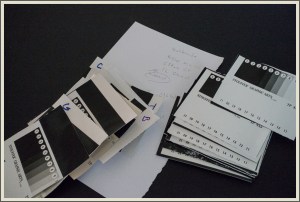
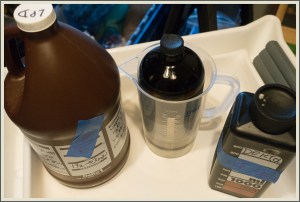
Into Darkness

A series about the darkroom. Geared for getting to a place of process, and procedure. This begins with few assumptions about your skill. I do assume your interest in the darkroom as part of a studio practice.

The first parts will be about the print, not the negative. There, ruined the mystery: we start at the end.

First,  we will get wet, but will use protection. This can get messy. This will stain.

I won’t give a full course in this set of posts. Too hard to do over the phone, and I don’t know who will ever use these notes. They are taken from some of my scraps of courses I taught at Syracuse University. You have the advantage of easy availability of other sources of knowledge. Cheap and easy – like locker room advice on acne, or jock itch.

What we will do:

  • Mix chemistry for B&W
  • Choose papers
  • Make some prints

Easy, simple. What took a morning of lab day, back in EXS. Every freshman knew how to develop and print film within the first week. Some took easily to it. Most stumbled and recovered. Others never understood the process – usually faltering over the mechanics. Those are the students who needed the digital age. Too bad they were learning at its birth (1975). I hope they have returned to photography now that the mechanical barriers have been removed. Photography is now accessible.

Coming

photo paper
Paper Trails

wet work