
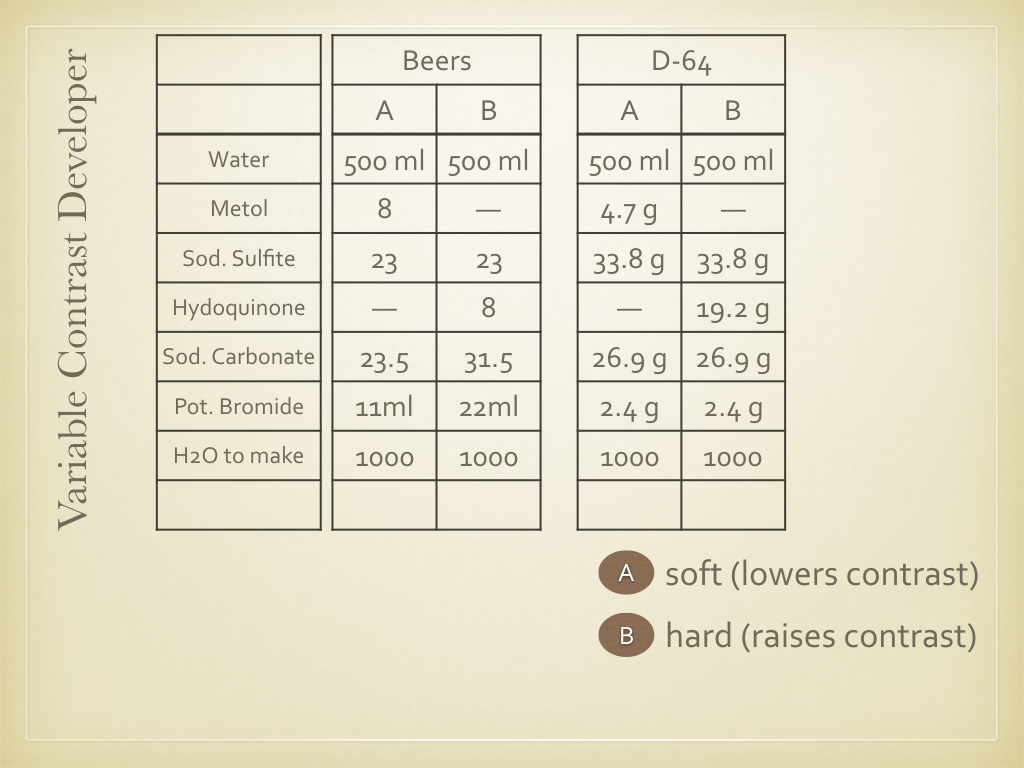
Dr. Beers is the widely known version of variable contrast developer, but in the 40’s and up to around 1955, D-64 was likely the choice. This was the time that Dupont Velour Black was a significant paper in commercial and industrial photography studios. Ansco Cykora also benefitted from D-64. These graded papers had uneven steps of contrast along with vary different exposure factors; this made changing contrast under production constraints a problem in need of a solution. D-64 was that solution. And the multi tray developing system. (using more than one developer at a time: one ‘hard’ & one ‘soft’)
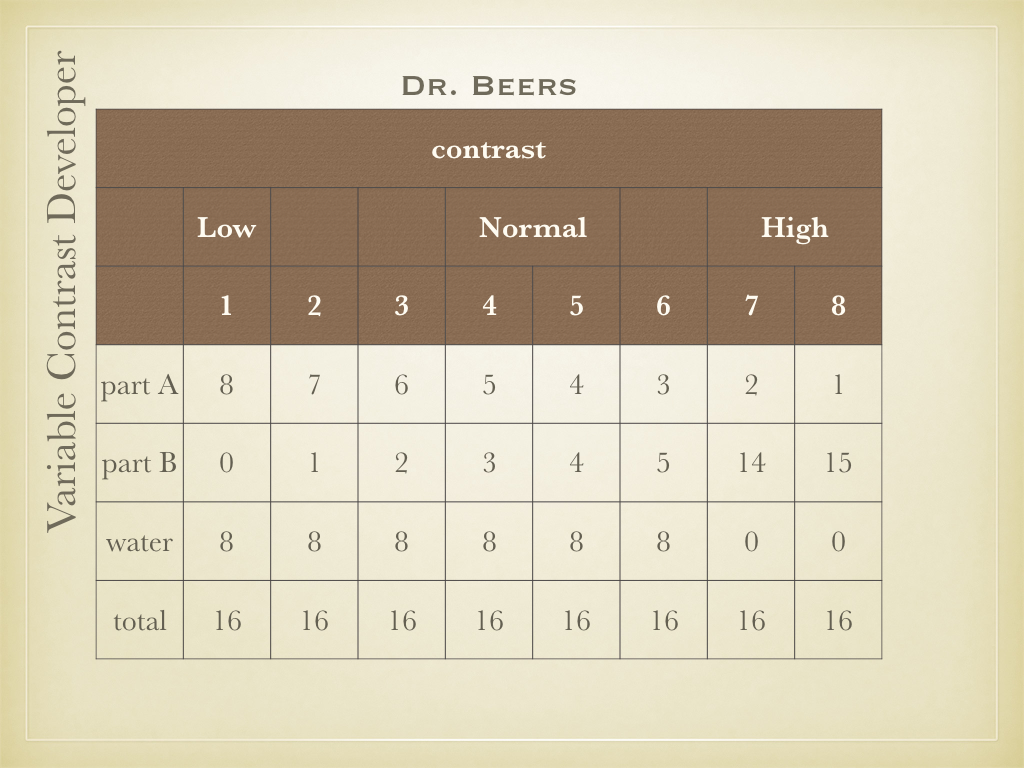
Dr Beers (Dr. Roland F. Beers) Developer
In the Beers formula I have used Sodium Carbonate rather than his original Potassium Carbonate. This has been a standard practice since 1963 when I learned the formula. It produces slightly more neutral prints — did on DuPont and Agfa papers; does now on Slavich, Adox, Foma papers. I don’t use Beers as a developer for Ilford papers, instead, I use 2 tray developing using developers from Moersch, LPD, or Dektol.
Kodak D-64
I use D-64 for film positives and internegatives as part of my repro process pipeline. Film, ortho copy and litho films are single graded (none) — their contrast is dependent upon the developer and where the exposure places them on the native response curve of the film.
I also use D-64 ‘soft’ for solarization of paper. This includes ALL papers that I use, even Ilford, my most frequently used paper.
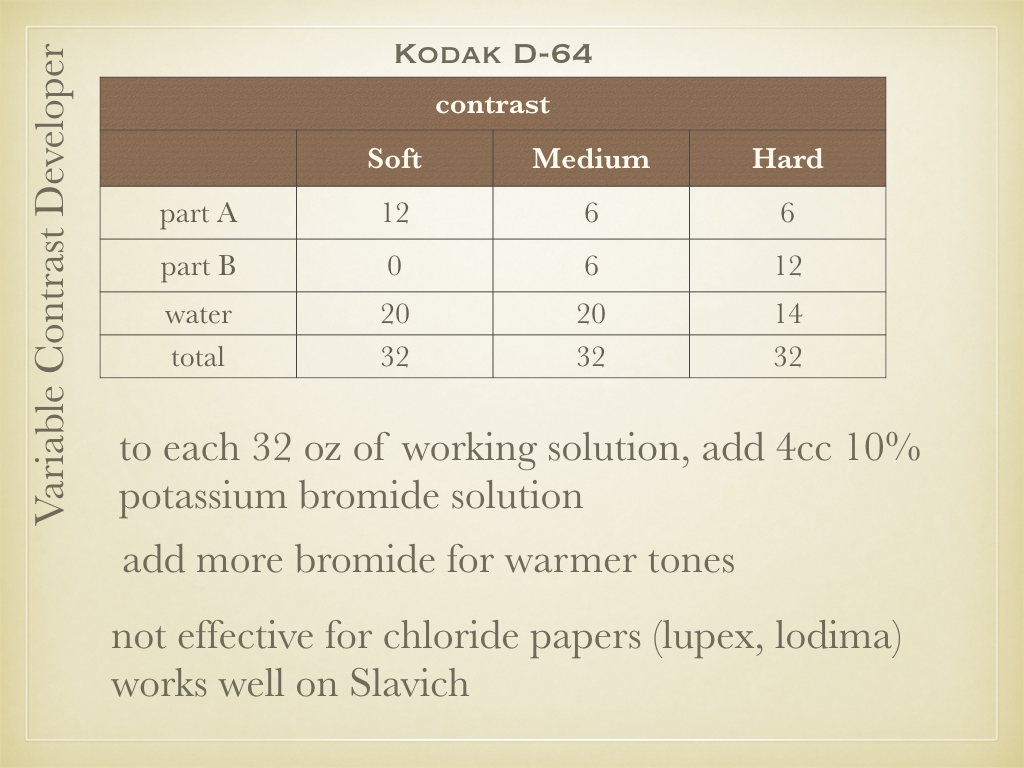
To make a 10% bromide solution, add 100.0 grams of potassium bromide to water to make 1.0 liter.

You must be logged in to post a comment.