
Barry Biblio
- Girls and Boys (Real Comet Press 1981) ISBN 0-941104-00-1
- Big Ideas (Real Comet Press, 1983) ISBN 0-941104-07-9)
- Everything in the World (HarperCollins 1986) ISBN 978-0060961077
- Down the Street (HarperCollins 1988) ISBN 978-0060963040
- The Fun House (HarperCollins 1988) ISBN 0-06-096228-3
- The Good Times Are Killing Me (Perennial/HarperCollins, 1988) ISBN 0-941104-22-2
- Come Over, Come Over (HarperCollins 1990) ISBN 0-06-096504-5
- My Perfect Life (Perennial/HarperCollins 1992) ISBN 978-0060965051
- The Lynda Barry Experience (spoken word cassette tape/CD 1993) ISBN 1-882543-17-3
- It’s So Magic (Perennial/HarperCollins 1994) ISBN 978-0060950460
- The Freddie Stories (Sasquatch Books 1999) ISBN 978-1570611063
- Cruddy (Simon & Schuster hardcover 1999; paperback 2000) ISBN 978-0684838465
- The Greatest of Marlys (Sasquatch Books 2000) ISBN 1-57061-260-9
- One! Hundred! Demons! (Sasquatch Books 2002) ISBN 9781570613371
- The Two Questions
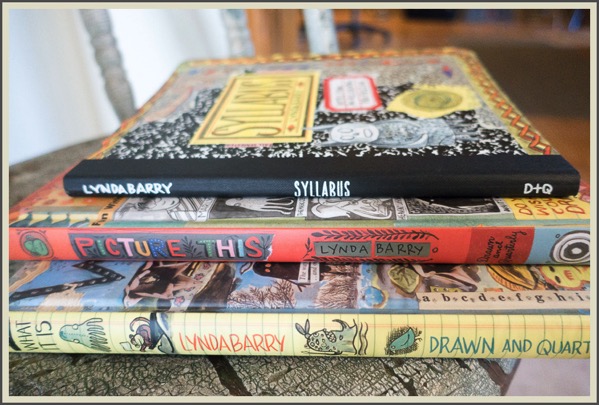
- What It Is (Drawn and Quarterly 2008) ISBN 978-1897299357
- Picture This: The Near-Sighted Monkey Book (Drawn and Quarterly 2010) ISBN 1-897299-64-8
- Blabber Blabber Blabber: Volume 1 of Everything (Drawn and Quarterly 2011) ISBN 978-1770460522
- Syllabus: Notes from an Accidental Professor (Drawn and Quarterly 2014) ISBN 978-1770461611
First Reads
- What It Is (Drawn and Quarterly 2008) ISBN 978-1897299357
- Picture This: The Near-Sighted Monkey Book (Drawn and Quarterly 2010) ISBN 1-897299-64-8
- Syllabus: Notes from an Accidental Professor (Drawn and Quarterly 2014) ISBN 978-1770461611
Her well known book is The Good Times Are Killing Me, but the books for an early art effort, or as an item of restart, that pat or kick you need, read the “First Reads” list. She is on tumblr, so you’ll find her if you are interested.
Jump Start: Restart
at least one way to get yourself doing/working/playing/making again

You must be logged in to post a comment.