synthesis over analysis

Harris Shutter.

  1. Clarkson ME, Vickerstaff T (1948) Brightness and hue of present-day dyes in relation to colour photography. Phot J 88b:26Google Scholar
  2. Drew JT, Meyer SA (2008) Color management: a comprehensive guide for graphic designers. RotoVision SA, SwitzerlandGoogle Scholar
  3. Foley JD, van Dam A, Feiner SK, Hughes JF, Phillips RL (1997) Introduction to computer graphics. Addison-Wesley, ReadingzbMATHGoogle Scholar
  4. Gatter M (2004) Getting it right in print: digital pre-press for graphic designers. Laurence-King Publishing, LondonGoogle Scholar
  5. Hunt RWG (2006) The reproduction of colour, 6th edn. Wiley, ChichesterGoogle Scholar
  6. Maloney LT (1986) Evaluation of linear models of surface spectral reflectance with small numbers of parameters. J Opt Soc Am A 3(10):1673–1683CrossRefGoogle Scholar
  7. Morovic J (2008) Color gamut mapping. Wiley, ChichesterCrossRefGoogle Scholar
  8. Sharma G (2002) Digital color imaging handbook. CRC Press, Boca RatonCrossRefGoogle Scholar
  9. Westland S, Ripamonti C (2004) Computational colour science using MATLAB. Wiley, ChichesterCrossRefGoogle Scholar

Color vision is based upon the responses of three classes of cones in the retina, each of which has broadband sensitivity but maximum sensitivity at different wavelengths. A consequence of this is that color reproduction is trichromatic – the use of three primaries allows a wide range of colors to be reproduced. Color-mixing behavior can be broadly classified as either additive or subtractive. The optimum primaries of the subtractive color system are cyan, magenta, and yellow. The use of cyan, magenta, and yellow subtractive primaries allows a surprisingly large – albeit limited – gamut of colors to be reproduced. In practical printing systems, black is also used so that CMYK is ubiquitous in printing. Extended gamuts can be achieved using more than three or four primaries and systems based on six or more primaries are becoming quite common. https://link.springer.com/referenceworkentry/10.1007%2F978-3-319-14346-0_13

  1. 1Chandler, A. R., “Beauty and Human Nature” (New York: Appleton-Century-Crofts, 1934).
  2. 2Allesch, G. J. v., Psychol. Forsch., 6, 1 (1925).
  3. 3Spearman, C., “Creative Mind” (London: Nisbet, 1930).
  4. 4Ishihara, S., “Tests for Colour-Blindness” (London: H. K. Lewis, 1948).
  5. 5Rabkin, E. B., “Polychromatic Plates for Testing Colour Vision” (Ukrainian Hirschman Ophthalmic Institute, 1939).
  6. 6Farnsworth, D., J. Opt. Soc. Amer., 33, 568 (1943).
  7. 7Kendall, M. G., “Rank Correlation Methods” (London: Griffin, 1948).
  8. 8Clarkson, M. E., Davies, O. L., and Vickerstaff, T., “Colour Harmony” (I.C.I. Pub., 1950).
  9. 9C.R. Comm. Inter. de l’Éclairage (Cambridge: Cambridge University Press, 1931).
  10. 10Moon, P., and Spencer, D. E., J. Opt. Soc. Amer., 34, 234 (1944).
  11. 11Birkhoff, G. D., “Aesthetic Measure” (Cambridge, Mass.: Harvard University Press, 1933).
  12. 12Littlejohns, J., J. Roy. Soc. Arts, 81, 592 (1933).
  13. 13Munsell, A. H., “An Introduction to the Munsell Color System”. In “A Grammar of Color” (Mittineague, Mass.: Strathmore Paper Co., 1921).
  14. 14Moon, P., and Spencer, D. E., J. Opt. Soc. Amer., 34, 93 (1944).
  15. 15Eysenck, H. J., Brit. J. Psychol., 31, 94 (1940).
  16. 16Graves, M., “Design Judgment Test Manual” (New York: The Psychological Corporation, 1948).
  17. 17Eysenck, H. J., Amer. J. Psychol., 54, 385 (1941).
  18. 18Eysenck, H. J., “The Scientific Study of Personality” (London, Routledge, 1952).

US5679141A [patent for magenta]
myth as word

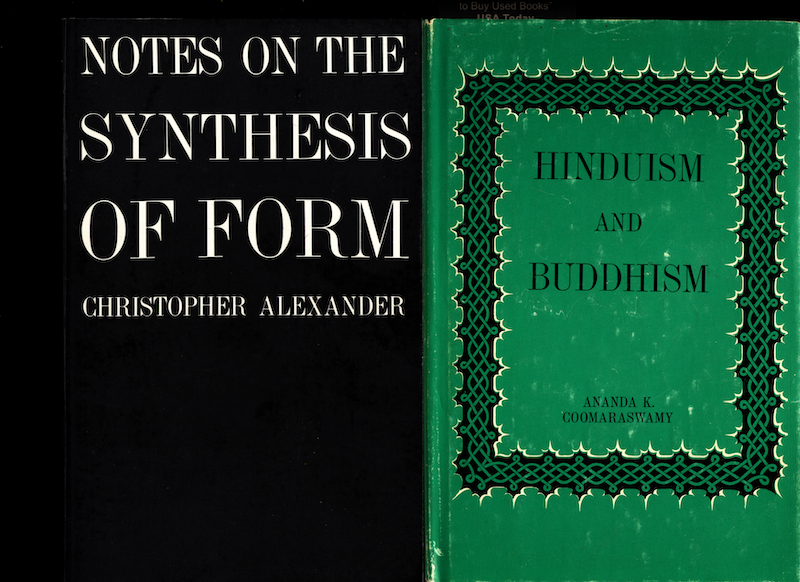
during an extended reading, re-reading, cycle of Rothko’s notebook, my memory nag was over older texts read while younger — those from Ananda and from Alexander. Both were used in my teaching of experimental photography during the 70s.

course texts
from Ananda: Myth as first question
In asking, What is Buddhism, we must begin, as before, with the
Myth. This has now become the Founder's life of some eighty years,
into which period the whole epic of the victory over death has now
been condensed....

It is, furthermore assumed that a Buddha is born in every suc-
cessive aeon, and that Gautama Siddhartha was the seventh in such
a series of prophetic incarnations, and that he will be followed by
Maitreya, now a Bodhisattva in heaven.

for other religions
Like the Revelation (Sruti) itself, we must begin with the Myth
(itihasa), the penultimate truth, of which all experience is the
temporal reflection. The mythical narrative is of timeless and place-
less validity, true nowever and everywhere: just as in Christianity,
“In the beginning God created” and ‘Through him all things were
made”, regardless of the millennia that come between the dateable
words, amount to saying that the creation took place at Christ’s
“eternal birth”.

Alexander is the touchstone architect, city planner thinker, used by software developers during the explosion of code as engineering, hacker-mode as silicon culture’s maker mark.

D’Arcy Wentworth Thompson, On Growth and Form, 2nd ed.
(Cambridge, 1959), p. 16

Henderson, The Fitness of the Environment (New York, 1918),
page v: “Darwinian fitness is compounded of a mutual relationship
between the organism and the environment.”

Karl Duncker, “A Qualitative (Experimental and Theoretical)
Study of Productive Thinking (Solving of Comprehensible Problems),”
Journal of Genetic Psychology, 33 (1926)

. J. Archer, L. E. Bourne, Jr., and F. G. Brown,
“Concept Identification as a Function of Irrelevant Information and
Instructions,”

there’is a factor of judgment in the choice and use of a logical system
which we cannot avoid. Logical pictures, like any others, are made by
simplification and selection. It is up to us to see which simplifications
we wish to make, which aspects to select as significant, which picture to
adopt. And this decision is logically arbitrary. However reasonable and
sound the picture is internally, the choice of a picture must be, in the end,
irrational.

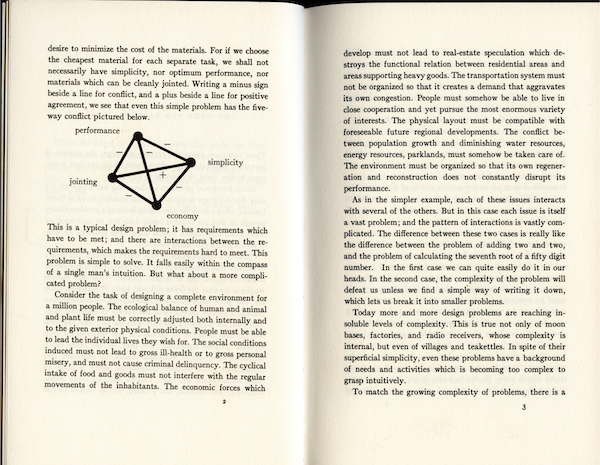
Consider the task of designing a complete environment for a million people. The ecological balance of human and animal and plant life must be correctly adjusted both internally and
to the given exterior physical conditions. People must be able to lead the individual lives they wish for. The social conditions induced must not lead to gross ill-health or to gross personal
misery, and must not cause criminal delinquency. The cyclical intake of food and goods must not interfere with the regular movements of the inhabitants. The economic forces which develop must not lead to real-estate speculation which destroys the functional relation between residential areas and areas supporting heavy goods.

.. more, or less, at some other posting

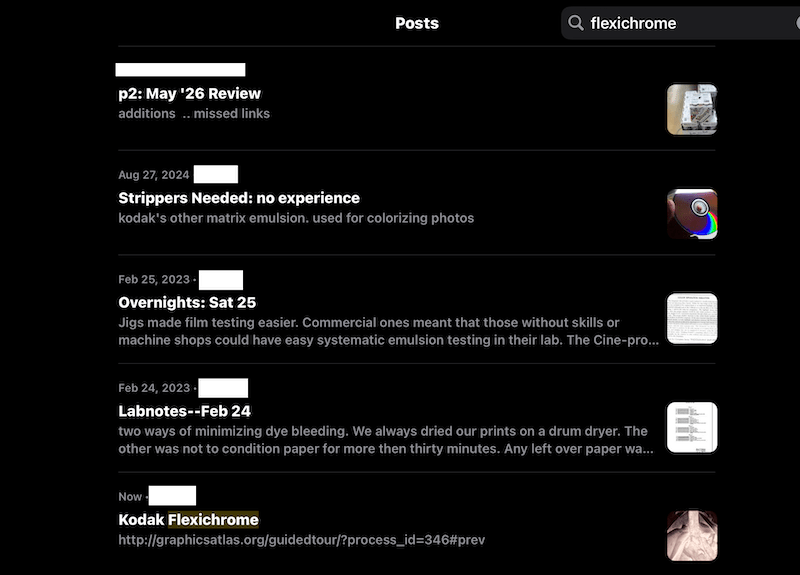
p2: May ’26 Review

additions [p2’s ] .. missed links and updates to prior posts.

>> link [ Seeing it in person, however, gives a more weathered impression than in photographs.
The greens are not as vivid, and the garden feels dry, even somewhat rough.
It’s best not to expect something overly decorative.
Tōfuku-ji,
A Study in Geometry and Garden Design in Kyoto

>> link [ Gabriel Antonio Reed is from New Market, Tennessee. He received his MFA from Hollins University and his PhD from the University of Tennessee, Knoxville.
“a will to change that derives from our inability to change ourselves”—Gabriel Antonio Reed
… Gabriel Antonio Reed

>> link VSW [Matthew Schlanger’s image processed video works are serial constructions created with custom-built analog and digital processors. Each video is a real-time synthesized recording in which sound and image are parallel structures, often using periodic waveforms as image and sound source material. Schlanger is both an artist and a tool maker. He has been working with analog synthesizers since the 1980s, and continues to create video in his home studio in Nyack, NY.

lumpy banger https://vimeo.com/18289189?fl=pl&fe=vl&goal=0_3b0c1d68ed-eef87426d4-631039129&mc_cid=eef87426d4&mc_eid=f0298e5cc5

–Invisible Fisherman: The Art of Bill Brand
now available through VSW Press

 VSW Press is pleased to announce that our most recent Film Art Book (FAB) publication is now available in the VSW bookstore! Invisible Fisherman: The Art of Bill Brand is a 160 page artist book featuring critical essays and full color images documenting the scope, breadth and impact of Bill Brand’s creative practice in film, installation, drawing and painting. Brand is well known for his work as a filmmaker and preservationist, and this book shines a light on his lifetime studio practice of drawing and painting. Brand himself navigates his portfolio in a “studio visit” with Tara Nelson, sharing his personal history with drawing and painting as a critical approach to problem solving and creative development throughout his career. 

Click to access VSWPressSPRING-26BillBrandRelease_FINAL042126.pdf

EXPERIMENTAL CINEMA, VSW provides a walk along the path, to this: https://expcinema.org/site/en/books/invisible-fisherman-art-bill-brand
AND opening that we come to a site of many others making the swim.
https://www.billbrand.net/biography preservation of experimental cinema-video.


flexichrome — photographs are always colorized, it’s just that some tell better color lies..

i seem to repeat myself .. someone, at some time asked a question..on the web, nothing ever finishes; nothing is ever found.

flexhichrome.

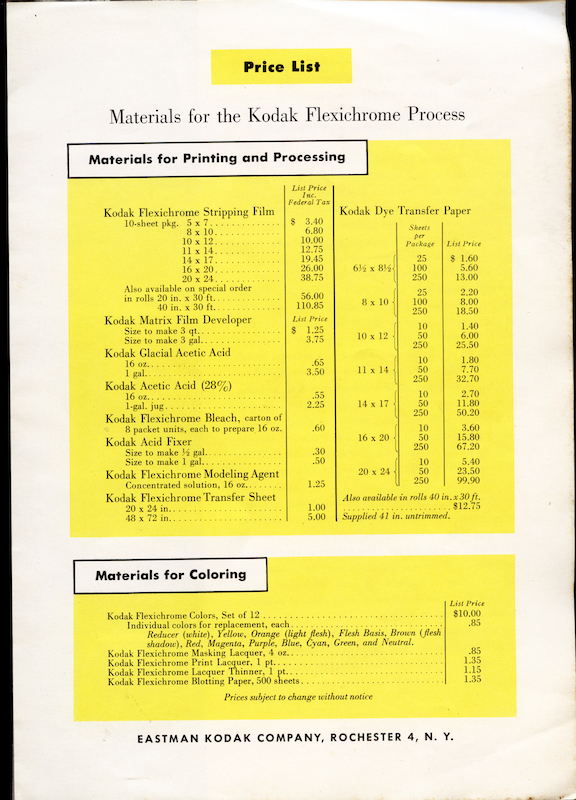
just Friday (yesterday), as if by synchronicity, C found an old Flexichrome brochure among poetry magazines she was reviewing… keep, or pass along..

That refreshed my thinking about some posts I made several years ago… I wrote, but never published.

The Flexichrome process has special memories… serving as release from constraints that I was setting upon myself too early in my career to recognize as bad habits. Habit of “giving away” my eyes. to some prior, unknown visionary. Why let them set my standards?

So, maybe I will finish and release the tech post I made more than a decade ago on the process of Flexichrome.

spray bottle has been returned to her place above the wet sink in the processing room of the lab. Used to keep the lavender seeds and seedlings moist. Now, they are big enough to take on full water..

Relative humidity as well as other concepts will apply longer than the specific instance. that’s how firms as well as art schools and studios acquire and extend practice and theory awareness..
early, in fact my first reading about application of registration of masks and subs, included paper tape. when I realized that paper tape included an envelope with adhesive, I was able to revive a method from the 40s when packaging tape was widely available.. this was part of making a ‘cab,’ a carrier to hold mask and original.
The general principle must be combined, must be modified by your local current awareness; what’s available to you locally, currently. photography, all plastic Art as a practice includes a physical component, a manual component.. Our current change to a “text to image ” is part of the sense of many that we lose skills — visual art becomes removed from prior plastic concerns and privileges. The scale of the hand, the privileges granted to those practitioners with that skill diminishes when that skill no longer controls the input to the eye of the receiver..

Conception to perception is a tough path for some. particularly for those stuck forever in perpetual adolescence.