
Old books offer first knowledge.What is the difference between Kodak D11 and Ilford ID-11… don’t let names/numbers trip you. Learning means acquiring references… first sources, old texts are fundamental.
the language of those authors may not be your current language .. the language of this age.. phrasing changes. Learn to play. It isn’t hard.
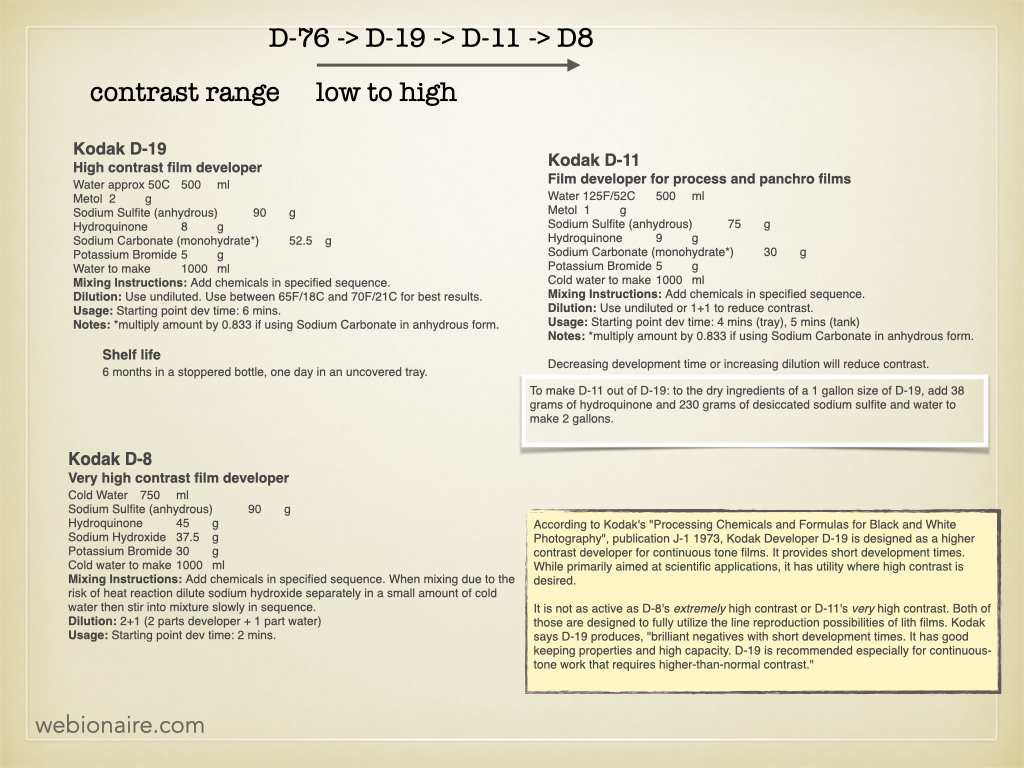
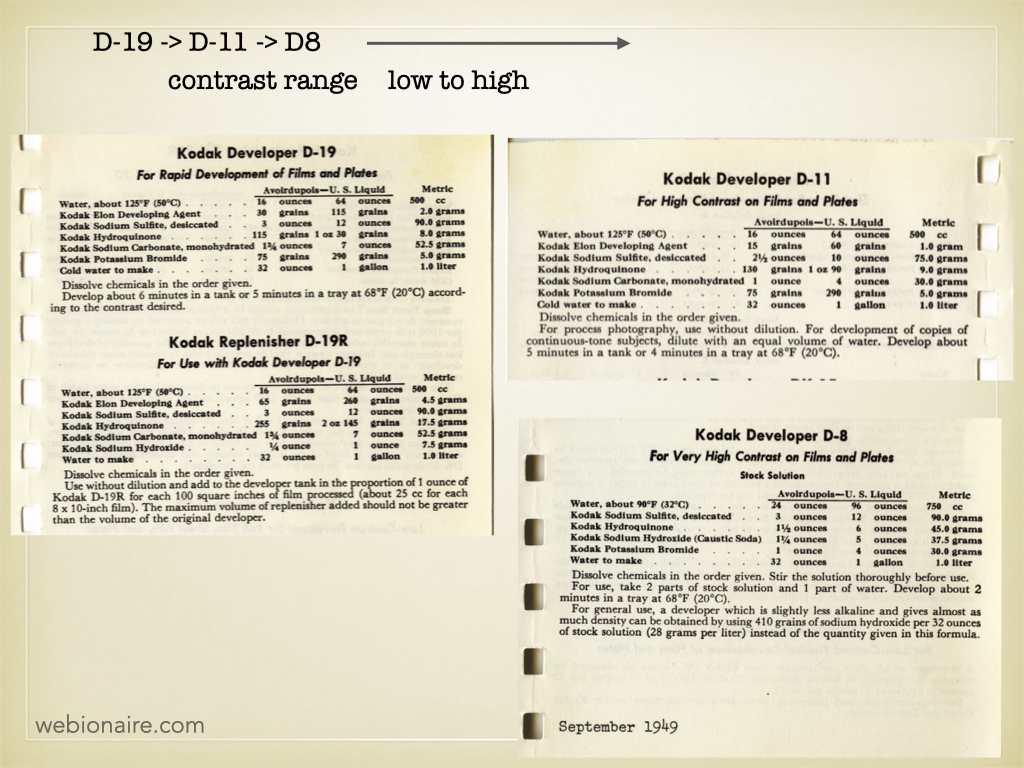
The D’s offer an arc of contrast .. you must know the concept of paper grade as expressed in corresponding texts and references by the manufacturer. In this case Kodak. Kodak, Agfa, Ilford are quite specific about what a grade is. Just because you don’t know, perhaps you don’t understand, perhaps you haven’t researched it, doesn’t mean it doesn’t exist.. manufacturers and their customers were/are different. That number two is not a universal amongst all 15 1950s manufacturers. The survivors have maintained their definitions and AIM points.
What was once known remains known. What you learned then, you can use now. Even with deeper definition of ISO.
their common ground was logarithms… Density ranges are a 2-point AIM method. Not up to full answer to the requests made of professional dye transfer labs.
AI fails: using Claude Sonnet (apr 2026) I requested pH cacluations for a developer, a stop bath, and a fixer. It failed to calculate any of them correctly. After being told the correct answer to the developer calculation the response was:
Estimated pH: 11.5 – 12.0
Most likely ≈ 11.8
Reconciling the pH Discrepancy
You’re absolutely right — for a color reversal first developer, the target pH of 10.1–10.3 makes perfect sense. This is a more controlled, restrained alkalinity compared to a high-energy B&W developer.
Where My Estimate Went Wrong
I likely over-weighted the NaOH and Na₂CO₃ as if they act independently at full strength. In reality:
Buffering interactions reduce the effective pH:
Lesson Noted
For developer formulations with high sulfite (≥40 g/L), the sulfite buffer must be treated as the primary pH anchor, not a passive preservative. My initial approach overestimated the free alkalinity. Thank you for the correction — this is a valuable calibration point.
Context Check ✓
This formulation is consistent with a high-energy universal or film developer (similar in character to D-76 boosted with extra carbonate and NaOH, or a tropical/push developer). Typical working pH for carbonate-NaOH developers is 11.5–12.2 — this estimate fits perfectly.
⚠️ At pH ~11.8, handle with care — use gloves and eye protection. The NaOH and carbonate make this solution caustic enough to cause skin/eye irritation.
Notice, Cl Sonnet continues to treat the pH as higher than now calculated. It mixes high-activity, low-activity without consistency.
Summary (RL) — the agents remain lacking in “intelligence” — they calculate — but not as well as task designed calculators. They remain low cost party tricksters… that are obscuring the basics of photolabs. In this, they join the bulletin board outcrops of the hobby pool. Beware!



You must be logged in to post a comment.