
A barely photographer. He was an activist, more active in the shadows … He worked from a privileged position. Even now, he is held on high within the weekend photographers. He selected ready to grasp subjects presented from a position of craft privilege. Dye transfer is a highly regarded means of printing; so highly regarded that it gains respect with just the mention, even though, in its time, it was done by thousands, by the thousands.
[ elsewhere I post the progression of the process ]
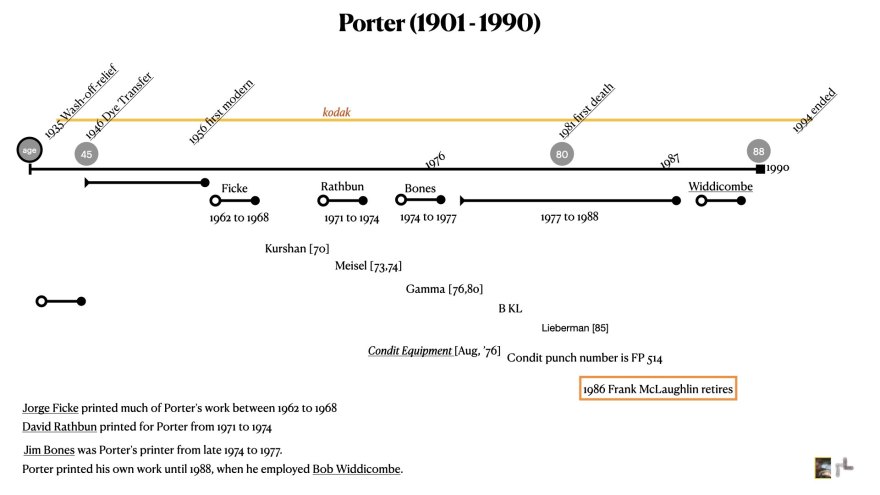
The painter Jorge Fick (b.1932 -2004) printed much of Porter’s work between 1962 to 1968. David Rathbun (b.1943- 2020)printed for Porter from 1971 to 1974. Jim Bones (b.1943–)was Porter’s printer from late 1974 to 1977. Porter printed his own work until 1988, when he employed Bob Widdicombe (b.1949 –).[ as of July 2021 ]
Porter’s library contained many more books on birds than on photography or art. His library index is heavy on Ansel Adams and Charles Darwin. His art history seems to come from the Newhall’s and little else. Philosophy nor poetry would fill a back pocket. Thousands of books, few on photography or artists.
Pictures of birds are harder to draw than to photograph; even using Dye Transfer.


You must be logged in to post a comment.