Kodak RA-4 Paper

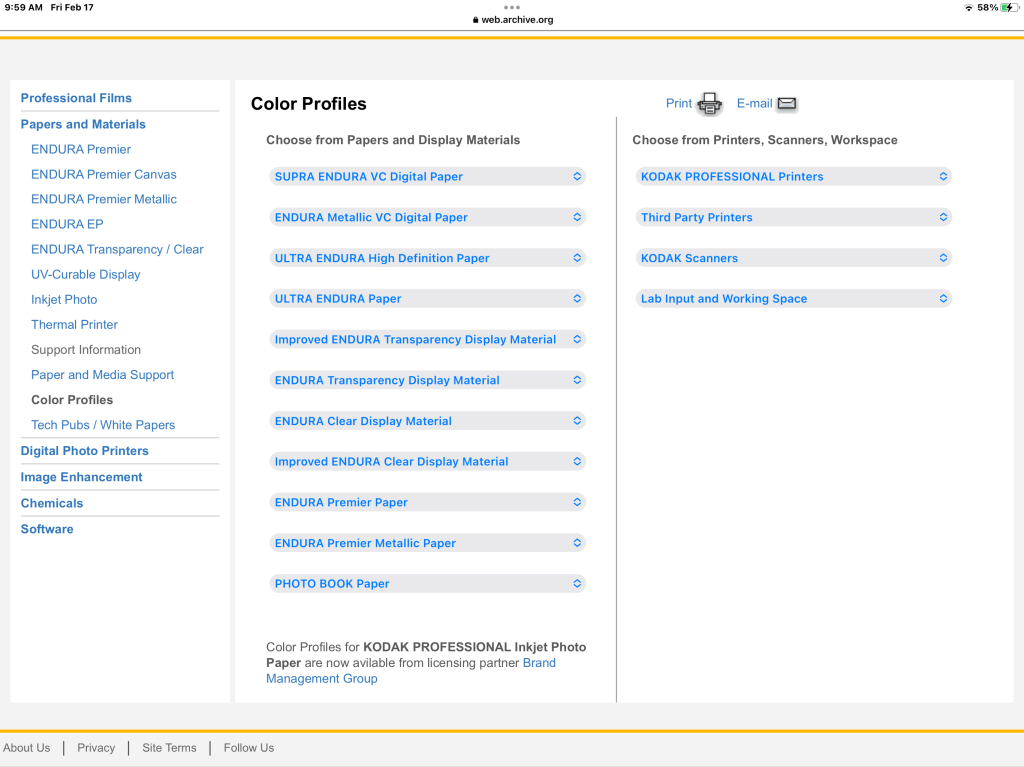
The digital RA-4 paper notes. Endura in 2013 included printing in darkroom. 2019, no such advise. See the calibration routines for setting your digital printer. I don’t know that any of these papers are sold in 2023. The world, especially in non-western countries, is rapidly moving from wet-lab to dry-lab imaging.
The “analog resurgence” is a thing in major metropolitan areas, but a thing for 35mm film. Along with this bounce has come a demand for scanning; a demand so strong that premiums are being paid for scavenged “scan heads” of minilab equipment.

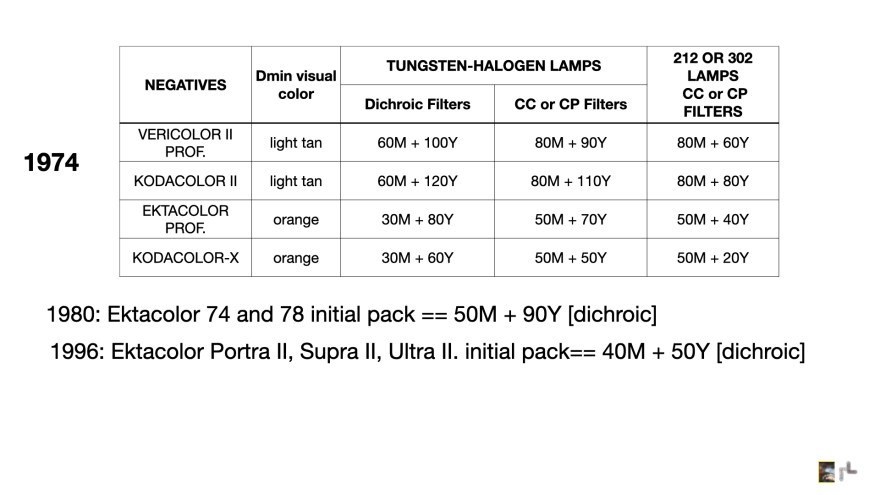
Of note should be the filtration recommended for Kodak Endura Premier paper. A white-light starting pack of 40M+50Y, or a Tricolor filter set of 25,99,47B … Don’t forget — still recommended are IR and UV filters (B).

From the datasheets you could build upon your Rosetta of process procedures.
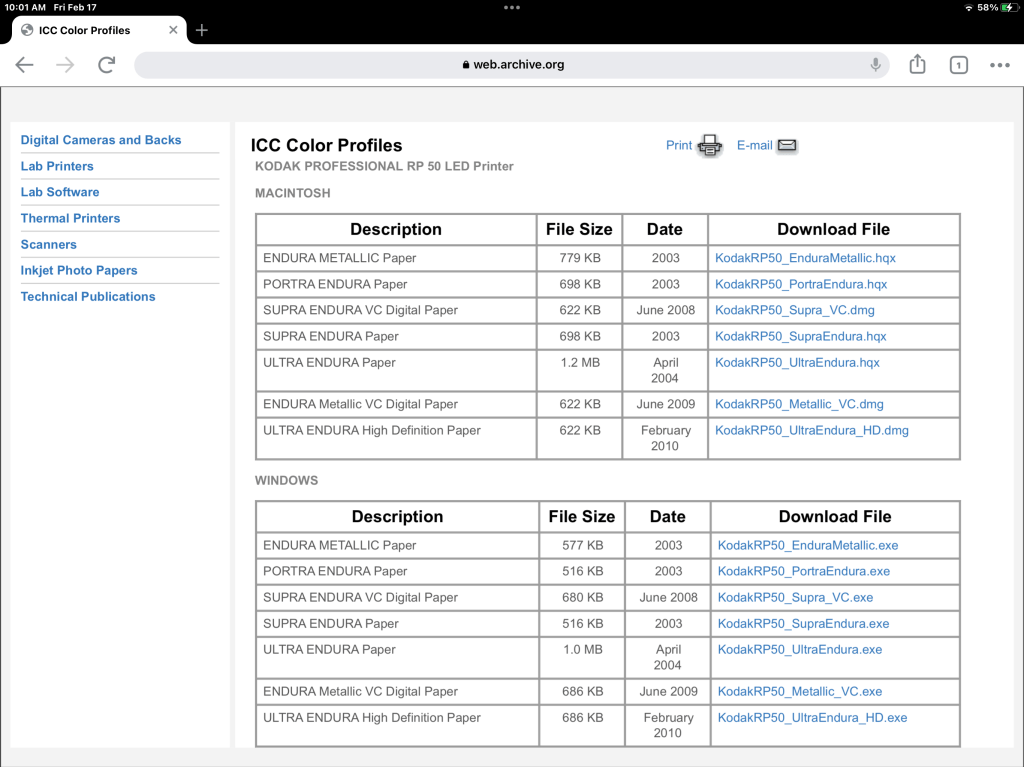
Profiles provided by Kodak give you an indication of what products have been made, but not what is current product.

Kodak’s LED Digital Color Printer model 20O/R can be controlled from within Photoshop. Yes, Kodak made LED printers, no matter what the Forgotten of Foradum say. It also suggests that calibration of LED printer is possible for at least one Kodak RA-4 paper.

Of course, ZBE’s Chromira is a long standing LED printer used by many US West-Coast labs.

http://www.zbe.com/usergroups/files/products/chromiraprolab/manual/ChromiraProLabUsersGuide_v1.pdf
Easy Assembly Color

handmade color was once the main way of making a color print. At first, obviously, the first color photograph was made by a technician — not purchased, but made. That process was an assembly process. The print was made by layering separate images until they formed the final single print. This was the synthesis step in a “multi-color” process.

Assembly systems are divided into “roll-up” and “lay-down” methods. Was it a ‘dye’ or a ‘pigment’ that is being assembled. They could also be classified as ‘direct’ or ‘indirect’ transfers. These processes are more mechanical than any other way of making prints. The whole direction of the Kodaks was to do the assembly at manufacture time: the integral, type C process. The key researcher for Dye Transfer was moved from dye transfer to type C print work by 1961.

The two most successful systems, those have large enough commercial backing to sustain many users, were Carbro, and Imbibition printing. Imbibition prints were more often known as Dye Transfer, and Wash-off-Relief.

Either process was time consuming, involving many steps with moderate to high skill needed at each. The difficulty lay in the combining of the steps in such a way as to be able to solve more problems than you created. Each stage offers choices; making the best choice comes from having a nice overview firmly in mind.

Either process could be described as consisting of very few steps. Leave out enough and we could just say: expose then print.

Teaching was always a balance between showing, telling, and knowing what to leave out.

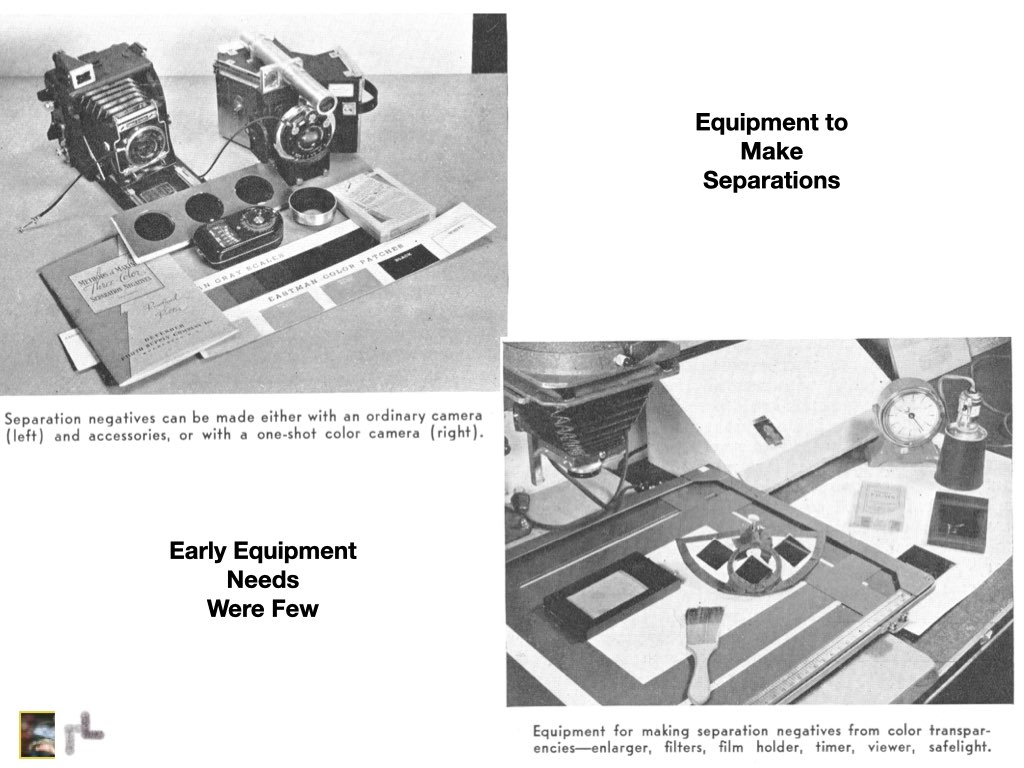
Early Equipment was primitive by what anyone working in this century would have:

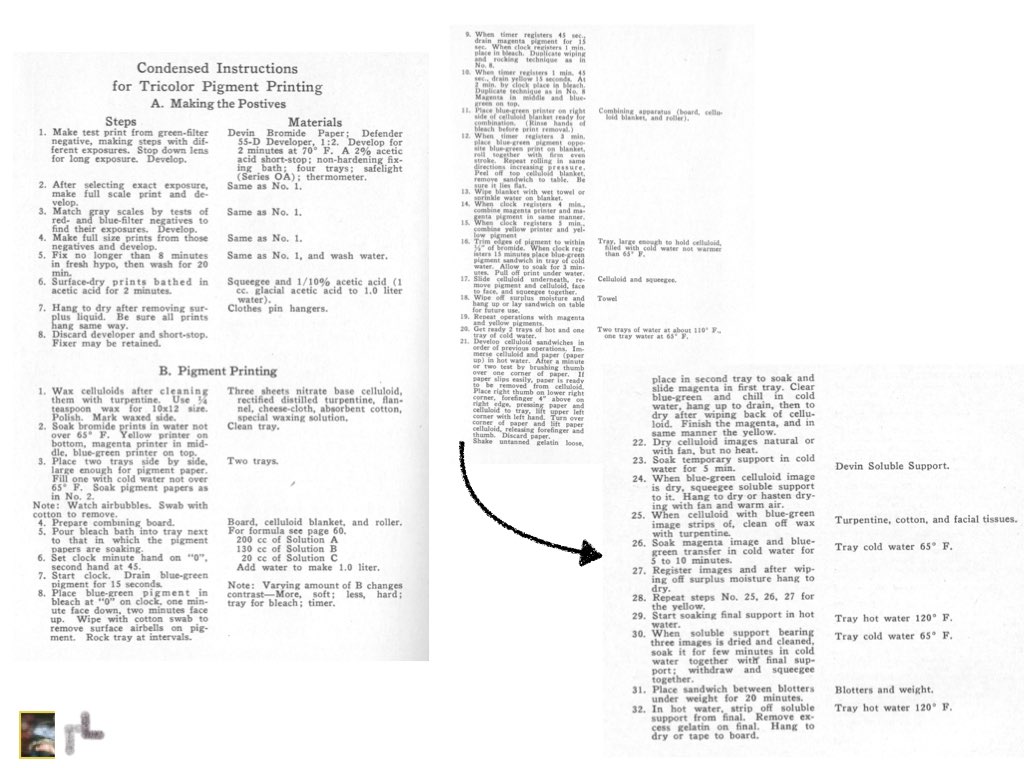
The processes compared in “follow list” form make their relative complexity obvious. Obvious about why Carbro was replaced. And why Kodak spend so much effort to follow the imbibition path broken by Technicolor.

The biggest step to take these days is: make tissue, or make matrix film. The history of assembly has returned to the carbon route. Firstly because the alt photography community began it as part of the 60s photography surge.

I’ve posted enough over the past years for someone to be able to make matrix film. There are enough webpages and specialty groups for anyone to be able to make their own carbon tissue. Carbro is a different, but easy enough alteration to carbon printing. Just about any soft emulsion photopaper can be used. Bromoil is harder to make than a carbro.

To begin. Begin. Make your own outline. Start with the minimum, not the maximum. Go faster than you feel you can. Make more mistakes than you want. If you read for an hour, print for three.

Assembly isn’t easy until it is done.