What do you call the earnest workers – those weekend, and retirement photographers – practicing diligently for years, but seemingly unable to provide an original motive. They are the faithful. Buying books; going to special exhibits; taking workshops, happy to hear tales of Ansel.
Zoners; Double- A? They think of themselves as keepers of a secret – the Books.
Amateur; dilettante; enthusiast; devotee- every sector has them, and these terms, in dictionary purity, don’t mark them as darkly as I do. How about Three Leggers – they always fret over the perfect tripod. Or Camera Baggers — that too is a matter of infinite concern. There is no end to seeking perfection, or requesting group support in these matters of taste and style.
Why Classify
Because I need a way to think of them as a group- a single entity with common characteristics. Classification provides distinctions. They classify themselves — they call themselves a name, even joking that they look different, dress differently — or, sometimes that they should wear a distinctive flower to announce themselves to others – this in the case of public lectures. The public lectures probably only being attended by that particular sub-culture, even though the topic of photography, or art is interesting to broad range of people, the Doubles shun topics outside their special interest of photographic use.
Subject First
They cling to a subject version of photography. Grudgingly they have split into separate herds – with inbreeding discouraged, but permitted – There is the Digital, Luminous group and the Analog, Large Film group. They are the Photographic Gap – full of hyphenated processes, aka, workflow.
These Notices
The caution are notices to travelers — stear heads at a water hole. Notice that if you drink enough, or often, you will perish. Treat it before consuming.
Kodak Azo was discontinued in 2005. It was in production longer than Kodak Dye Transfer products. Monochrome outlived color. Just a tiny part of the tale.
Texture Sheen Tint Contrast
Azo came in most surfaces and weights; it was used widely because it was cheap and constant across so many types of surface. Deckle edged postcards, cheap studio proofs, or retouching prints for advertising agency work — all could be done on Azo.
Amidol was also easy to buy during that day. Drugstores sold it in glass tubes, ready for processing film or paper. Only Kodak’s Vitava Opal came in more configurations.
When a favorite paper drops dead what are members of the Silver Circle to do? Make it themself or sponsor someone else to make some.
Smith & Chamlee, of the workshop world, chose the latter. Other workers gladly coat small runs learned while workshopping their craft sense at places like George Eastman, and Photographers Formulary. Chloride papers are easy enough to coat, but clearly this is small scale demand, which isn’t a problem for people who hold to their belief that the longer something takes to do the better it is. Self coaters are the slow dry painters of photography.
Lodima Dreams
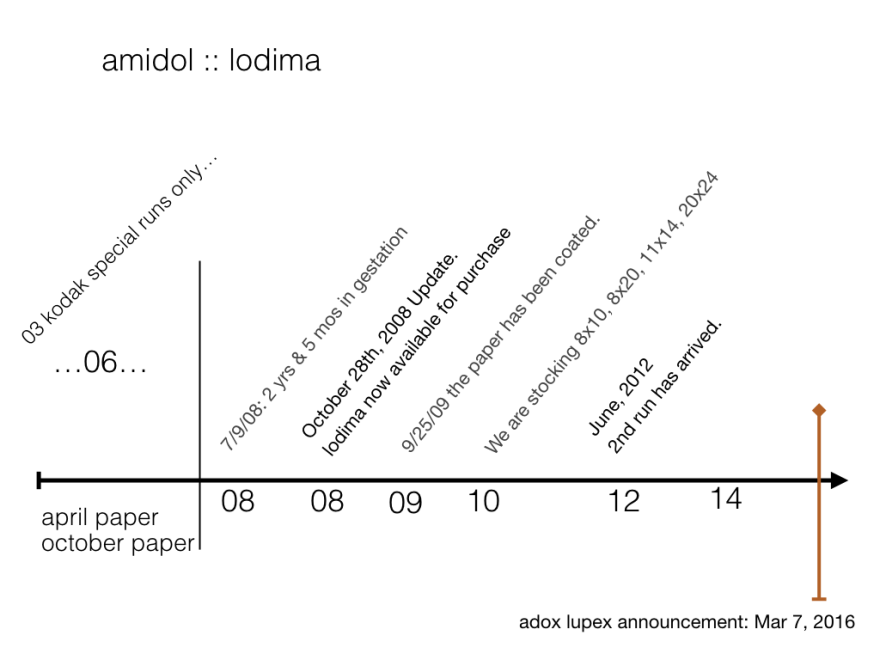
A new company and identity was introduced in response to the Kodak discontinuation of Azo. Photographers Michal Smith (MAS) and Paula Chamlee bought much of the Azo stock, going so far as being the last Kodak dealer for its sale. As demand dropped for all photo papers, Kodak, in trouble, dropped its black and white darkroom papers. Smith and Chamlee sought a producer of a replacement paper suited to contact printing – their preferred mode of print production.
Constructing the details of these progressions hasn’t been straightforward. I’ve collected posts from multiple web sources – some of which had to be retrieved from archived crawls. The posts on Photrio (nee Apug) and Large Format (LFPF) remain available (10/17).
lodima timeline
Azo paper goes well in amidol developer; so much so that several onliners preach that you can only achieve nirvana when both are present. I’m a heathen. Amidol is nice, but not exclusively so, but then, azo (chloride) paper isn’t perfection in silver. They are just what they are: one way across the field.
Kodak, in their azo publication, indicated developing in Dektol 1:2 for 1 minute; that would have been the conventional processing for azo the last 20 years of its production and use. Graded paper can be “contrast” adjusted using divided, 2 tray, developing. Amidol is so active that a water bath suffices as the ‘other’ developer. I prefer using dektol 1:1 and an accelerator as the second tray.
I use amidol and have used lodima paper although my current contact paper is Adox Lupex – has been since April, 2016. Lodima, the paper and the company, don’t provide me any advantage over Lupex. In my procedures Lupex even liths. It also handles wet life better than lodima. Lodima comes in more grades, but Smith Chamlee cannot keep it stocked in grade and size offered on their price list which seems to be updated irregularly. In short, as business, Lodima paper is the sideline of Smith Chamlee workshopping business.
Michael Smith draws much fire from online fora – LFPF as example. That would usually earn him points on my card, however, what I see his success, his contribution to my community of photographers to be is: publishing. I’ve met him twice in 30 years, and only corresponded with him twice – once when I ordered paper he didn’t have; the other time was a request for confirmation about work he may have made. The business conversation went better.
Smith Chamlee have survived the years since Asilomar ’75 by selling simple solutions to the easily influenced junior photographers. He is a businessman who has succeeded by turning his life into a tax deduction. His contribution to artists is as a book publisher, and paper vendor to a few of the lesser imagists of the past 20 years.


 I use amidol and have used lodima paper although my current contact paper is Adox Lupex – has been since April, 2016. Lodima, the paper and the company, don’t provide me any advantage over Lupex. In my procedures Lupex even liths. It also handles wet life better than lodima. Lodima comes in more grades, but Smith Chamlee cannot keep it stocked in grade and size offered on their price list which seems to be updated irregularly. In short, as business, Lodima paper is the sideline of Smith Chamlee workshopping business.
You must be logged in to post a comment.