
the only way to print is with a stopover to the screen. digital is the “new” analog. (it has been since the time of Scitex; the time when removing blemishes was called: Scitexing). One constant over time is that those people less capable of retouching, deride it in all its forms: brush, pencil, or mouse.
Scanning brought knowledge and doubt. Some have knowledge, some know-how, many more have doubt. The transition to ready scanning methods took more than 60 years to make. Scanners are part of the age of transition from chemical to computer; machine space to math scape.
Is there magic in the sauce? Maybe knowledge is held by some, being shared in the darknet (of books, journals, patents and conference lectures)
Glossary
Raised by my reading (about) Richard Benson, reminder of many other printer/printmakers, some having influence, such as Dan Margulis, some not. Dan Margulis was an early Photoshop advocate and user of LAB.
- Gamut. the range of colors that can be produced by a process.
- GCR gray component replacement, using black to some extent rather than cyan, magenta, and yellow in combination
- Metamerism. visual phenomenon that two colors may appear to be the same under certain lighting conditions but different under others; two colors exhibiting this are called a metameric pair.
- UCA undercolor addition. adding cyan, magenta, and yellow to areas that are predominantly black, to a achieve richer, darker color
- UCR GCR that is confined to shadow areas
- YCC Kodak’s proprietary colorspace much like LAB.
In the begin– [T, skoffs: I’m highly skeptical about what ‘people’ say on forums about scanning software mimicking RA4. The reason for this is that I’ve never come across any hints that these people had any inside information on the color algorithms and for the most part seemed to make an educated guess, only. Sometimes, that is good enough, but especially in this case, I don’t think it helps any.
— \\in fairness, krk is responding. as naysay to:One comment, by a couple of users on the facebook Coolscan community – really caught my attention: these people mentioned that the tool was engineered to produce a result that closely matches the colour response of C41 film onto RA4 paper – as most film for the pa..
Certainly, it may seem to those not a member of the change-over, the time of Scitex and others, that no one could have inside information about the algorithms, ie, the science being used by Kodak, Fuji etc. Luckily, color science is a widely published field — both the densitometric and the colorimetric theory is available in text and articles distributed at conferences. Nikon scanners as well as Hasselblad ones implemented modes introduced by firms such as Scitex along with Kodak and Fuji.
Sensitometric Curve sources: profiles from PhotoCD[Kodak]
[April 2, 2021: VueScan first started supporting different film types about 20 years. We originally got film profiles from the PhotoCD database. These film profiles contain ‘sensitometric curves’ for different film types, and they don’t vary much in film types in use in the past 15 years or so.]
Negafix claims similar source for their film-types.
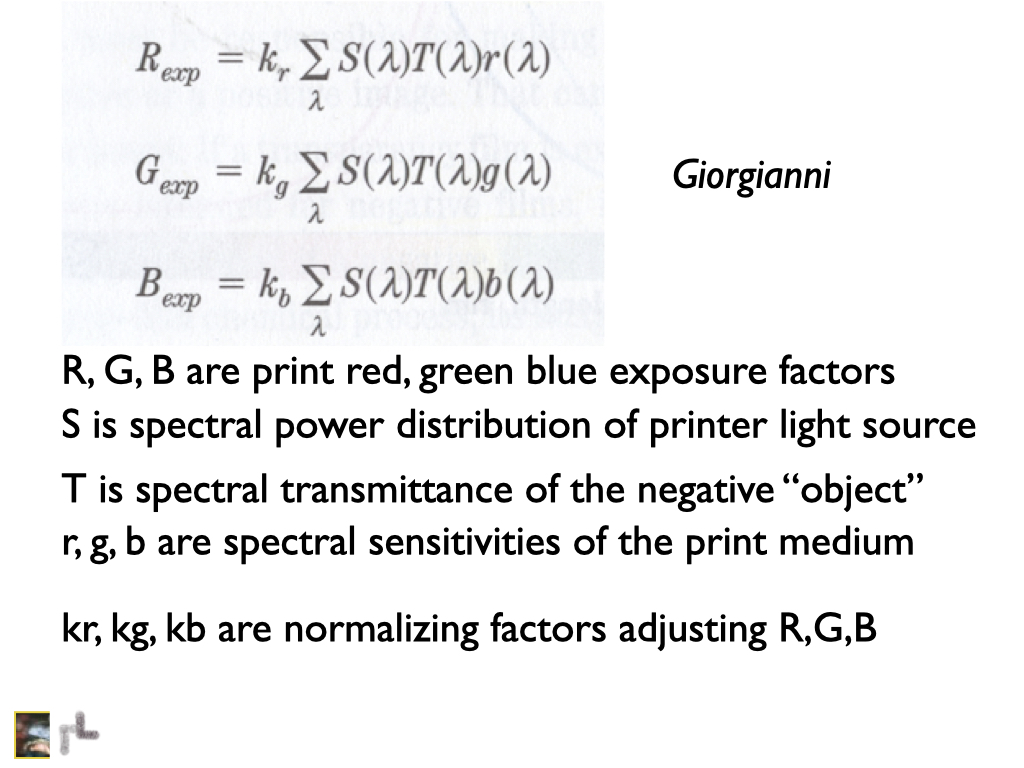
[from the Kodak designers, “… each photographic negative is designed to be optically printed onto one or more specific print films or papers, using specific printer light sources. That fact provides the key to making meaningful measurments of color negative images.” — Giorgianni and Madden.
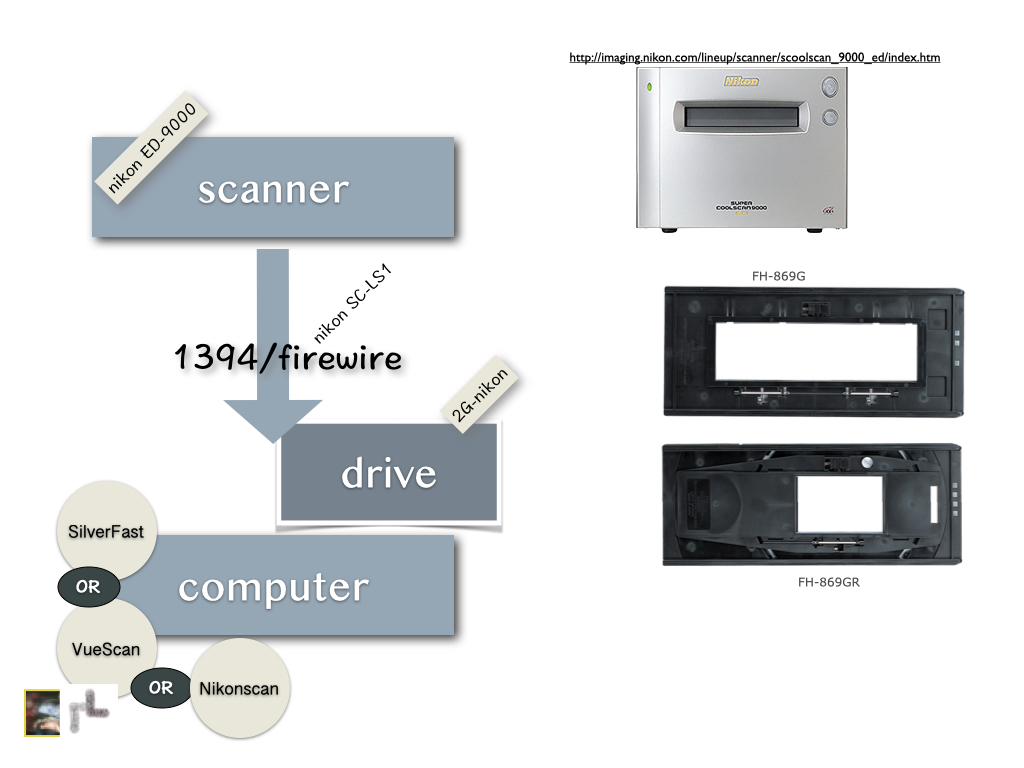
What do I do?: I use Nikonscan with a Nikon Scanner. I scan to a NEF format file. My use of Vuescan is for making PDFs with an Epson scanner. Hasselblad has a native camera file format which I request when someone scans with a Flex*.
“[157] since negatives are not meant to be viewed directly, it would not seem logical to also measure them using methods based on the response of a human observer” [meaning standard colorimetric measurements] [160] The neutral and color characteristics of color negative films are designed in terms of computed printing densities; therefore, printing desnities are the most meaningful desntiy measurements tat can be made from color negative films.
Nikon film scanners were manufactured from 1988 to 2004. Nikon Scan is Nikon’s own proprietary software for film scanners but it only supported computer operating systems up until scanner development stopped.
- most recent to oldest >–>
- Super COOLSCAN LS-9000 ED
- Super COOLSCAN LS-8000 ED
- Super COOLSCAN LS-5000 ED
- Super COOLSCAN LS-4000 ED
- COOLSCAN V LS-50 ED
- COOLSCAN IV LS-40 ED
- —
- Super COOLSCAN LS-2000
- COOLSCAN III LS-30
- —
- COOLSCAN II LS-20
- Super COOLSCAN LS-1000
- LS-4500
- SCANTOUCH AX210
- SCANTOUCH AX110
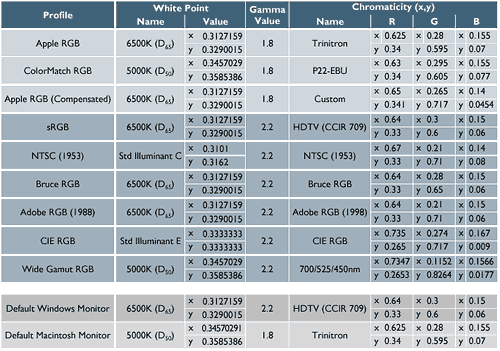
” Nikon Scan 3 and the Coolscan IV provide a choice of a wide range of color spaces, and screen gamma settings of 1.8 and 2.2 (the default gammas for Windows and Macintosh monitors, respectively). With the color management option enabled, Nikon Scan also supports the full ICC-standard workflow: The software chooses an input profile based on the scanner model it detects, uses the one of the offered color spaces as the “edit” profile, and allows you to specify a monitor profile for accurate screen display. (You’d develop your own monitor profile using any of a number of available profiling applications.) The chart below (courtesy Nikon USA Inc) shows the colorimetric parameters for the standard edit color spaces offered.”


You must be logged in to post a comment.