The biggest detour is the detail. Paper clips and pencil sharpeners are the enemy of good writing; so too the enemy of good photography is the search for a better developer, lens, film, or, worst of all, opportunity.
Opportunity doesn’t knock, it hides right behind you.
Students teach their delays to their teachers. In teaching adult learners, while also teaching full time students, I noticed a significant differences. Those people who had to use the picture made better pictures earlier. The just followed the notes on the wall; used the chemicals provided; bought the student pack from the local store. At the end of a month they were making prints and talking about elements other than the ‘how do I’ of photography.
There were some who took to the process quickly, effortlessly absorbing details of the process, while also shooting. Shooting a lot. In fact, that was the secret of the successful student — they advanced themself — dedicated effort. They took the assignment: ‘a roll a day for a month’ in earnest, even extending it to the entire first year.
Basic Silver
Three Kings
…. In the chemical age, in every age of commerce, we move among choices; are moved, actually, thinking we have choices, so there is the belief that we can be better, newer, improved with only another mixture. Rarely is that true.
These developers are my at hand mixture. LPD, Dektol, & D-76. I keep them mixed because they are useful, and are delivered as a powder. These days, LPD is also sold as a a liquid. I always suggest to the novitiate that they buy liquid, even though you are paying for water, you are getting freedom from air borne chemical dust. This is as close to magic as we get.
Basic Bullets
My key point is that those who pursue a better developer/film/camera/ .. anything such as that, lose sight of the image; what it is, where it is, and why. To cover the lack of understanding of the power of an image, or in being lost to understanding aesthetic growth, or “shock,” those folks cover their lack with a homily about being after the process or the print. They are only lost, and covering their tracks. They are only addicts, not artists.
The magic bullet isn’t something you will buy; it isn’t something outside you that is missing. You lack the magic.
Besides, silver bullets always go bad, and actually carry little impact.
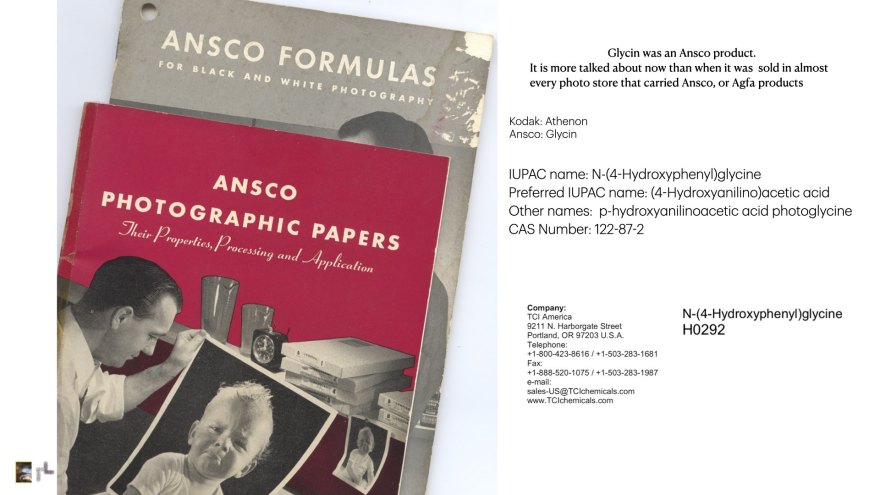
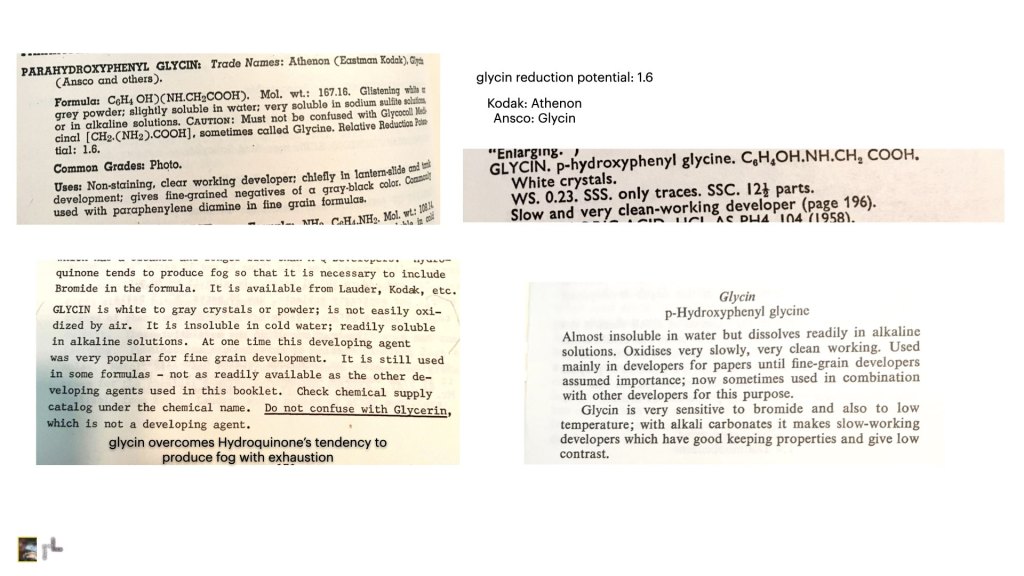
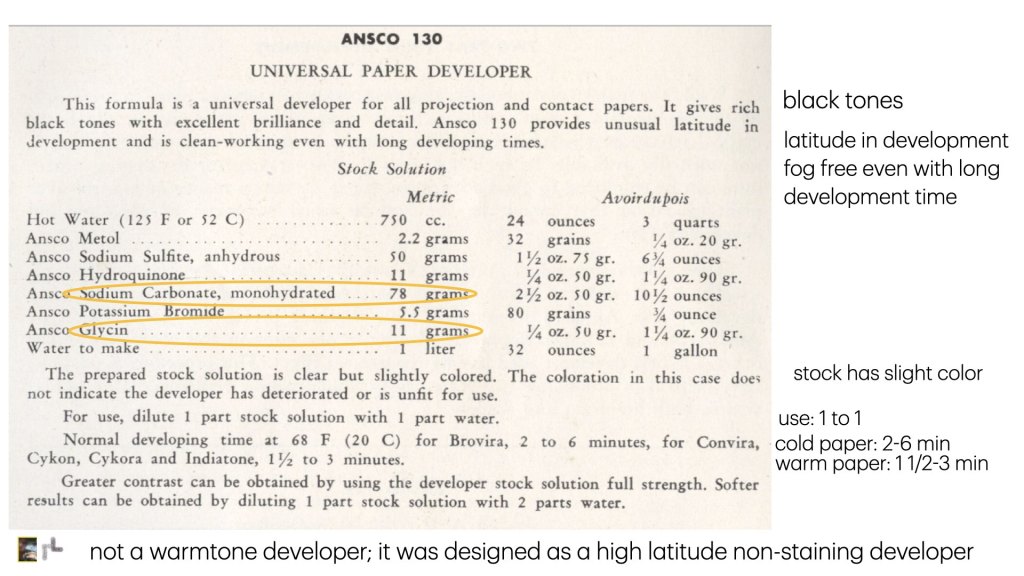
The Magic Beans, as exchanged in the halls of the camera cult, are Amidol, Pyro, and Glycin. I have posted about Amidol; while Pyro has so many vocal advocates, just ask ‘google’ … however, Glycin is do some airing out.
GLYCIN
In the beginning there were several beginnings — however, the history of the Camera Crafters is drawn across the landscape in the Zone Shades of Ansel Adams.
This: “With some papers glycin gives a light “stain” to the very high values and this appears as a “glow” which I have found rewarding at times. Usually a slow-working developer, glycin is sometimes preferred when a considerable number of prints are to be developed together.” Ansel Adams, The Print
His first series of technical articles was published in Camera Craft in 1934, and his first widely distributed book, Making a Photograph, appeared in 1935. Most important, in 1936 Stieglitz gave Adams a one-man show at An American Place.
So, Glycin — a trademark, which is close enough to ‘glycerin’ which was used in the darkrooms of dye-transfer printers, but definitely not the same stuff.
catechol has been reported to be capable of image development even in the presence of considerable amounts of silver halide solvents, making this developin agent suitable for combined developing and fixing solutions.
Pyrogallol.. in developers containing low concentrtions of preservative, the oxidation products of pyrogallol development produce a residual yellowish-brown stain. This stain reinforces the silver image and is expecialy effective in obtaining maximum emulsion sensitivity and fine grain from the photographic material
the possibility of providing developers that improve both the graininess and sharpness was the objective of a study by Alman and Henn. [Effect of developer composition on the structure of photographic igmages. Phot. Sci. and eng.,5:129 1961
converting a developing agent into better surfactant will improve it electron-transfer capability and, hence, its ability to serve as a developing agent. [haist, 170]
William Evan, New Ways with Pyro, Am. Phot., 39(5) May 1945
Behrens, A Versatile Developer: Pyro, Am. Phot., 43(7) 1949
1948: Kodak lists SD-1 for pyro stain. SD means special developer; little use. Kodak needed a tanning developer (they had one) but they didn’t want stain.
A lith print is a darkroom print made using ordinary Black & White paper processed in lith developer, then processed in stop and fix. Many current workers tone their lith prints. The developer is the key in current practices.
NOTE- if you’re APUG, or Large Format Forum registered, you may not use this material. Please, leave this site now!
First Things
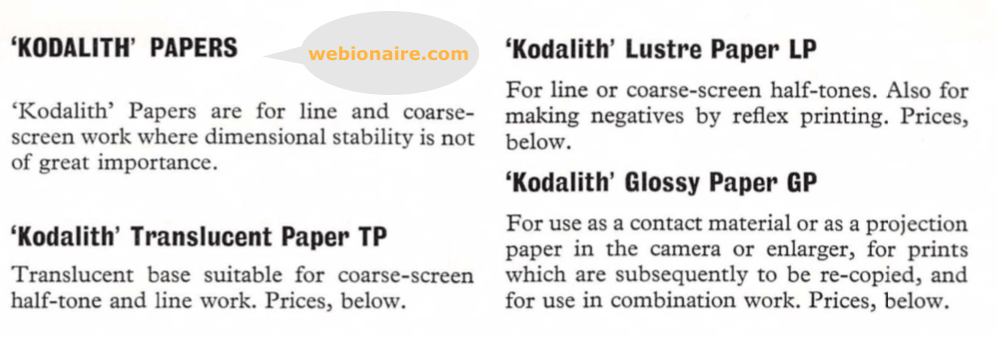
An introduction. Background, please. “Lith” is a contraction of “lithograph,” a printing process which made use of very high contrast emulsions and strong developers that exhausted quickly and suddenly. Kodak’s version was Kodalith – both film and paper were made. The film was used outside commercial print shops for decades as an abstractor by darkroom enthusiasts. It carried the stigma that is attached to Photoshop Plugins now.
‘Kodalith‘ paper with ‘Kodalith‘ developer in 1931, and ‘Kodalith‘ film following in 1933. (BJP 1973)
There were those who made use of the tone effects of lith film, but they are very few artists. Like most technical things, it remained something dabbled in. Kodalith paper was used by science labs for a decade before being transferred from the labs and print shops to the studio darkrooms of photographers. Here in the art world it seemed to answer a need for prints that could be made quickly; prints that seemed old, because they were faded and brown. Lith paper was around before lith film by several years.
Since the lithography process no longer uses lith film or paper, it isn’t manufactured. Current lith prints are standard black and white papers developed in lith style developer. This produces, like all photography, an approximation of what it references.
Early Lith Printers
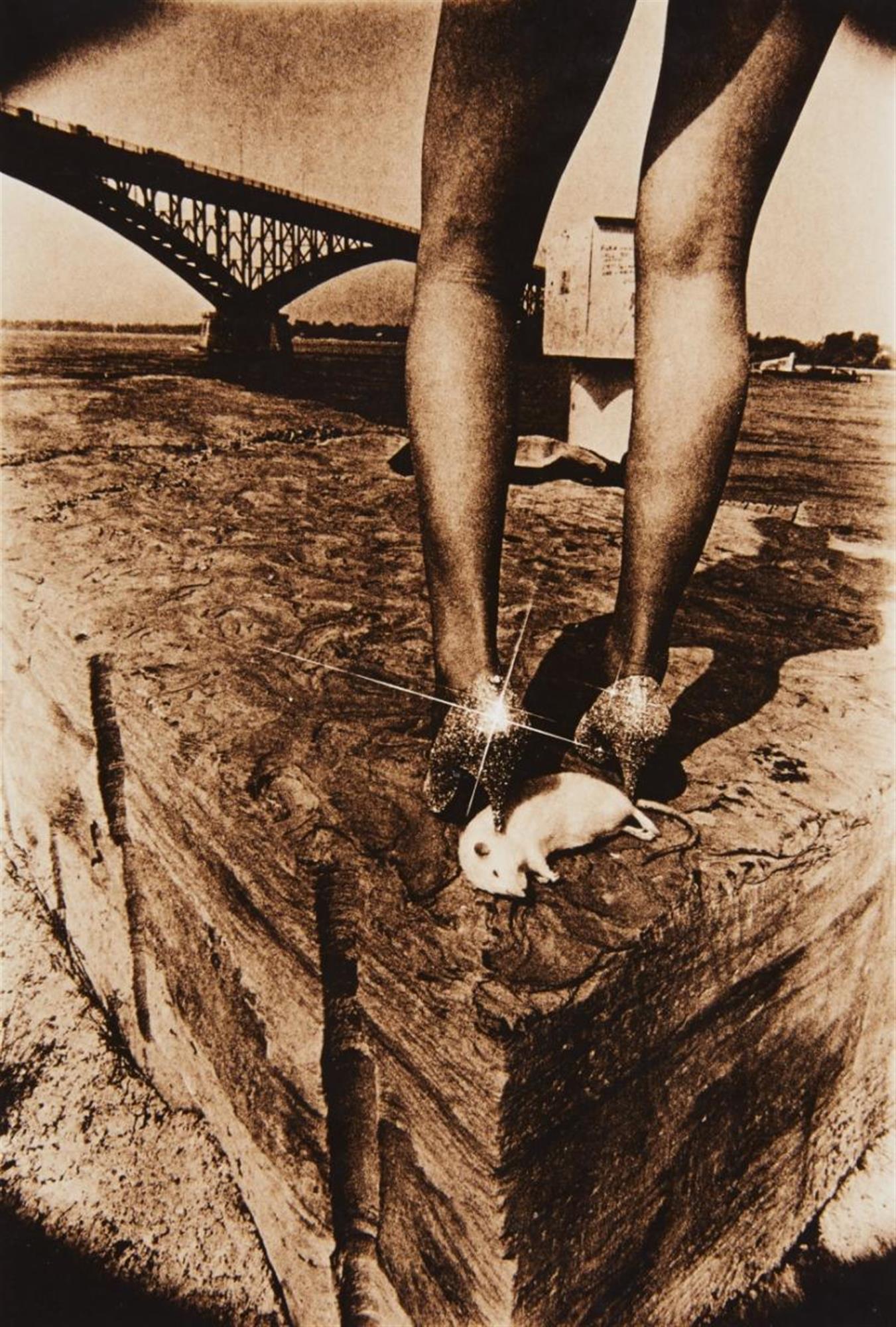
Les Krims (Leslie Robert Krims), New York( 1943- 2018 ).
from a time when we spelled it Kozmic; Janice has escaped from Port Arthur but not from its empty cold fear filled conformism. There was no choice for a middle ground so lith, crosstars and glitter were called into the metaphoria.
Hommage to the Crosstar Filter, (1971) Kodalith print. Les Krims
similarity within the frame prompting multiple meanings from outside — between the frames
bridge == panty
woman
triangle
corners
oh, and the cliches // crosstar effect ) commercial photography grasping eye appeal — shiny shoe … all cast in doubt by the violant stiletto heel..
rat underfoot. along the edge of land and water. atop a concrete slab.
commerce introduces reason to buy — maintain modern , other world look… fictional somethings
Others working with the Kodalith were so common that no one kept track. I must have had 200 students who made kodalith prints. Notables, other than Krims are Michael Becotte, Ron Leighton, also Christopher Cardozo shows up in some old show catalogs.
Kodak ceased production of Kodalith Paper mid-70s … Prints sold thru VSW print program went from $75 to $275.
Current
The progression wasn’t much progress, instead falling to what is done by those attempting to raise their work by citing ‘print making’ as their cornerstone. These are principally photographers updating the landscape, adding to the world’s collection without increasing the world’s concepts. The world of the weekend and workshop took over, and they are holding on for everything they’ve got.
Current commonly referenced text is Tim Rudman’s Master Photographer’s Lith Printing Course. I consider it a ‘not to own‘ book. As far as essential information, it has 2 pages that present information of some interest to the curious experimenter. I’d suggest you hit sites such as Moersch, and Freestyle for ready to use information — online.
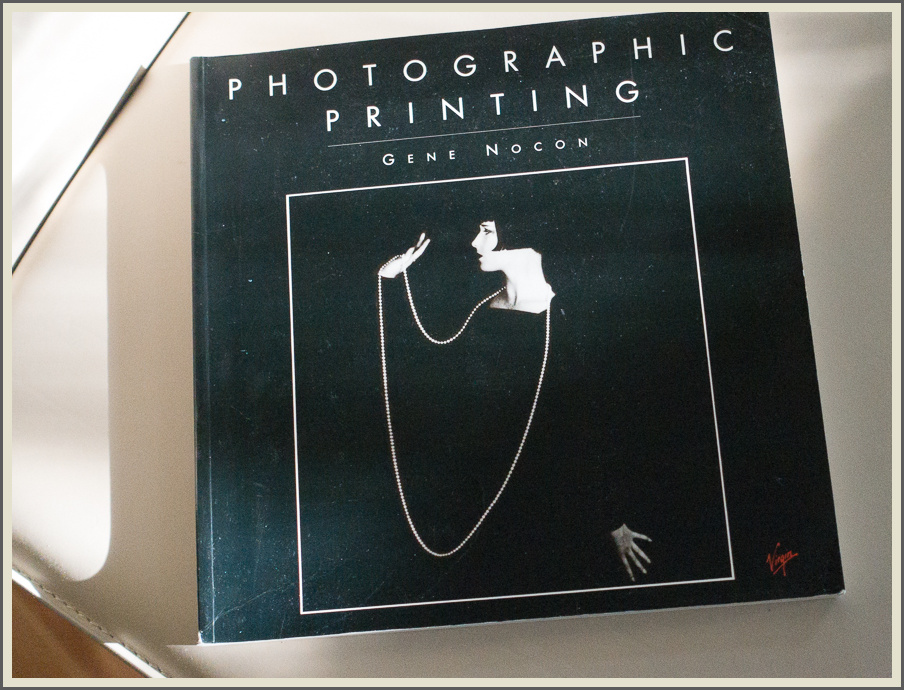
If you want an offline, (in the can) information source, use the Gene Nocon book. It contains more information, much more about printing. Its chapter on lith printing is concise with beneficial information. Be aware that the papers referenced are gone.
Rudman Lith Printing
Gene Nocon
Next. The things
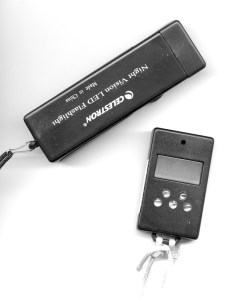
Your darkroom should be red light only, no OC safelights. Consider an inspection red flash light such as one from RH, or Celestron –
red inspection lamp
Chemistry and paper – will your paper lith?
PAPER TEST: in white light, put 2 drops of lith part B onto it. If it darkens, it isn’t lithable.
Some Why
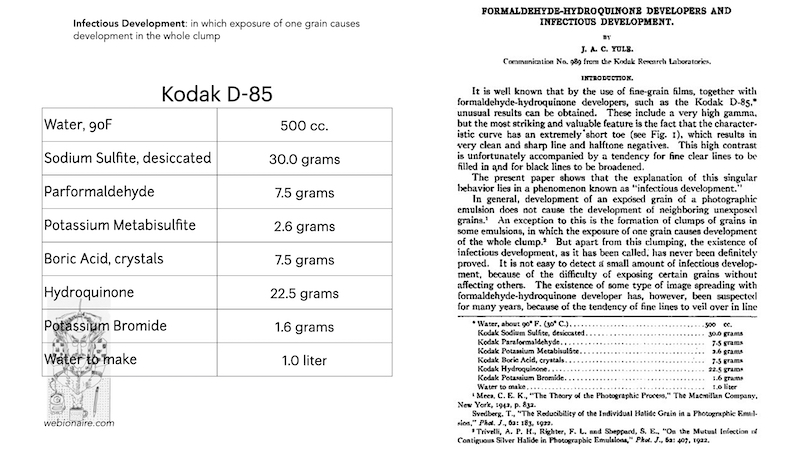
Infectious development- key chemical reaction for making of lith. It was a requirement of lithography that an image be composed of extremely sharp dots of high density. This meant the developer would produce high density silver then exhaust. The oxidation products of the developer become developing agents resulting in an accelerating, non-linear development process. With lith films this produces a very high contrast film consisting of stark, distinct areas of clear and dense image areas. With lith printing, this same low solvent, hydroquinone developer produces our lith print.
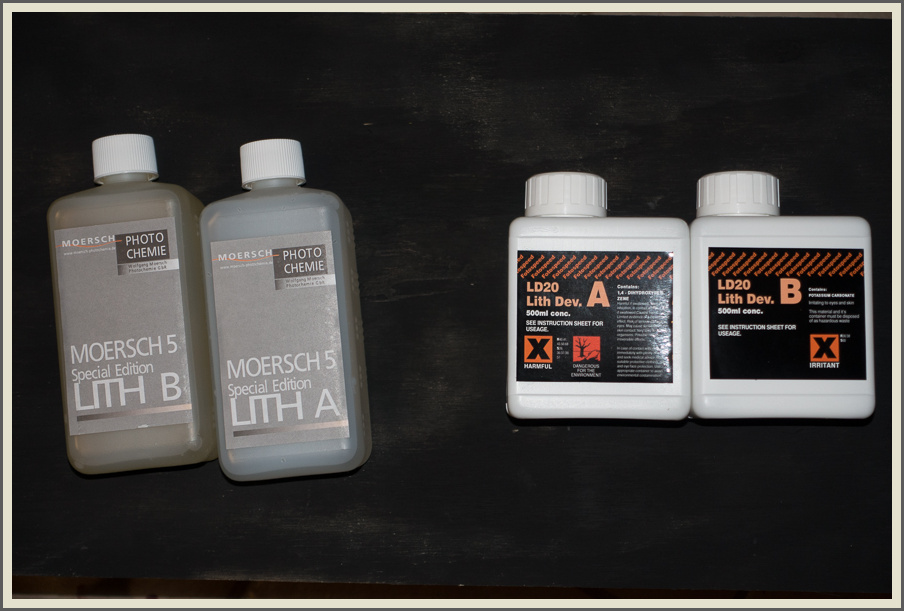
– developer: Moersch or Fotospeed
(’16) current choices. I use both brands, but prefer the Moersch for Foma and Slavich paper [Unibrom 160BP], my preferred papers for lith. Freestyle carries both developer brands, and Foma papers. B&H will order Slavich paper; drop shipping to you from a west coast importer.
Lith Developers
Mixing– Moersch
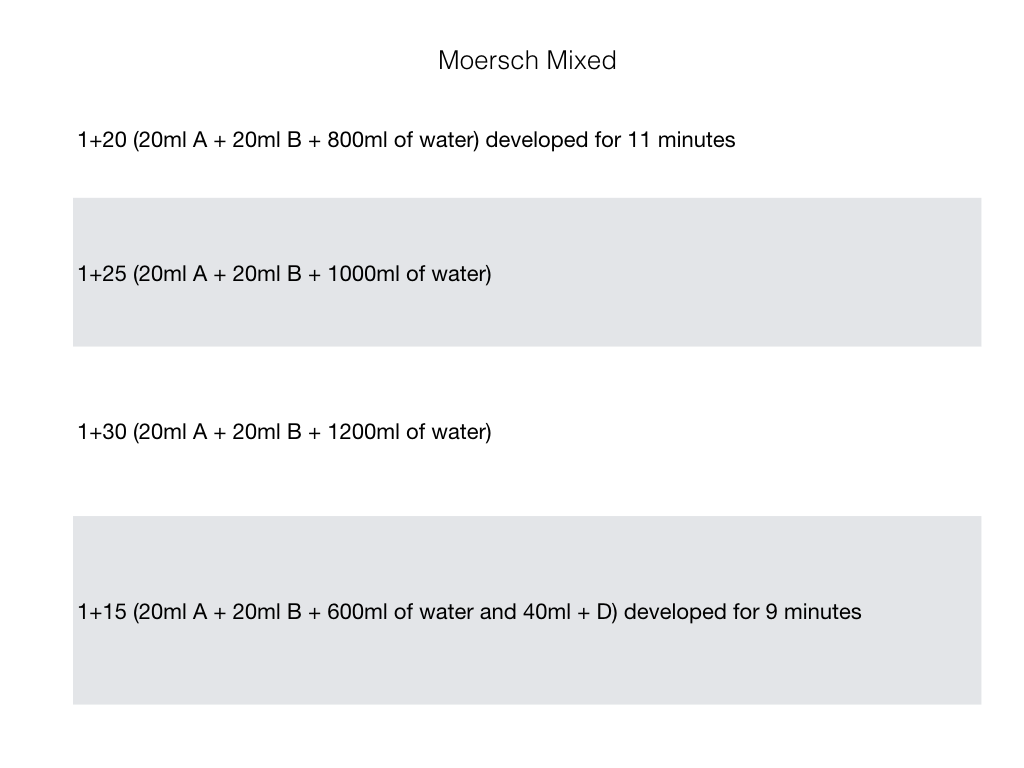
Lith developers are two part chemicals. The standard mixing is balanced, or symmetric, meaning part A and part B are used in equal parts. The ratio is the combined concentrate to water (A + B + Water). Asymmetric (unbalanced) is when the A & B are not mixed in equal parts.
I use the 1+25 most of the time, occasionally following the 1+15 routine. Developing prior to snatch is always over 7 minutes.
MIXING– LD20 Photospeed
1 part Fotospeed lith LD20 Dev A + 1 partFotospeed lith LD20 Dev B + 16 parts water (between 4 and 20 parts)
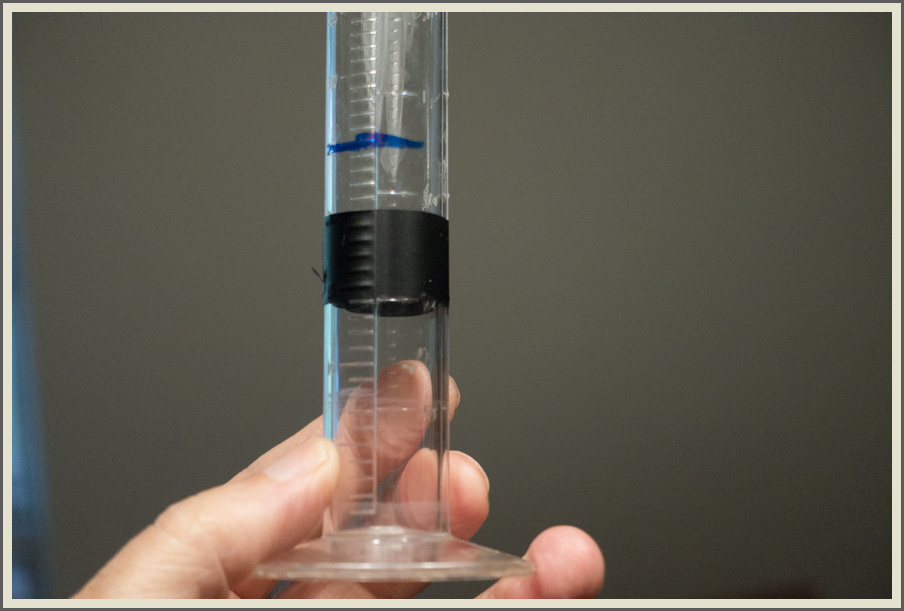
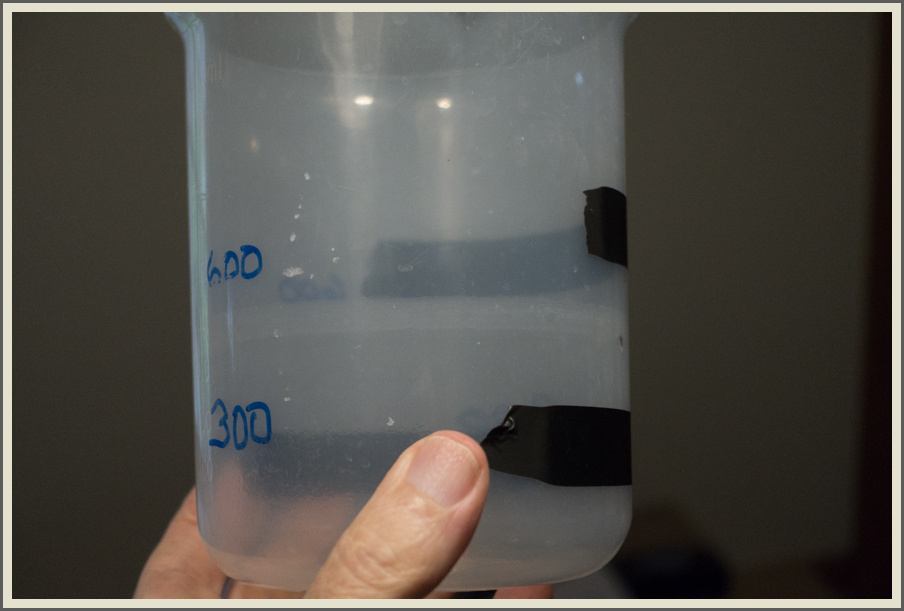
I prefer droppable plastic measures for the Wet Room. Mark the amounts with marker and tape — you can see and feel to confirm.
“A” “B”Water
Worksheets
I often make worksheets so that I can keep notes, using them as a start point in later sessions, with other negatives. These 3 sheets can be used as points of departure for your own studio practice. The left is a process sheet; the middle compares the components listed on the MSDS’s of the key lith developers (ao: 2016), the last, with yellow marker, is a dilutions table — easy to just write 1+20 on note instead of details of quantities used.
Additives: Potassium Bromide (10% [50g in 500 ml h2o] // Sodium Sulphite (20g per litre of A+B syrup)
Procedure
Lith prints take time in the developer, much more time than other processes. Some colors on some papers can take 15-20 minutes to reach completion. My process means developing times exceed 7 minutes before the darks of the image mature.
Determine starting exposure using your normal developer. A lith print will need several stops more exposure than a standard gray scale print. I use an on easel lightmeter and an RH timer to make my test sheet — as an initial test, using Fomatone, consider this example: if the normal paper exposure and development is 12 seconds exposure with 2 mintues in dektol 1:2, then the test steps I use for lith developer is the sequence [20 | 40 | 80 ] seconds and the development will go to at least 4 minutes, up to 11 minutes. The longer the development the deeper the tones
1L new lith developer + 500ml old brown in a 11×14 tray for making 8×10 lithprints. Using a larger tray provides easy physical management of the print, it also provides enough developer so that it is active longer for more prints. You can use a count of prints as an index of how much, or when, to replenish.
Exposure: more gives warmer highlights and softer gradations. As development time increases, before reaching “infectious” development, the greater the lith effect.
Snatch Point — the shadows are going to build into the middle tones overtaking them and hiding critical low values. Also, when the color is right. If you are slow to judge, or you prefer to stop the action quickly, use a citric acid stop such as Ilford’s IlfoStop, or LegacyPro’s EcoPro odorless stop. In any case don’t use indicator stop.
Refreshing developer — Charging the day’s tray without ‘old-brown’ means adding 2 8×10 sheets of undeveloped paper; do this with the white light on so that they paper darkens to black. This is a good use for that eBay paper you bought that was of unknown origin, but from a non-smoking home. WHEN: under white inspection light evaluate color of developer – yellowish (10 – 40YCC) to ‘amber’ still good – deep brown == dump, reserving only 40ml or so to use as old brown.
Using at least 1 liter of developer in a tray, the working life is a full 10hr day. Every 10 prints, refresh with 4ml each A & B & 40ml of OB.
Old Brown [OB] — developer turns brown as it exhausts in the working tray. Saving this developer till another processing time in a jug is the ‘old brown’ used in lith printing and solarization. Not all ‘old brown’ serves the same purpose, or is as effective. I prefer the exhausted developer from a solarization session for my ‘old brown.’
Developer Formulas
From my old darkroom wall sheets:
Papers
Adox —
MCC [ development will take more than 20 minutes for the best lith effect ]
Foma —
Fomatone 131 & 542 [my choice for range of lith colors.
Fomabrom [ coarser blacks rather than ‘tone’ effect, but I prefer Unibrom]
Ilford —
Warmtone (barely — only use as a trial paper if you already use it. ) If you wish to use Warmtone, I suggest using with a more concentrated developer, say 1+10. If you are familiar with 2 tray, ie, split Lith, then that works well with thin negatives. Your exposure must be increased even more than with regular lith papers, so that your ‘snatch’ is under 5 minutes. By watching shadow growth closely you can get a nice flavor of lith – tones are good, but color is not as wide ranging as other more lithable papers. After toning can be used to widen the colors produced. Fortunately Ilford Warmtone takes well to toning. I use prepared toners from: Moersch, Foma, Formulary.
Art 300 [beware this paper will stain, or mottle. Wash time should be less than 45 minutes]
Slavich —
Unibrom 160BP — my preferred paper. Liths consistently. Doesn’t have the range of colors as Foma’s papers. I use any of the 3 grades: 2,3,4 — I keep 100 sheet boxes (11×14) of #4 , and 25 sheet packs of #2 & #3.
Silverprint (a store) stocks “lith paper” being Slavich Bromoportrait FB #3. Their other lith paper is Fomatone 131 & 132 FB, and Fomatone 532 Nature II. [..not as of 2025]








You must be logged in to post a comment.