Henry: Controls in Black and White

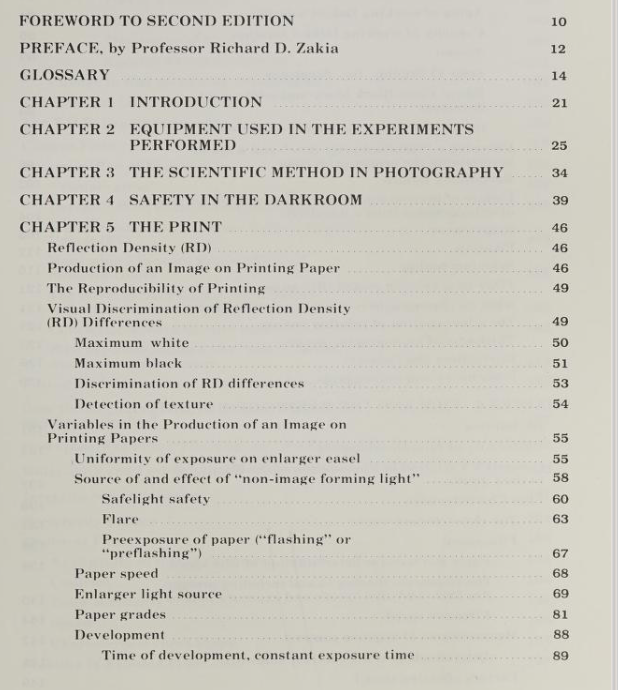
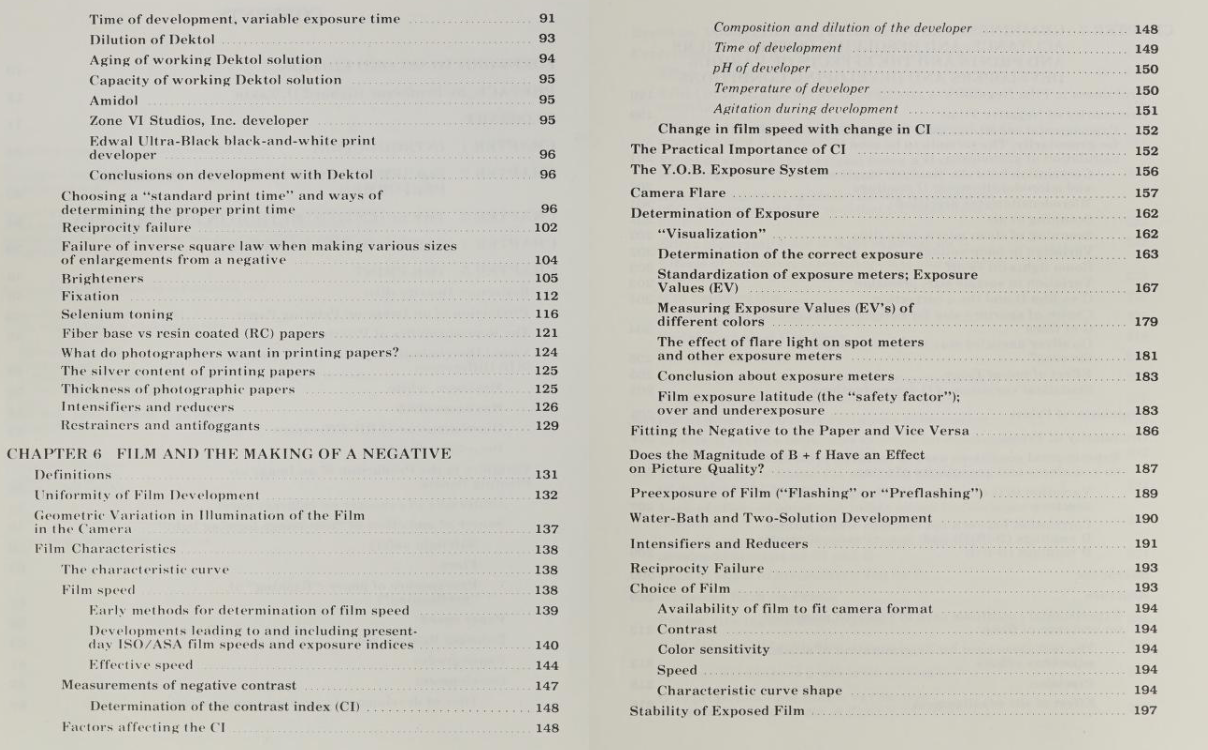
Richard Henry’s oft quoted study of the variables in making black and white photographs was meant to test common, and widely held opinions among darkroom practitioners.

Henry did his work in 86-88 time using Ilford and Kodak products. Chapter two is overview of the equipment and supplies used in his testing. Haist’s book[s] were published ’79; he finished writing them in ’78, although the last copyright was 2000.
It is remarkably different in content, intent, approach and result to the Lustrum Press “Darkroom” set of books. I direct people to those over this book, and strongly advise against the Ansel Adam’s series. I bet you already own Ansel’s books and google brought you here thinking you’d get a free look. Sorry, just some summary info, although I have mentioned his conclusions throughout posts and I do use his results to inform my process.

In Brief: Everything You Hear on The Forums is Useless.

henryPost.001.png

The magic bullets: Dektol (1:1); D-76 (1:1)

My magic bullet: make more pictures, even if they’r digital. Read books that don’t have charts and formulas — this assumes you are after what is sold by the workshop world as “vision.” I don’t know if you will get vision. I don’t know if you’re capable of making pictures that X or even Why.

I am certain that the longer it takes you to get beyond the methods books and message boards the less likely you will reach satisfaction in image making or photography.
Tanning Developers

some use photography to take them into the world. others take the world into photography.
I take photography away from the world. the using excuse

tanning developer. dye+mordant. matrix and blank. These are the key elements of imbibition print making.

Dye transfer works because …

differing thickness of gelatin gives different amounts of dye to transfer from the “matrix” to the “blank.” The gelatin of the emulsion is the same thickness before it is exposed and processed, developed. After development the emulsion is “washed off” providing a relief image. Soft gelatin washes off, melts, at 90F. To maintain an image means hardening the image forming gelatin. This is done by using a “tanning developer.” Tanning being the action of hardening gelatin.

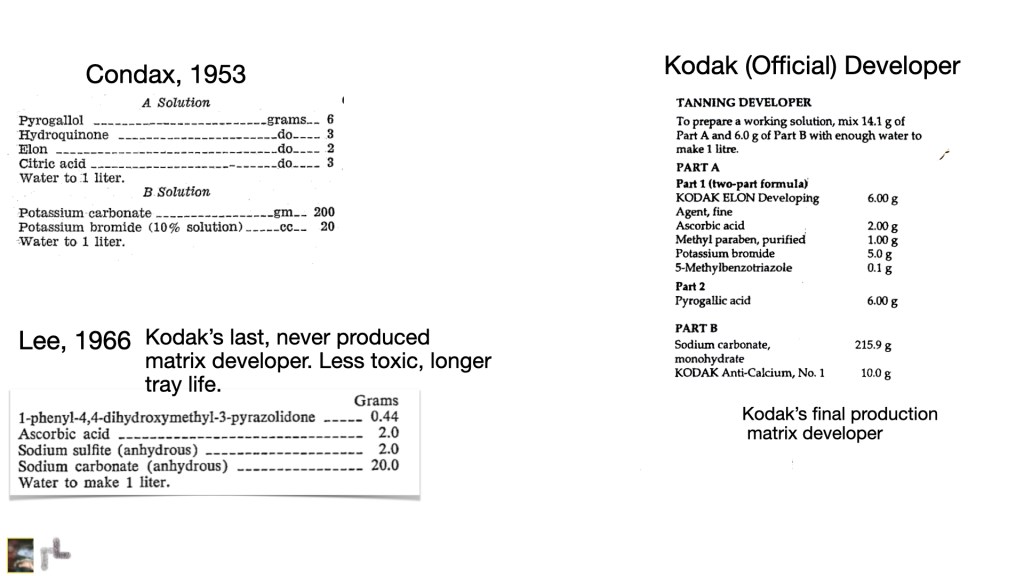
Tanning developers must not stain, only harden the gelatin around the silver site. Practical tanning developer solutions are highly unstable since preservatives, such as sodium sulfite, cannot be used in quantities found in more common developers. The presence of these chemicals react with the oxidized developer reducing the extent, or effectiveness of the tanning action.

The first versions of imbibition printing, wash-off relief, used the principle of a tanning bleach such as a dichromate. Dichromate systems were not as sharp as tanning developer systems, so dichromate methods were discarded before 1950.

  • 1879 JW Swan patented the use of pyrogallol-ammonia developer without sodium sulfite to produce relief images on photographic plates useful for printing processes.

  • Leon Warnerke (BP 1436 1881] to dissolve or etch away in warm water the parts of the image that were not developable in sulfiteless PA developer. 

  • 1906 A and L Lumiera and Seyewetz showed that gelatine could be insolubilized in the absence of of silver halide if a pyrogallo-sodium carbonate solution was allowed to oxidize in air

  • Technicolor [bp 785873 (1957) Improvements in or relating to Dyed Photographic Relived Records, solved the “breakthrough” in the highlights — gelatin too thin to absorb sufficient dye for transfer.


  • Mees and James, The Theory of The Photographic Process, 1966, p.304
  • US 2,415,666
  • US 3,293,035
  • US 3,746,544

Further notes:

  • R-10a needs clearing, otherwise dyes look yellow/brown when using slip-sheet assembly method. [2.20.23]
  • Jos-Pe process invented by G. Koppmann in 1924(?6) was the first commercial process based upon tanning developer.

list of Koppman patents

Koppmann patented using pyrocatechin without sulfite with subsequent wash-off in hot water. Variation was to develop in a non-tanning developer then the unreduced silver halide could be exposed and developed with a tanning developer. Upon wash-off the primary image and gelatin would be dissolved..

Further, use of a ‘dye’ to prevent over-exposure was noticed along with using matrix emulsions “poor in silver.”

Ref to Mixing: