east lyme: pilgrim age

You know the names of the people, even if you don’t recognize the name of the place. Fellow photographers prompt us. Place probably prompts geographers and letter carriers.
Influence felt and spread. Will you explore for inspiration? What does seeing what they saw provide? I have no answer to either of the questions. I don’t travel to visit places of others. I have never been a pilgrim.

Walker Evans, east lyme… the note idled over a month… for no reason. Okay, one. I considered buying the book. I still haven’t bought it.

Walker Evans lived in this house in East Lyme, Connecticut, from 1967 until shortly before his death in 1975. The house was designed by Evans and his friend Robert Busser, a Yale architecture student. Letters and postcards were often addressed to Old Lyme or Lyme because their Mail truck turned around at Stewart’s Corner, East Lyme.]

Reviewing others’ work provokes a review of mine. Same thing sometimes happens as I edit or revise current work. Few interesting matters ever reach finality.

as test to yourself: Why hold interest in another past place. We don’t see Evans’ time, footprints. A deed with his namespace; perhaps a deposit check could hold as much history– commerce, reverential. Or, is the structure a demonstration of built world a key to His namesake. A keepsake worth travel of two current actors on the artworld.

[Two photographers, James Welling and Mark Ruwedel, just two years apart visited Evans’ home in 2016 and 2018, respectively. This volume places the projects undertaken by both in dialogue, highlighting their similarities and differences.]

[Shooting passersby against a plywood backdrop as they crossed his field of vision from distant right to close left (some noticing him, most not), with the light striking and modeling their features, Evans found that what he was creating with these images was “the physiognomy of a nation.” This book compiles the photographs, contact sheets, small-version printlets, Evans’ annotations to newspaper clippings, drafts for an unpublished text, telegrams and every available print Evans made, along with the Fortune spread as published. Labor Anonymous captures a long-vanished moment in American history, and a crucial project in Evans’ oeuvre.}here

Welling: (b. 1951)

Ruwedel: (b. Bethlehem, PA 1954)
quickstep across

— Although The video is not mine... it is worth my time, perhaps yours also. What does it consider?

YouTube (YT) is a key supplier of opinions. It is the Hot Media. It is widely dispersed, with sense, nonsense. Its basis is advertising, so like water in a desert it may nourish, it may also poison. YT channels stratify the field. Entry layers gaining greater advertising hits. This is like the threaded online boards, except they are in decline, with YT continuous increasing attention. Even in the time after TikTok and pulse viewing.

I wouldn’t link to a poison. I don’t know this person, not even his work, other than what is shown in the video. His imagery isn’t my reason for directing you to his video.

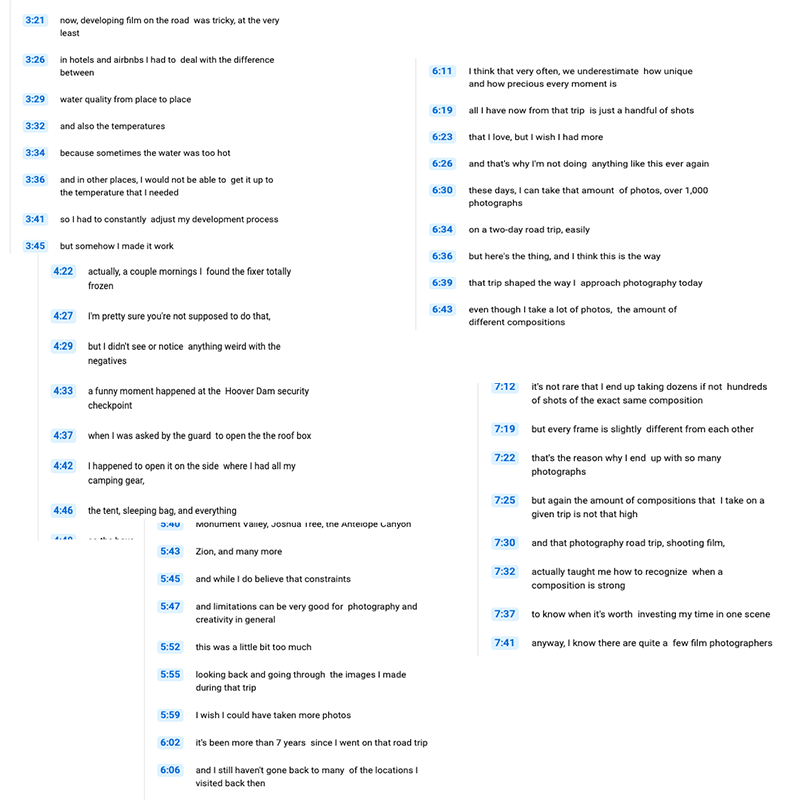
one video about roadtrip… my response after the video. My response is here, rather than on YT, so I can better remember my shorthand. YT responses are better for a short statement sent into the bucket. Please watch the YT version.

The nature of film is the image is not seen immediately. Polaroid was in every commercial studio as part of the solution to this boundary. Polaroid along with messenger service and a quick turn lab within a few blocks was the method of New York photography. Why we dominated. We had the community, the infrastructure nourished its own. Manhattan was home to Madison Avenue, the source of work and seemingly unlimited funds to maintain this intense group of photographers.

selected transcript from the video.
  • Travel with chemicals -[else] keep them concentrated. Process one-shot.
  • Pickup distilled water at gas/rest stops. Also, ice for temperature control of process.
  • learned to stay, shoot enough to “distil” the composition.

This equipment he takes surprises me: a scanner. His reasoning is to verify that his camera and process are producing useful results. This is a hybrid thinking solution. I carry duplicate cameras. For bellows based cameras, carry electrical tape, or “bellows” patch (scuba glue).

I suspect he is now a digital first photographer, since it seems he was using film as input to scanner. He liked the camera, had fun with film. So it goes.


Travel opens the world. The road trip is a standard of photographers. Even studio photographers make road trips (Avedon) , just rarely is that considered their prime work.

–> other bit about travel to tripod spots.

By Their Death

The RIP of others. Two three today. There are few weeks that pass without a death of the world of meanings.

When younger, I didn’t note the passings of most of my field. Maybe because I was raised on independence. Perhaps because by 22 I’d knew the smell of cordite, skin, blood. Whatever mixture makes real actions, until the past decade, death was final as well as paper.

burial camps: you honor yourself in the way you honor them. The self you never had they are yourself they took the path you never took a live the life that you read about 

the thing they share: they work in black.

George Tice: [‘Bard of New Jersey’ With a Camera, Dies at 86] I knew of his work without following his life. His is work that meanders into or across my ready understanding. It can add. Maybe it will, although I doubt it since my work, world of workers is quite full. My ideas run over.

The others: two from the camp of others, those whose images didn’t cross over my middle or current table. They would have held me as a young imagination, just not for long. They took similar paths, maybe, but they certainly have similar followers. Often death is the marker of similarities.

Too often death marks our life with our absences, lacks, short falls. Reviewing a life provides stimulus to consider ours. Who do we live among. What is your relationship with photography. Do you have a constructive, nurturing system?

How much is enough?