east lyme: pilgrim age

You know the names of the people, even if you don’t recognize the name of the place. Fellow photographers prompt us. Place probably prompts geographers and letter carriers.
Influence felt and spread. Will you explore for inspiration? What does seeing what they saw provide? I have no answer to either of the questions. I don’t travel to visit places of others. I have never been a pilgrim.

Walker Evans, east lyme… the note idled over a month… for no reason. Okay, one. I considered buying the book. I still haven’t bought it.

Walker Evans lived in this house in East Lyme, Connecticut, from 1967 until shortly before his death in 1975. The house was designed by Evans and his friend Robert Busser, a Yale architecture student. Letters and postcards were often addressed to Old Lyme or Lyme because their Mail truck turned around at Stewart’s Corner, East Lyme.]

Reviewing others’ work provokes a review of mine. Same thing sometimes happens as I edit or revise current work. Few interesting matters ever reach finality.

as test to yourself: Why hold interest in another past place. We don’t see Evans’ time, footprints. A deed with his namespace; perhaps a deposit check could hold as much history– commerce, reverential. Or, is the structure a demonstration of built world a key to His namesake. A keepsake worth travel of two current actors on the artworld.

[Two photographers, James Welling and Mark Ruwedel, just two years apart visited Evans’ home in 2016 and 2018, respectively. This volume places the projects undertaken by both in dialogue, highlighting their similarities and differences.]

[Shooting passersby against a plywood backdrop as they crossed his field of vision from distant right to close left (some noticing him, most not), with the light striking and modeling their features, Evans found that what he was creating with these images was “the physiognomy of a nation.” This book compiles the photographs, contact sheets, small-version printlets, Evans’ annotations to newspaper clippings, drafts for an unpublished text, telegrams and every available print Evans made, along with the Fortune spread as published. Labor Anonymous captures a long-vanished moment in American history, and a crucial project in Evans’ oeuvre.}here

Welling: (b. 1951)

Ruwedel: (b. Bethlehem, PA 1954)

quickstep across

— Although The video is not mine... it is worth my time, perhaps yours also. What does it consider?

YouTube (YT) is a key supplier of opinions. It is the Hot Media. It is widely dispersed, with sense, nonsense. Its basis is advertising, so like water in a desert it may nourish, it may also poison. YT channels stratify the field. Entry layers gaining greater advertising hits. This is like the threaded online boards, except they are in decline, with YT continuous increasing attention. Even in the time after TikTok and pulse viewing.

I wouldn’t link to a poison. I don’t know this person, not even his work, other than what is shown in the video. His imagery isn’t my reason for directing you to his video.

one video about roadtrip… my response after the video. My response is here, rather than on YT, so I can better remember my shorthand. YT responses are better for a short statement sent into the bucket. Please watch the YT version.

The nature of film is the image is not seen immediately. Polaroid was in every commercial studio as part of the solution to this boundary. Polaroid along with messenger service and a quick turn lab within a few blocks was the method of New York photography. Why we dominated. We had the community, the infrastructure nourished its own. Manhattan was home to Madison Avenue, the source of work and seemingly unlimited funds to maintain this intense group of photographers.

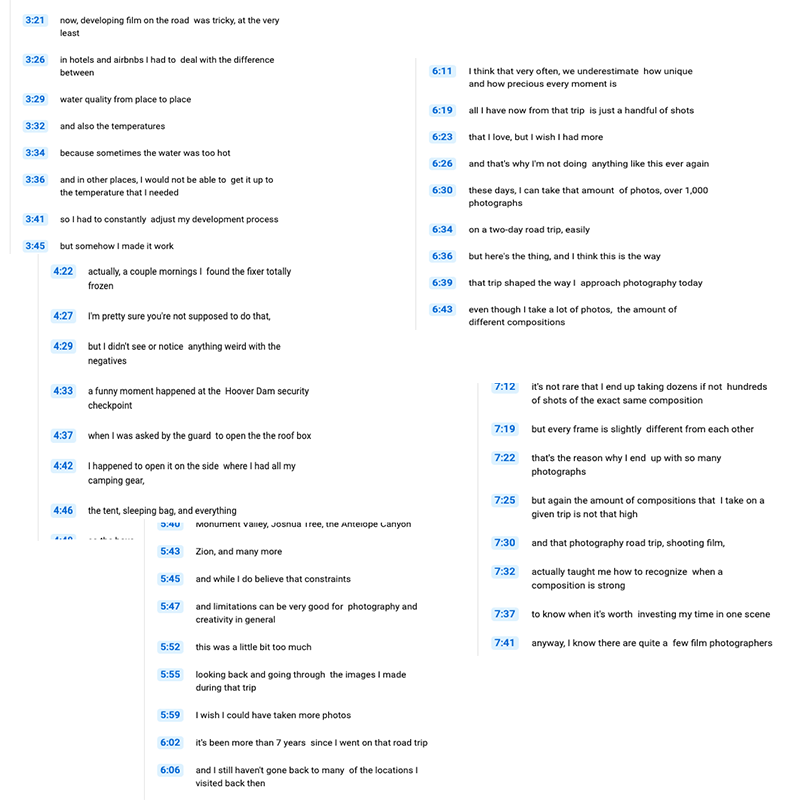
selected transcript from the video.
  • Travel with chemicals -[else] keep them concentrated. Process one-shot.
  • Pickup distilled water at gas/rest stops. Also, ice for temperature control of process.
  • learned to stay, shoot enough to “distil” the composition.

This equipment he takes surprises me: a scanner. His reasoning is to verify that his camera and process are producing useful results. This is a hybrid thinking solution. I carry duplicate cameras. For bellows based cameras, carry electrical tape, or “bellows” patch (scuba glue).

I suspect he is now a digital first photographer, since it seems he was using film as input to scanner. He liked the camera, had fun with film. So it goes.


Travel opens the world. The road trip is a standard of photographers. Even studio photographers make road trips (Avedon) , just rarely is that considered their prime work.

–> other bit about travel to tripod spots.

Showing Prints on the Web

Beginning printers learn by coordinating their eye and hand, by looking at more things, until they can make assessments of greater abstraction, ie, things removed, even remote, from the origin object. With skill, you see the tree not the print — do this enough and you will see the print as you look at the mountain… The representation of an image may serve as mnemonic, even as illustration to other visualizers. A common grounding; a touchstone needn’t be stonehenge. The self aware growing their visual mindscape. Certainly making a point in the Web2 world can be made with an illustration.

While a “print” can’t be shown over the wire, it can be transmitted, even understood; understood well enough that Telemedicine works.

craft doesn’t have to limit, nor does conversation have to be limited to craft 
“The real voyage of discovery consists, not in seeking new landscapes, but in having new eyes.” — Proust

It was commonplace to teach by way of slides. I used it as supporting background teaching dye transfer. Additionally, I was able to demonstrate differences in filtration methods in making Type C prints. Side by side on the same slide. Humans capable of making art are quite apt at understanding comparisons. We see in relationships. For absolutes we need a machine. Our eye is the bundle of the revealed brain.

One use of the cellshot is a record, a timestamp of that “light”

You Don’t Show, not even as illustration because:

  • don’t have
  • embarrassed by what have
  • don’t know how to show
  • afraid [you/ someone] will steal
  • don’t care about your opinion
  • [why expend so much effort claiming a ‘one true’ way] Even the emoji using redundant engineer. I assume he didn’t study physics, or isn’t interested in current “frame” meanings.

Can I show more using the ‘net? Is electronic imagery more flexible? Can you, using chemical means, balance the curve differences of color (RA4) paper? Not without recourse to multiple colored masks. An almost triiavl task for intermediate skilled digital based retoucher/printer. A well managed system provides immediate soft=proof.

Assessing the Mentor:

said / meant

I’ve never taken a photograph with my cellphone.  [i’m not good enough photographer to use the simple tool, to make memorable or useful picture]

Prepaid cell offering less coverage in remote locations. Still, makes a great retort of comfort to those steeped in creating a nearer to Thee legend.

An underdeveloped visual mind is terrible thing to brag about.

Their safety concern– how deep is their ocean?

  • ” I have only a cell phone for emergency roadside need.”
  • “I have never taken a picture with one [MEANING: so he can’t show you anything he has or has seen.]”
  • ” Besides, even the cell phone selfie phonies couldn’t get reception at the beautiful points in my recent travel.”

If you carry the phone for emergency roadside use… and there is no reception…. your life lessons may be flawed. Not the best guide; not a skilled map-maker.

The logicians involved are retired very active forum posters. One, an aerospace engineer who was retired at 55; the other an order processor at a softwoods shop. He retired in his late 60s; clearly more critical in job function than the redundant engineer.

They would have you follow their advice, (why they give it so often) that a cell phone is only good for roadside emergency — even where there is not service[?]. Lacking cell service, the supposed phone provides recording features, alas, not of use for these cellular phonies. Perhaps they mean they have a satellite phone. Good for them.

Behind their legend: in one case, mystery permits changing his story to fit the need for boasting of skills. In showing nothing, he lets you imagine him more capable than he is; more productive than he ever was.

Reasons for maintaining their legend:

  • they are embarrassed by what they have
  • they don’t have what they claim
  • maybe lack skill of translation

Skill types… the reason for craft is translation. Good to see your work is well regarded.

Exposure. Composition. Using the meter and following the measure of 18th century drawing rooms has a simple reward. Just not up to meeting on the majors stage

You must know where to show. Certainly the large, long-lived photo forums lack the shared background for worthwhile exchange. As well, they fail at being able to exchange craft information.

Perhaps they have stalled in all roads of their life — the roadside service has no on-ramp ramp

Tip toe through the tall tale

You can’t show on the Internet, you can’t evaluate a photograph, yet he didn’t like the prints, the photographs only seen on the Internet .
 That web fight was between Drew, Kirk Gittings,& Bob Carnie over print quality.

once this was pointed out to him, once it was pointed out to others that he had a website, within weeks his “own” website was taken down — chose to no longer show on the internet.