
Cover to uncover… picture making method. Meaning within the frame. Understanding what comes from beyond the frame.

US 91, Leaving Blackfoot Idaho shows two young men picked up by the photographer. Though the men seem intently focussed on the road, the car windows are blank. A text by the English philosopher and statesman Francis Bacon is in the visor; this Frank had copied down when he visited Dorothea Lange before he set off on his journey to find the heart of America.
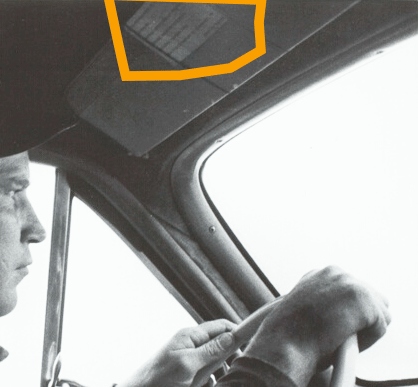
one aspect of “reading” for understanding is in your covering items contained within the frame… What is lost
in this instance, it is very difficult to understand the text — it cannot be read .. it is mere squiggle. What would it be?
We have to leave the frame for the content..
That text reads: ‘The contemplation of things as they are/without error or confusion/without substitution or imposture/is in itself a nobler thing/than a whole harvest of invention.’
https://www.artic.edu/artworks/87174/u-s-91-leaving-blackfoot-idaho
For the second half of Dorothea Lange’s life, that quotation from the English philosopher Francis Bacon occupied space within her day. She pinned a printout of those words on her darkroom door in 1933. It remained there until she died, at 70, in 1965 — three months before her first retrospective opened at the Museum of Modern Art in New York .
Referenced in publications
- Robert Frank, The Americans, Paris, 1958.
- Sarah Greenough, Looking In: Robert Frank’s The Americans, Washington, 2009, 248.
- https://www.nga.gov/features/robert-frank/the-americans-1955-57.html
proof sheet: https://www.nga.gov/collection/art-object-page.78965.html
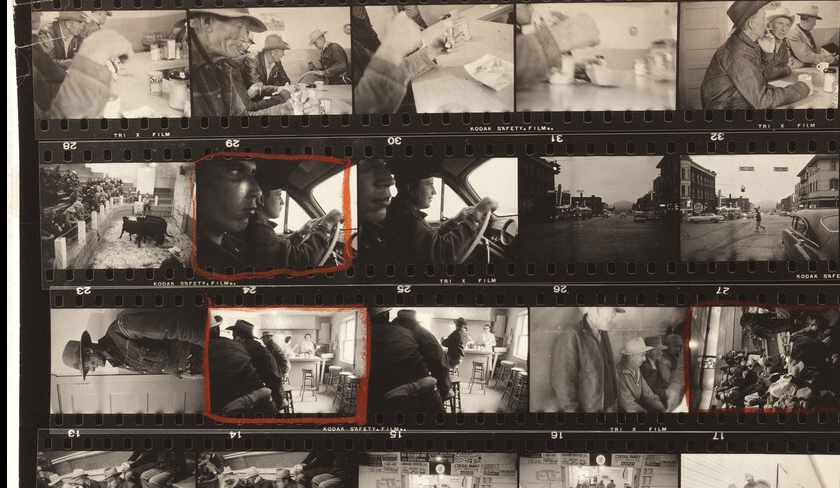
2 possible frames … chose the one without the space between the figures.
same configuration choice in next row of grouped figures.. make the group of one blob.. cluster into single tone pack
Robert Frank’s book, The Americans, is divided into 4 sections. Flags mark the divisions of the book.
- Flag blowing.. Parade, 1955.. two people “looking” out of windows (First Chapter)
- Flag hanging over stripe shirt, and… Fourth of July, Jay, New York.
- Flag as shade… Backyard, Venice West, California.. just two pages after Bar, Detroit.
- Tuba player… 1956, Political Rally, Chicago (Fourth Chapter)
Robert Frank (b. 1924) traveled across the United States to photograph, as he wrote, “the kind of civilization born here and spreading elsewhere.” During his nine-month journey, he took 767 rolls of film (more than 27,000 images) and made more than 1,000 work prints. He then spent a year editing, selecting, and sequencing the photographs, linking them thematically, conceptually, formally, emotionally, and linguistically. https://www.sfmoma.org/press/release/sfmoma-presents-looking-in-robert-franks-the-amer/



You must be logged in to post a comment.