Print Finishing.

The Print… between books and followings: Mortensen or Adams.

William Mortensen (1897 – 1965) was one of the most well known and respected photographers in America in the thirties. Ansel Adams called him ‘the Antichrist’ and wanted him written out of history.

Ansel Easton Adams (February 20, 1902 – April 22, 1984) 

The Print… Adams (outlasted ..)

Print Finishing.. Mortensen (came first)

Should you want to make prints, the Mortensen is overlooked; it shouldn’t be.

The contents, shown below, is why. Much more content.

Adams is about curves and chemistry… in search of a print, whereas Mortensen is about how to retouch, to introduce the hand, while also providing specifics about drying, flattening of the print.

Even though he was there before Adams, we all know Ansel Adams.
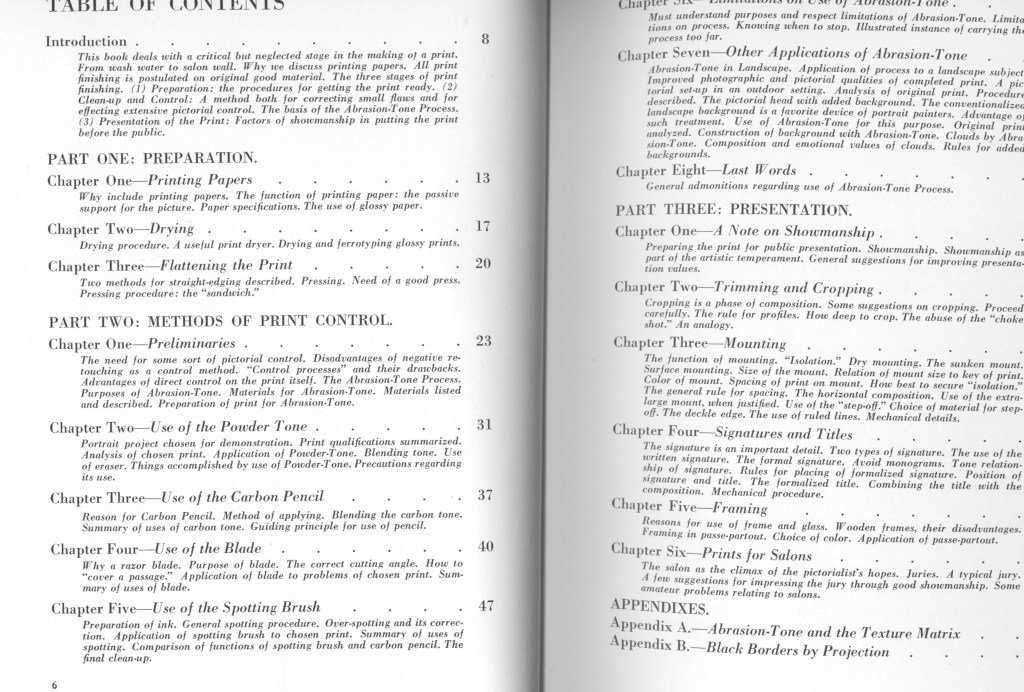
Mortensen’s method required the hand. It was all about the final print; what could be done by the individual photographer… using haptic tools in addition to the optics.

Not the Zone System. A tone system.

In "Venus and Vulcan" -- a series of 1934 Camera Craft magazine essays -- Mortensen defended Pictorialism against criticism from the f.64 school and other "straight shooters":

Photography, like any other art, is a form of communication. The artist is not blowing bubbles for his own gratification, but is speaking a language, is telling somebody something. Three corollaries are derived from this proposition.

a. As a language, art fails unless it is clear and unequivocal in saying what it means.
b. Ideas may be communicated, not things.
c. Art expresses itself, as all languages do, in terms of symbols [William Mortensen, "Venus and Vulcan 5 - A Manifesto and a Prophecy," Camera Craft 41, n. 6 (July 1934): 310-12. As quoted in A. D. Coleman, "Conspicuous by His Absence: Concerning the Mysterious Disappearance of William Mortensen" in Coleman, Depth of Field (Univ. of New Mexico Press, 1998).]

Mortensen could draw. Had a larger world to draw from than Ansel’s insulated Carmellows. Limited by his piano, limited by playing to predetermined steps; not the human voice, rather the machine one. Chartable. The Adams universe prevailed since it relied less on human spheres. It is something that can be done on the weekends, alone. All that is needed is money and weekends.

Ansel gave us Coffee Cans and Canned Landscapes. Mortensen… another voice from the past, even though it seems possible that his whisper remains stronger than Ansel and the Newhalls wanted

The digital age is the age of retouching, even more than the chemical age.

Drying Fiber Prints

baryta. Ferrotyping. Screen dryers. Air-box dryers. Heat- press. Pako drum dryer.

paper curls as it drys. Take it from very wet to very dry quickly enough and the gelatin (emulsion) shrinks more than the paper (base).

Use the slowest way of drying your print. Fiber darkroom paper will not air-dry flatter than when it comes out of the box in the darkroom. If you need to use strong easel pressure during exposure, that paper may have a defect.

Paper-makers dry paper in an air-box. In labs, during last century, we used large heated rotating drums. These had canvas belts which could become stained, hence, the need for the Anselites to dry on screens. Screen drying racks came from the silk-screen and fine-print maker studios of that time. Many darkroom makers hung prints from clothes lines, like they did with their film. Let it air-dry in a damp basement.

All things considered, it worked well enough. Recently, discussions arise over changes in methods of the years. Large drums are gone; screens remained. Crinkle edges abound. We no longer dry under pressure and controlled temparture. Kodak made drying rolls suitable for prints smaller than 11×14 — they work well. So does ironing the print after it drys down to “damp” — iron from the back on lowest heat setting.

Or, you can flatten the dried print in a heat-press. (such as used by silk-screen printers)

Videos:

paper maker drying box

Getting from the question to the respondents — why the need for experts brings out some of the worst.

This is the place WileyPhoto references. He had prints there, that he reclaimed. At various tellings, they were Cibas, or Fuji Crystal … depending upon the need to convince, the topic at hand.

His legend also has it that they were printed such way as to make use of “fading” /// They were also up for “decades” … yet, this retrofit was in 2009, so the prints went up after that. The frames were also made by Wiley, in his very own garage.

I have never sold a print, then reclaimed it. Perhaps a vanity showing is what Mr. WileyPHoto had. The work was on loan, never sold. People visiting the lawyer, think the work was bought. This makes it seem valuable, not mere decor on loan. The work is hardly remarkable, like most decor, it must accommodate, blend into the background. Most of the work in the lobby is BW; that in the offices is by some of the lawyers — their fishing trophies.

This serves as an example of expanded importance. A puffery. Some small thing used to build many big things.


Formulas: Print flattening and for Ferrotype polish

Glycerine USP60ml (or) 125 ml
Add Water to make1 Liter
at 60ml, soak print for at least 5 min.
at 125ml, dampen BACK of print, using sponge. This is the better method
Print Flattener – formula

Paraffin0.7 gr
Carbon Tet32 ml
Plate Polish: Paraffin base

Benzol (FLAMMABLE)125ml
Yellow Beeswax2.7 g
Plate Polish: Beeswax base

the instruction for making the Beeswax included the warning not to make or use around burning cigar or pipe.

These formulas are from the 40s — notes from Kodak, Haloid, and Defender, all makers of silver papers(AgX)