Links: BW Masking. film

A mask is a piece of film used to modify another piece of film. Simple enough. Masking is the process of making these masks. From the 40’s until the 90’s, masking suggested that you were doing color work; some type of assembly, or photomechanical process. Much of the literature was written with those commercial goals in mind. They taught the method of achieving reprographic standard.

The first methods of aligning, of registering the mask-set, relied upon steam and glycerin. Next step involved cut-n-butt, the optical alignment of the films. Lithographers introduced button registration in the 30’s, Technicolor introduced pinset registration.

In the 60’s the enlarger makers, Omega, Durst, etc. introduced “color separation enlargers” with pinsets. Condit( & Bregman) came on the scene after them. It seems nobody enforced the patents.

After the decline, actually the drop, of dye-transfer BW (monochrome) separation took root. Contrast reduction from the Ciba/R world was enlisted; however, much of the equipment that had been in the lab was being trashed during the early 90s.

Along came some avid believers. the market was small enough that the workshop world could become a market for a small scale business.

Contrast Reduction Masking —

LINKS

— Lynn Radeka https://www.radekaphotography.com/

https://www.freestylephoto.com/contrast-masking-the-traditional-print

EZ Note:

  • You can expose with either clear glass, a diffusing glass, or both. You can even put a thin glass between the two pieces of film to further decrease sharpness.
  • A good masking film has no AH layer or a minimum AH layer, and has a good quantity of acutance dyes in the emulsion itself. Pan Masking film was made just for this purpose and could be exposed either through the base or emulsion side.
  • Both highlight and contrast masks are similar, they just address a different part of the tone scale, if I read what you are saying right. And you can make one either sharp or unsharp depending on what you are trying to achieve. You can even combine several results into one mask, or you can use several masks together in registration. Lith masks are also nice to try, giving quite nice special effects.
  • In color, you can make separation masks for color correction that can also be unsharp if desired. They can also reduce contrast. Therefore, by this method a transparency can be printed on Ilfochrome and yield results equal to the best color negatives with the proviso that you always lose some tone scale in pos-pos printing due to the two toes and two shoulders of the materials you are dealing with.
  • Just make sure you keep everything in register with each other, so you don’t get really odd results.
  • BTW, a nice unsharp mask can be achieved by developing in Dektol 1:3 for 3 mins or by inspection to get a just visible image. Underexpose and develop for up to 3 mins (just about the right time for that developer) and you will have a very nice B&W unsharp mask.
  • Ron Mowrey

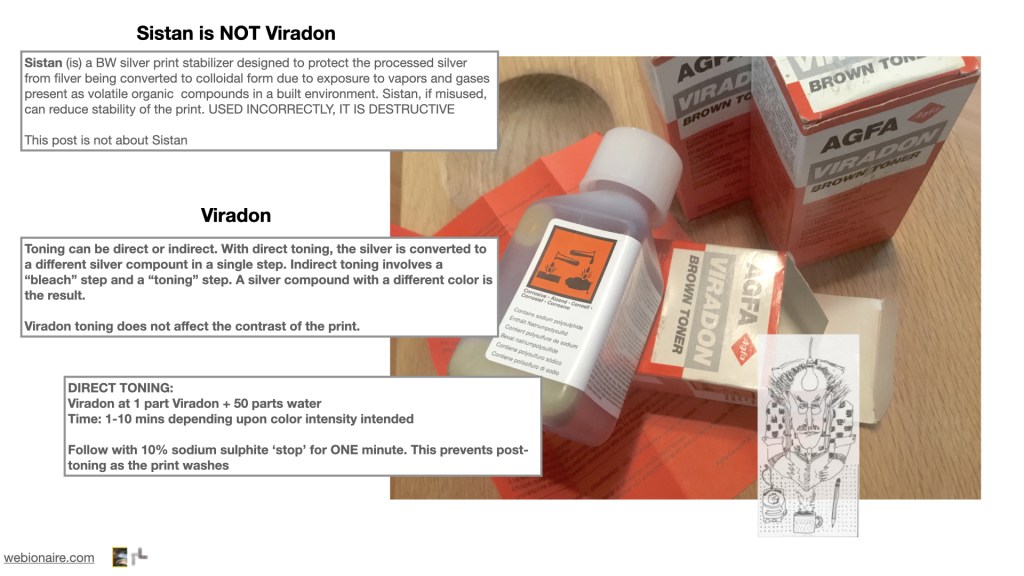
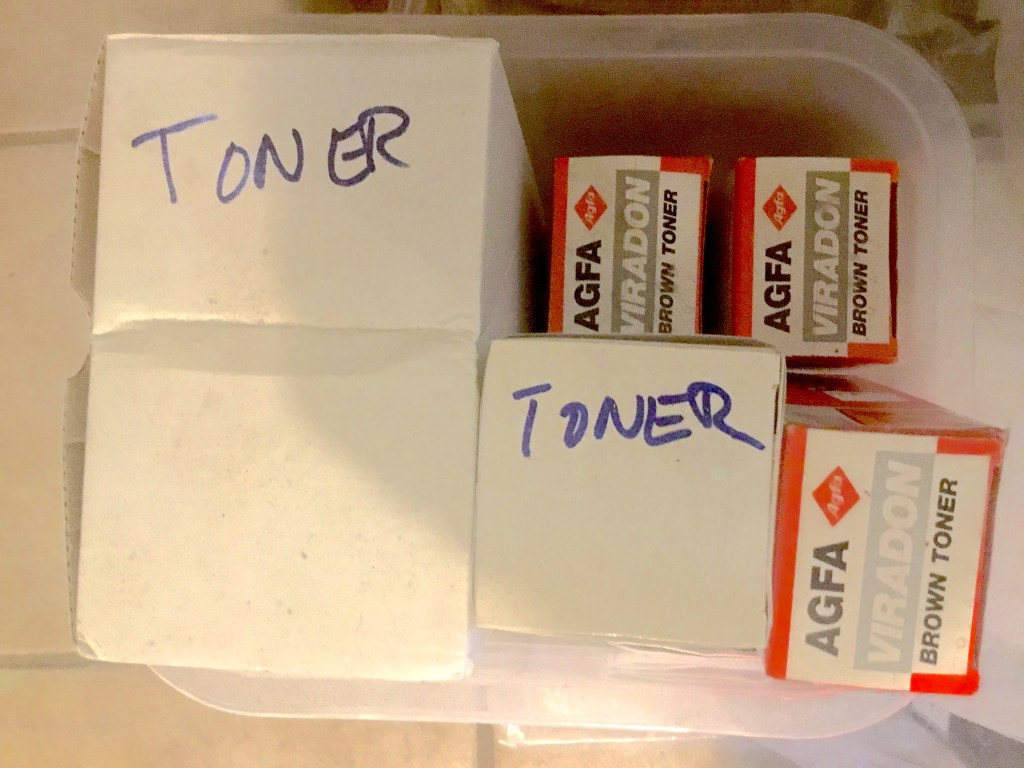
Browntones: Agfa Viradon

The toner concentrate VIRADON is used to modify the tone of a print. The effect depends on toner concentration and composition of the silver image. Since the keeping properties of toned prints are even better, VIRADON can also be used for image stabilization. Dilute 1:24. Immerse print for 2 – 10 minutes. [ online directions]

SDS for Viradon:
Aqueous Alkaline Photochemical Solution containing Sodium Polysulfide [
Smell of hydrogen sulfide (foul smelling)]

Polysulphide toners act on all densities equally, thereby providing color change and protection to the image. The original, 1930s formula included selenium but the later formulas removed that because of environmental impact awareness [2000]. Dilutions of 1+25 Viradon mixed with a working dilution of Selenium toner results in image tones comparable to the original Viradon.  Polysulfide toners work faster as they become exhausted or diluted. This is one reason for using the sulfite “stop” bath before washing. Also, very diluted or mostly exhausted Polysulfide toner can leave an overall yellow or peach-colored stain.

This speeding up of toning means that as you wash the print after toning, the toning increases! To arrest this you can use a 10% solution of Sodium Sulphite; better, use a 2% colution of Kodak Hypo Clearing Agent (HCA).

To assure even toning and ‘stopping’ the print must be agitated immediately upon being put into the solution. This agitation must be continued, otherwise the print will become smoky, or milky. The Viradon will pick this up. It must be filtered, or discarded.


Agfa failed; with that, Viradon went off market[2012]. It was similar to Kodak Polytoner, Kodak Brown toner. None of these are are the market. Kodak’s T8 toner is a substitute that can be made by those with proper skill and workspace:

Water: 750ml
Potassium Sulphide: 7.5g
Sodium Carbonate monohydrate: 2.5g
Water to make: 1 litre
Kodak Rapid Selenium toner and Kodak brown toner can be 
combined to give a single-solution toner which works rapidly 
at room temperature. This combination toner is recommended 
for Kodak warm tone papers.
Kodak Rapid Selenium Toner 17.0 ml 
Kodak Brown Toner 75.0 ml 
Kodalk Balanced Alkali 30.0 grams 
Water to make 1.0 liter 

Tone Prints for 3 minutes at 70F 

Capacity: 80 8x10 prints per gallon 
Replenisher: Selenium Toner diluted 1:5 add 30.0 ml per ten 
8x10 prints 
Capacity with replenisher: 150 8x10 prints per gallon. 

Image Stability, Keeping Quality: Selenium Toner

Lee, Wood, and Drago published a paper in 1984 about the stability properties of a variety of toned images finding that selenium acted well as a protective treatment; however, the Image Permanence Institute at Rochester Institute of Technology investigated the action of selenium, they found that selenium worked well for high density areas (shadows), but did not convert the mid-tones and highlights well. Kodak investigated the problem, finding that field users were having unusually stable prints even though lab tests couldn’t support this field result.

The answer was in the quality of the chemicals used to make the formulations. This is one time where lower quality chemicals (GPR) were acting better than lab grade (AR). The consumer toners contained sodium thiocyanite; the effectiveness of the selenium toner as a image preserver was really because of the active sulphur compounds within the general purpose practical grade chemicals. Most trained archivists know this.

Notes: [IPI]

  • P. Z. Adelstein, James M. Reilly, D. W. Nishimura, and K. M. Cupriks, “Hydrogen Peroxide Test to Evaluate Redox Blemish formation on Processed Microfilm” Journal of Imaging Technology, Vol. 17, No. 3 (June/July 1991), pp. 91–98.
  • James M. Reilly and Kaspars M. Cupriks, Sulfiding Protection for Silver Images. Final Report to the Office of Preservation National Endowment for the Humanities, (March, 1991).
  • Christopher Gmuender, On Black-and-White Paper Image-Stability Enhancement: Effectiveness of Toning Treatments on Silver Gelatin Prints Determined by the Hydrogen Peroxide Fuming Test. MFA Thesis Report, Rochester Institute of Technology, 1992.
  • P. Z. Adelstein, J. M. Reilly, D. W. Nishimura, and C. J. Erbland, “Stability of Cellulose Ester Base Photographic Film” SMPTE Journal (May, 1992), pp. 336–353.
  • Preserving the Illustrated Text. Report of the Joint Task Force on Text and Image (The Commission on Preservation and Access, Washington, DC, 1992.