
There are no silver bullets – except Dektol and D-76
Testing & Testing
I hate to do paper / developer tests. I dread the tasks; won’t even read anyone else’s results, since I do what I do, they aren’t going to make my prints, and I’m not going to make theirs. As a teacher, I had to show while telling… even encouraging some students, those with technical compass heading, to do the detail testing of different constituents of photographic developers. I hated, and regretted, the time spent on technique over reasons, reactions of imagery. But, in the chemical age, students had to fumble through the darkroom.
Why My Change
Since B&H had their shipping failure, coupled with an obvious re-working of their order system, I had to work through my preferences for chemicals, emulsions, vendors – what, where, when I could supply myself. I needed to replace Ilford Warmtone developer, since I bought it from B&H, yet they don’t understand how to read Harman’s SDS.. put a sticker on the box and ship it, even by international passenger air. I could buy from Freestyle – I buy most of my prepared chemistry from them. I have used Fomatol PW developer with Foma papers, but hadn’t tried it with other emulsions.
Emulsion Choice
Conventional wisdom holds that the “emulsion makes the choice” of color – is it warm, cold, or neutral. The size of the silver is fixed by the manufacturers, although, as the emulsion ages, it will shift gradually cooler in color. Emulsions from before 1990 may have included chemistry that sustained the warmth, but they are not used by Ilford, Foma, etc. in current emulsions. Hence, the reason that we are told to use the paper within (2 or 3) years, else it will change hue (going colder), and lose contrast range (lower contrast) Old paper is not the best choice; they don’t get better with age.
Foma Fomatol PW Developer
“Specially formulated positive developer in powder form, preferably designed for the processing of Fomatone MG-line photographic papers. The developer features slower developing kinetic, lower speed utilization and a warm image tone.” foma
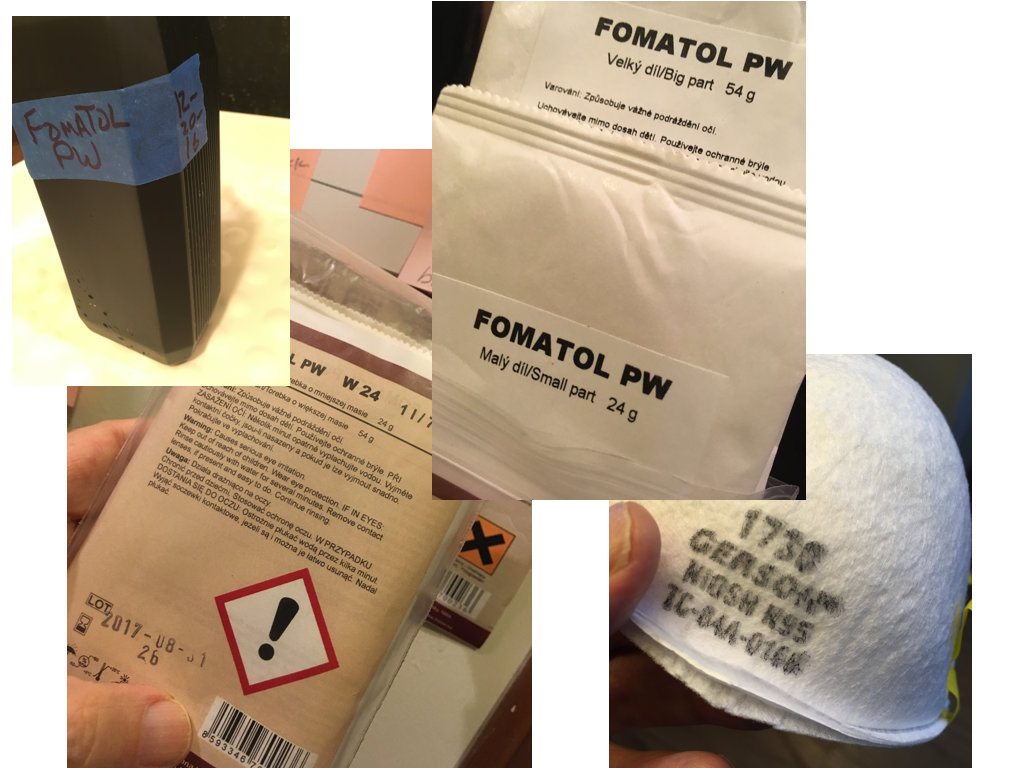
In using so much darkroom chemistry, I have many ‘old’ bottles.. the one in the above illustration, bearing the Fomatol PW blue-tape, is an empty Moersch bottle. I date all my stock chemicals with mix date.
Foma dates their PW; they also include the proper caution (that diamond stamp) — Use dust mask during mixing. The NIOSH N95 means holds back 95% of (standard size) dust, making it more than adequate for mixing dry chemicals such as paper developers. The same should be worn while mixing dektol, or D-76.
Mixing is easy – follow directions… current packages are marked with “Maly/ Small” & “Velky/Big” … Mix using liter graduated plastic beaker… stir with a plastic spatula.. dissolve fully… add water to make one liter of stock.. pour into storage bottle… label .. done [ less than 5 minutes elapsed time from beginning to clean-up ]
I use the stock as working, since it is very slow acting developer; even then, my basic developing time is 5 minutes. The following is adapted from Foma datasheets. Also given

are the R values for Ilford Warmtone, and Seagull VC-VBII Warmtone. The Ilford warmtone is a widely used paper, notice that the R for the Seagull is wider- the contrast range is wider, providing “flatter,” and “harder” contrast than Ilford. The Fomatone is even narrower contrast range… still I love its look, as well as the touch of the paper.
Warm Paper, Warm Developer
Does the developer move the emulsion? Supposedly NO — since I was running some experiments anyway, I decided to test the Seagull paper I had set aside as not being significantly better than Ilford. The following tests compared Dektol + Ilford papers as baseline: Dektol at 1+1, and Ilford Multigrade FB Classic

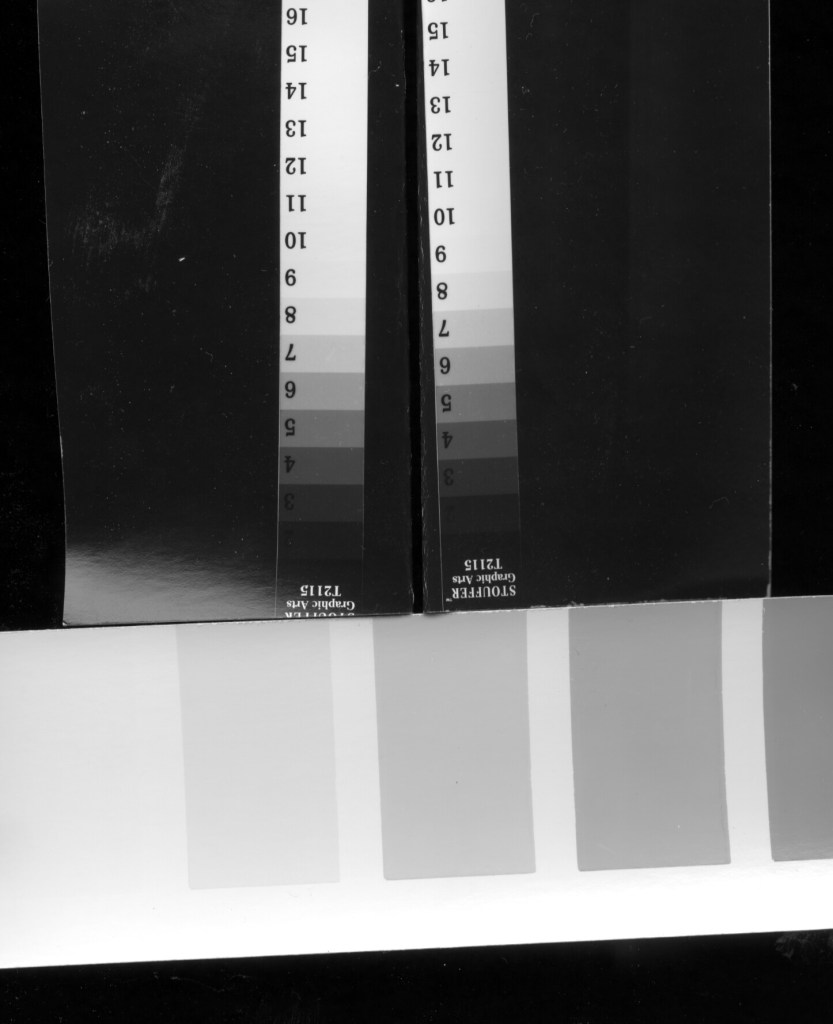
The 3 scans: [A] is the tests grouped into stacks by developer (dektol, Moersch SE1 Sepia, Fomatol PW) [B] is Ilford Classic, Ilford Warmtone, Fomatone 131 comparison. [C} compares Ilford Wamtone, Fomatone 131, Oriental Warmtone in Fomatol PW developer.
[C} is the reveal – Oriental warmtone in Fomatol PW is a very strong warmtone paper; much warmer than Ilford Warmtone.
These tests confirm the old adage, and break it. Ilford papers stick to their label. They change less than other papers with a change in developer. The Oriental Warmtone changed so much it is now my preferred paper for warmtone prints replacing Ilford Warmtone. All because B&H hiccuped causing me to search my cupboard.
The downside of this developer is its activity. It is S L O W to come up, reminding me of lith times. It also loses paper speed. Oriental Warmtone + Dektol vs. OWT + FPW is a 3 stop difference in the enlarger. For very large prints, this could probably spell problem, with the time going into minutes; however, with my setup and standard sizes it moves my times up to around 48 seconds… reasonable in my process.
Why Of Silver Tones
Warmtone / coldtone — advance recede. Cultural inclination, taste — preferred acceptance … more on the [secret page]


You must be logged in to post a comment.