notes from the Dichroic Age

Those abbreviations were short for something. Abbreviations, mnemonic notations meant something, more to some than to others. I don’t know that they have much carryover into this century, probably not for the future decades– the age of emitters.

Filters aren’t masks. Filters block light; colored filters block some light and pass other light from the beam — the light path. So, what color does a filter pass? What color do you see? That is the color it passes.

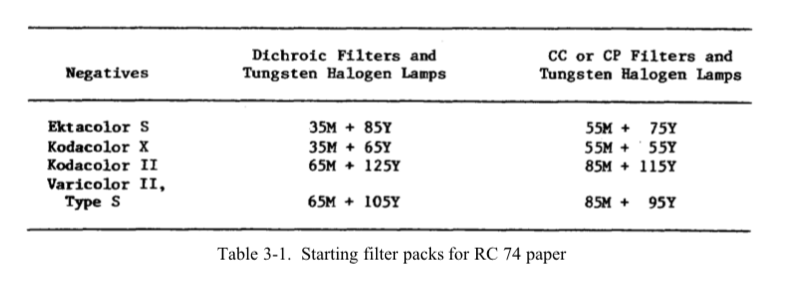
filter nomenclature such as CC 10Y means “color correction .10 units of yellow.” CP meant color printing filter. CPs went between light and lens, CCs could go in focus path, not only in light path.

10 is a low value, not the lowest, but a low common use amount. Filters came in simple (primary) and compound (secondary) colors. In the land of dichroic, meaning color heads, there are 3 dials — for the secondary (subtractive primaries) of yellow, magenta, and cyan. That number is a reference to the amount of light absorbed. The higher the value, the more light is absorbed. the 10s are third stop changes. A 30 filter absorbs half its complimentary color by one stop (halves the amount).

[ CC values are calculated log d x 100: 10cc is 0.1 log d or 1/3 stop. 15CC is a half stop. 30CC is a full stop]

FilterApprox Peak Transmission
05 (CC05Y)89%0.05
1079%0.10
2063%0.20
3050%0.30
4040%0.40
5032%0.50

Printing color negatives (those orange pieces of film) use the (m)agenta and (y)ellow filters. The cyan filter entered the pack if printing “reversal” direct positives (type Rs, cibas, or dupe films)

  • filter density affects exposure (gels).
  • the amount of correction isn’t the same for each color. 10cc yellow only needs 2% more exposure. 10cc magenta needs almost 10%
  • color emulsions have multiple layers of ‘tuned’ sensitivities — they are subject to reciprocity failures — exposure times from 5 to 40 seconds are best.
  • the “digital C” papers are best exposed less than 15 seconds.

voltage stabilizers (regulators) were standard lab equipment — as enlargers became more sophisticated, their power supplies contained the regulated voltage.

voltage fluctuations caused color balance changes; also shortened bulb life.

I continue to use UV and IR filters in light path, and a regulators.
If the borders are not ‘white’ then you have stain or fog.

–Cyan probably is chemical stain; yellow is age fog. Tape is the diagnostic tool — waterproof surgical tape. Think about it.
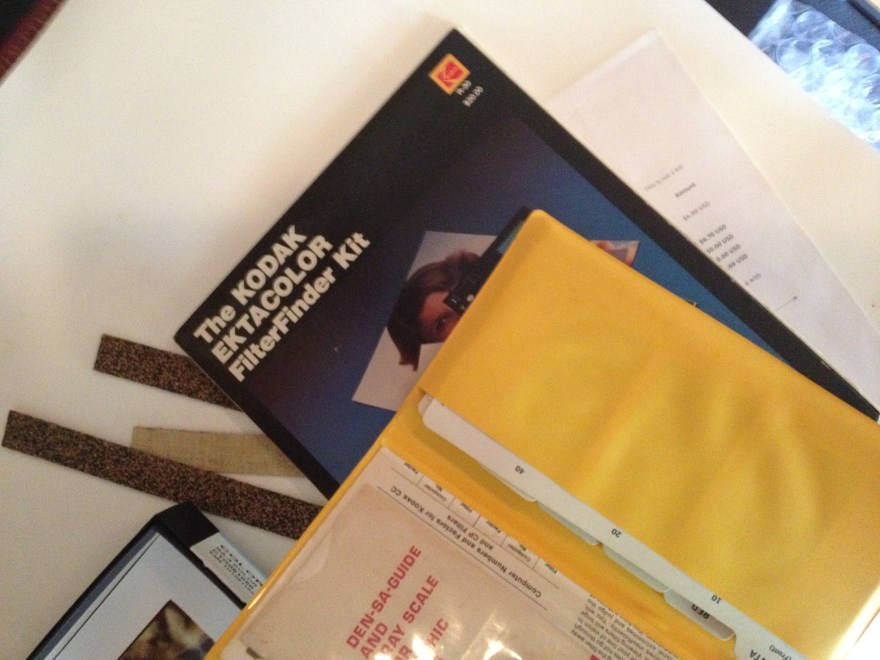
More [Kodak]:

  • Kodak Ektacolor Filter finder Kit, R-30
  • Kodak Color Print Viewing Filter Kit, R-25
  • Retouching Color Negatives, E-71
  • Color Photographic Processing
  • How to process color prints in tubes
  • How to process color negatives using process C-41
  • Finishing Prints on Kodak Water-Resistant Papers, E-67
  • Printing Color Negatives, E-66

Type R = Reversal notes

patents about reversal processes. emulsions and chemistry. covering several foundation concepts including Solarization.

knowledge from the phone-booth

stuff you hear, again and again — stuff that just makes sense. Usually about something you don’t fully understand; usually said by someone seemingly making it all clear. Like butter, clarified, purified, ever so easy to swallow.

grain size is color: AgX — true wisdom. At least, often heard. Does this explain the lith-print color? Does developing BW (silver gelatin) paper shorter or longer make the silver image tone (color) different? If it does, why did, do, the manufacturers have so many different emulsions? Why hasn’t any of them just sold: Vario Tone, the variable color easy tone printing paper? Seems they missed the market on this one, big time.

All those PhDs, MBAs — just shanked it, wide and short. Didn’t they oh genius forumatti

They could have made one paper, one developer with a direction sheet of time & colortone wanted. Too bad for them they never figured that one out… maybe they know something the forumatti don’t.

All this about lith-prints. Different developer makeup affects AgX prints some — lith developer and methods emphasize these differences. A simple simon explanation seems more correct than none, so it sparks acceptance — no one will review it — none of the forumatti explore any feature well or fully. They repeat, they don’t discover. They play in a phone-booth.

“The optical properties of silver nanoparticles change when particles aggregate and the conduction electrons near each particle surface become delocalized and are shared amongst neighbouring particles.”

“As to small particles, it’s basically the black-body principle. No material is perfectly reflective, so the more reflections a light ray undergoes, the more attenuation occurs. A pile of tiny particles essentially acts as a “light trap.” ” — an internetter

“The color tone of black and white developed images not only depends on the photographic materials used but also on the grain size, grain thickness, grain structure, grain surface and reflecting power of the developed silver.” — patent, emulsion maker

Credible References:

Research Disclosure Item 29963, March 1989; Photographic Science & Engineering, Vol 7, No. 2 “Observation on fine structure of developed silver in the presence of added tone modifiers”; C.E.K. Mees, The Theory of the Photographic Process, 1st Edition, p. 568, The Macmillan Co.,New York; and A. Rott & E. Weide, Photographic silver halide diffusion processes, pp 61-65, 1972.

AND

The tight packing of chemically developed filamentary silver ensures the spectral neutrality of this type of silver image and the black color thus appears to be due to multiple scattering and absorption of tight. James and Vanselow, in Photographic Science & Engineering, Vol. 1 No. 3, January 1958, “The Influence of the Development Mechanism on the Color and Morphology of Developed Silver” showed that the greater the extent of physical development, the less black was the silver image, the color usually passing to a brownish hue.

How much can, does this change? You can make warmtone paper warmer, and coldtone colder. You will not get a warmtone look from a coldtone paper by developing longer, shorter, hotter, colder, standing up, or sitting down. Change paper.

But what about the lith effect? We will never get the original lith print — that paper and developer are long gone — back when lithographers stopped needing it.

I miss the Itek Print — never expect it to return.

We can cause many current BW papers to “coarsen,” “pepper,” “shift colors,” with lith-style developers. Much of the color tones are a result of “residual” effects — what the chemists say about exhaustion products. For added color effects, just add silver solvents — small amounts. See what swirls up in the fix.

The major factor of making lith-prints is choice of Paper, then choice of Developer, not how long the paper is in the developer.