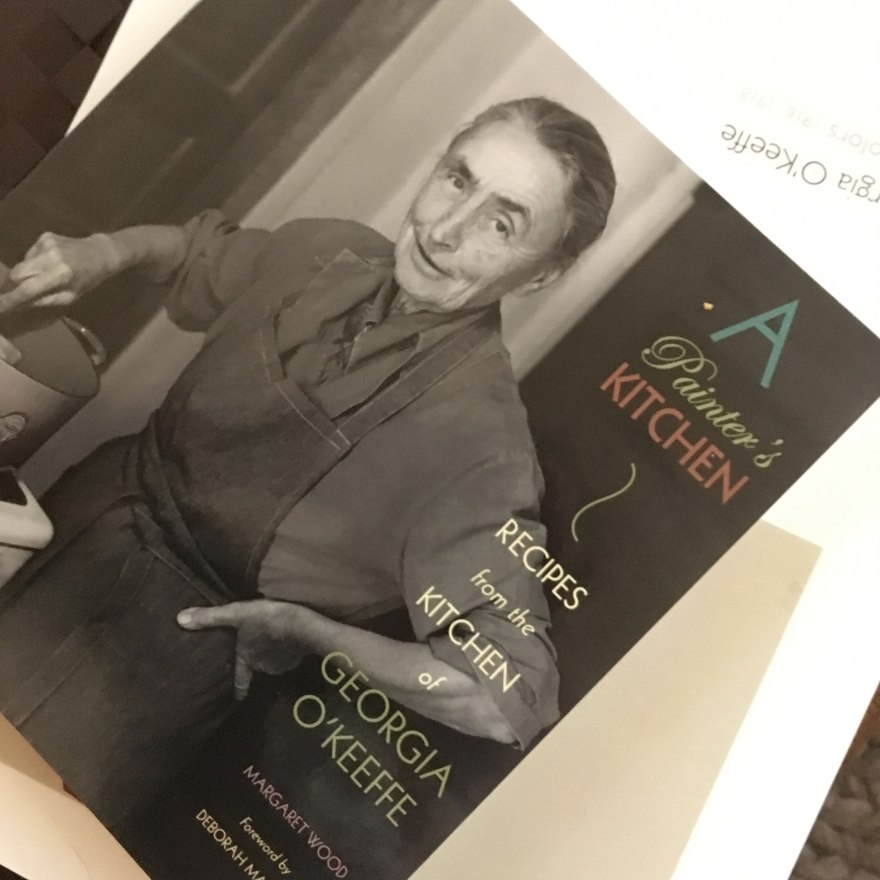
A Painter’s Kitchen: Recipes from the Kitchen of Georgia O’Keeffe Paperback use pre formatted date that complies with legal requirement from media matrix – August 16, 2009 by Margaret Wood
O’Keefe on cooking is one of the funniest ‘cook books’ ever. Not intentionally, I think, but it is in its content. The recipes are spartan, and often leaving much more to the imagination and ingenuity of the cook than most cookbooks. This is certainly not an escoffier, nor a Betty Crocker mannered book. None of the books of my previous post on artist cookbooks is as open ended. I suspect this is a revelation of lifestyle as well as art ages. Perhaps it is a revelation of the mind of this particular artist.
A Recipe (of Life?)
choose several fresh leaves, those of best size. season to taste.
And So
I think that all actions of a creative person have pathways in common with their aesthetic path.
Many paths up the same mountain.
The recipe replaces the ingredients. The fewer ingredients the better they must be, to satisfy the diner. Most seasonings are elements that consume the ingredient, the main content of the dish, covering its taste with reciped flavor – taste made standard.
This kitchen book, I choose to call it that instead of ‘cookbook,’ leaves much to the kitchen of the reader-preparer, as does the best of art- art that lives within your aesthetic life.
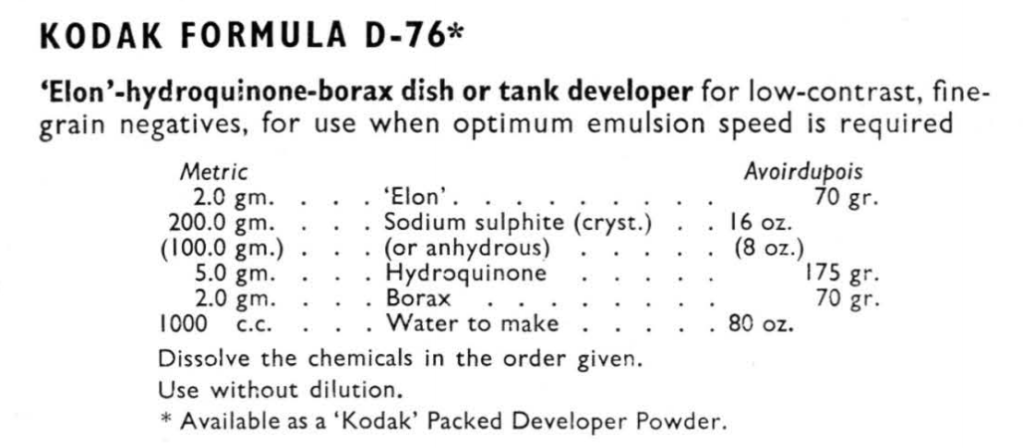
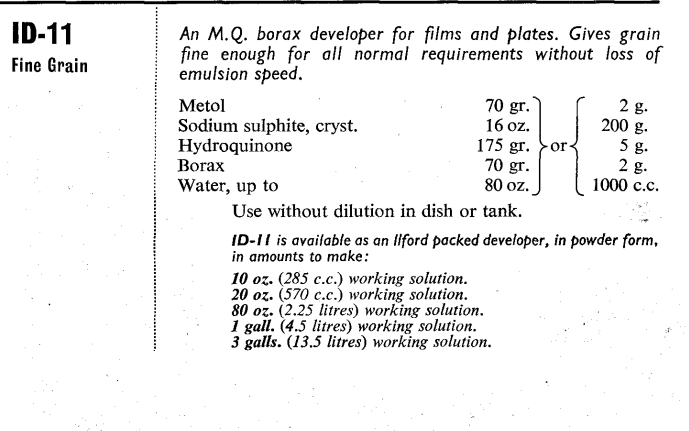
Widely held belief: D-76 changes differently than other developers; sometimes changing activity without warning. This makes it a developer of doubtful performance among many camera counter experts, who direct the new darkroom photographer to a different developer. [needlessly]
Is it true? How true? What happens when mixing the developer? Do you have to wait a week before using? What makes the developer last?
All HQ containing developers have a small pH shift in the first few hours of mixing. The pH goes up, then down, due to oxidation of HQ, formation of the sulfonate salt of the quinone, and release of Sodium Hydroxide.
The chemical that causes the changes is a main player in most developer formulations before 1970; this includes Dektol (D-72). HQ (hydroquinone) reacts with oxygen producing quinone, which in turn reacts with sodium sulfite (in the developer) making HQ-mono sulfonate and hydroxide; this is the cause of the slight pH raise. This very slight pH increase results in a slight increase in activity of the developer (it develops more). However, there is also a loss in HQ which lowers the effect.
Where does the oxygen come from: initially, from the mixing water. Later, it comes from storage, and from tray or tank agitation.
How long does the ‘stabilizing’ of pH take? Depends upon your water and mixing vigor, but not longer than 4 hours before the pH stops changing. Definitely not weeks. Mix in the morning, use in the evening. HQ developers, as they age(ripen) in a replenished (re-use) system also produce sulfonate, and release Sodium Hydroxide. That action is what makes these type of developers “non self-replenishing” — you must use a Replenisher formula. Unless you are souping hundreds of rolls, sheets of film, one-shot is a real world solution.
Once again take care of oft heard advice, even from established workshop instructors: “As D-76 ages a chemical compound, hydroquinone monosulfonate, is formed. This chemical compound will INCREASE the activity of the developer and the contrast of your negatives in a big way with T-MAX. ” — Sexton.
From another vantage point: storage of D-76 type developers affects ‘graininess’ of Tri-X (from 1968) Rarely did this alter the contrast or speed of the venerable old lady, much to the chagrin of labs hunting magic bullets. They did, however, alter D-76 packaged developers with an additive: for each liter of D-76, add 8 grams Sodium Carbonate (anhy) and 3.6 grams of Sodium Bisulfite. pH will be 8.6 at 70F.
Kodak’s 2003 • CIS-61 gives the pH as 8.5 +/1 0.05 at 77F, which is the same pH as T-MAX RS. XTOL should be 8.2.
Mix from the bottom: this reduces aeration of the chems.
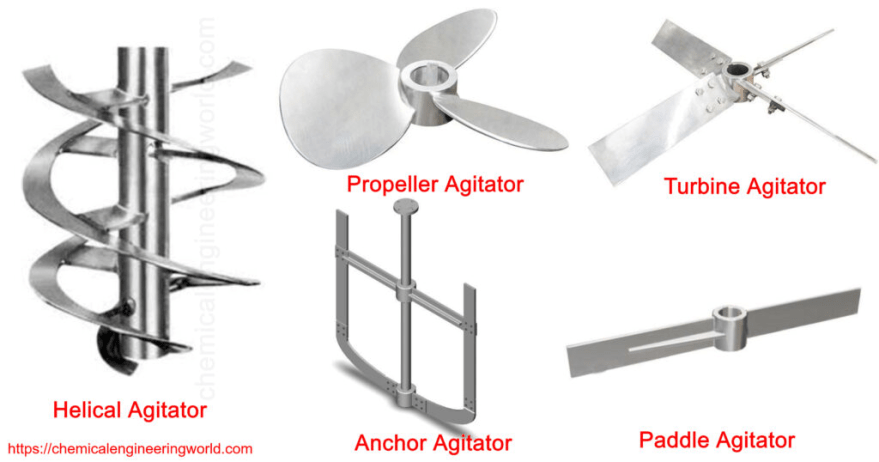
chemistry propellers… as an idea. Magnetic mixers mix from the bottom. They should be a first choice for the small volume (under a gallon) user.
Better advice:
comment is technically incorrect. HQMS is lower in activity, but it produces a byproduct of Sodium Hydroxide as it is formed. This causes the rise in pH.
One way to check D-76 is to measure the pH 1 day after mixing. Prior to use, re-measure the pH. If it is higher or lower by more than say 0.2 units, do not use it, discard.
Refs:
Haist, G., Modern Photographic Processing. Vol. I. 1979
James, T.H. and G.C. Higgins, Fundamentals of Photographic Theory, 1960
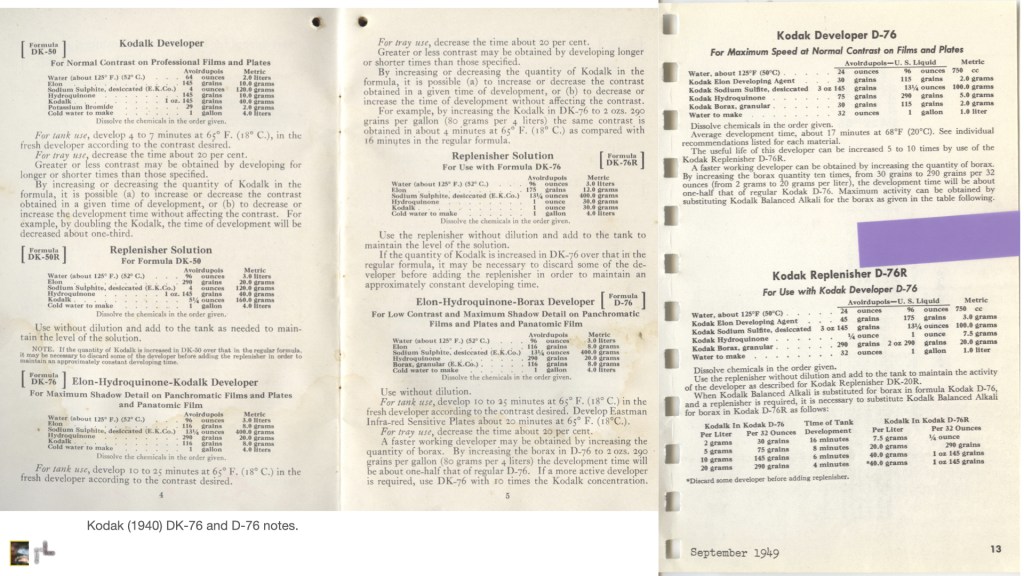
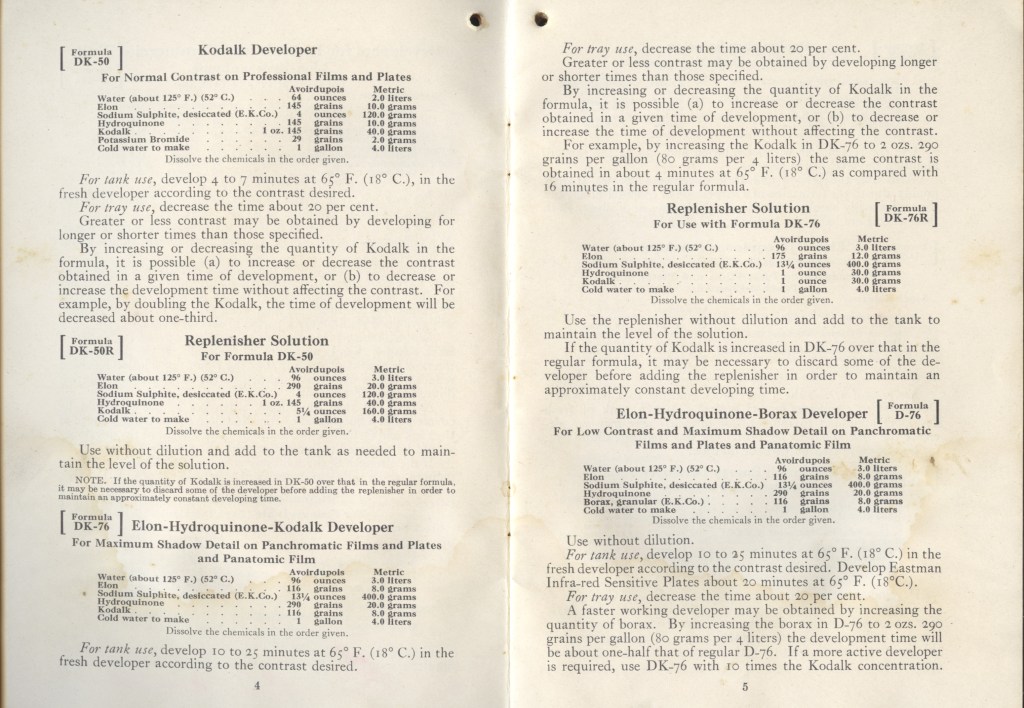
Kodak D-76 replenisherIf using a replenished line, or processing large volumes of film, consider using DK-50. It lasts.
control of agitation is essential.
— the initial agitation being the most important contrast control .
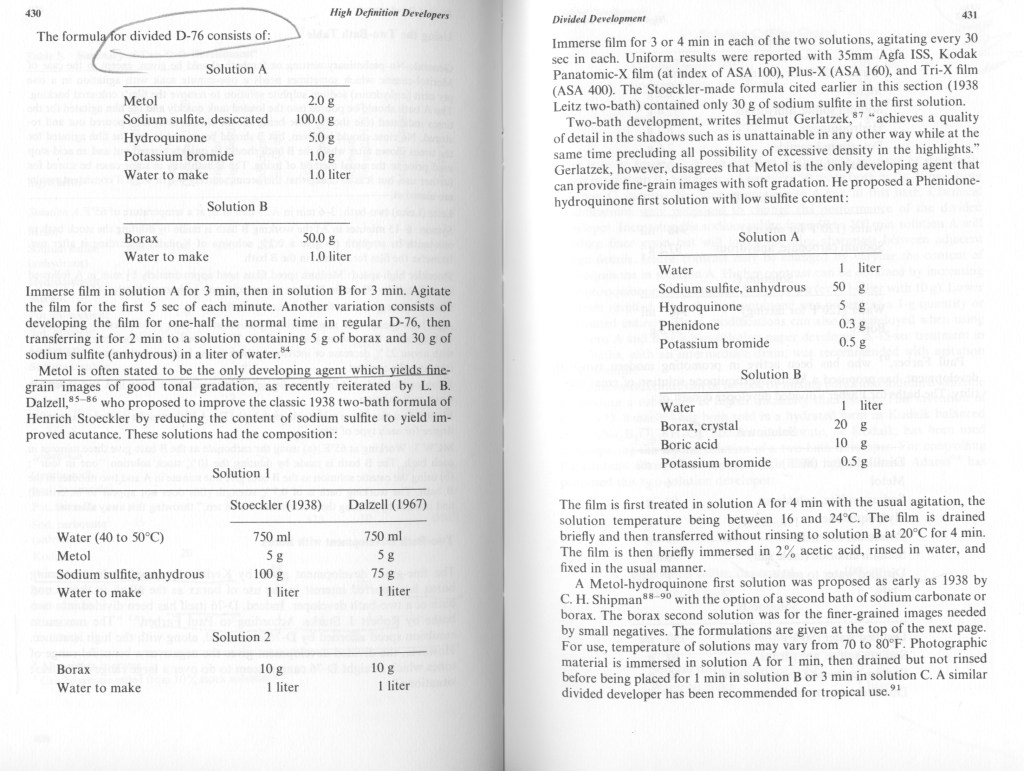
read the highlighted passage
Kodak Kodalk Developers — the “K” in DK
Divided Developers
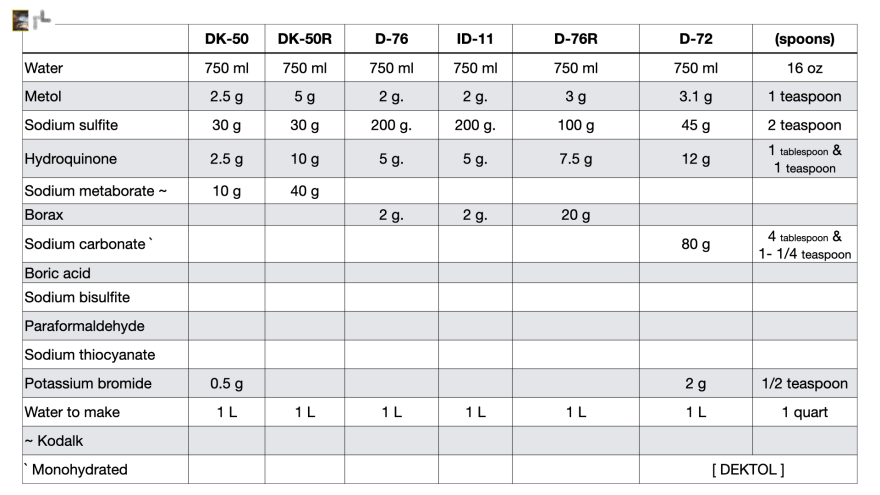
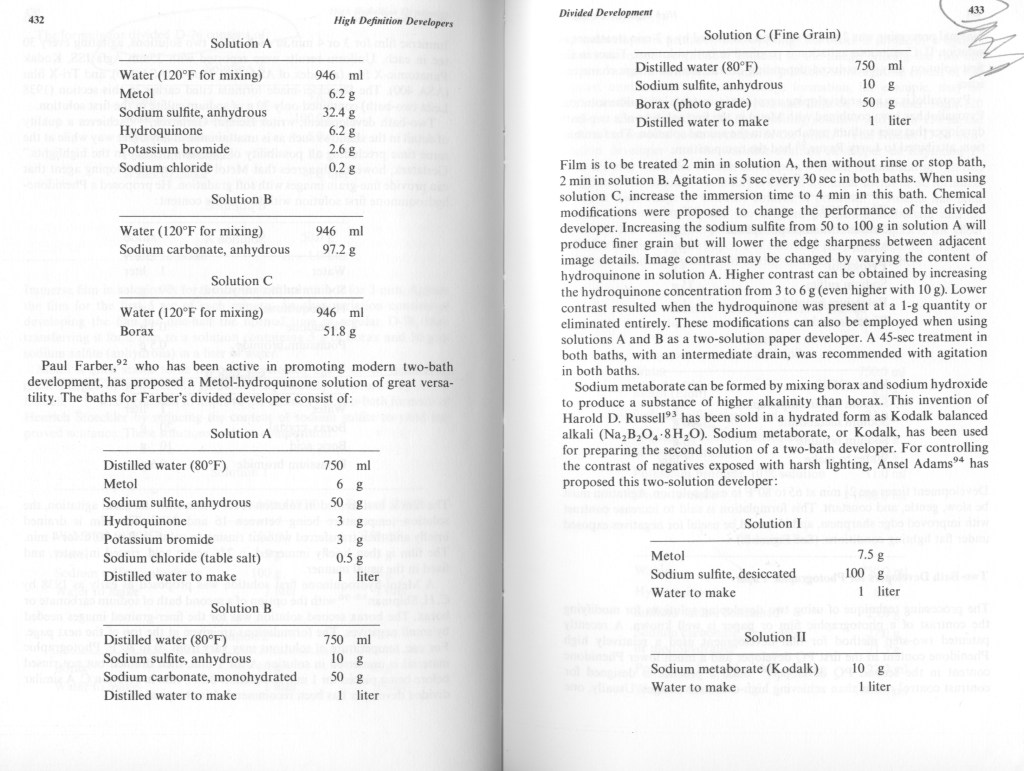
Turn D-76 into a divided, two-step, developer. Solution B is borax. This is a good procedure for other developers even off the shelf ones. Kodak’s Kodalk was sodium metaborate which has higher alkalinity than borax. This form of bath ‘B’ is a great benefit in controlling (compensating) for hard (high contrast) subject lighting. See the above page copies for specific formulas.
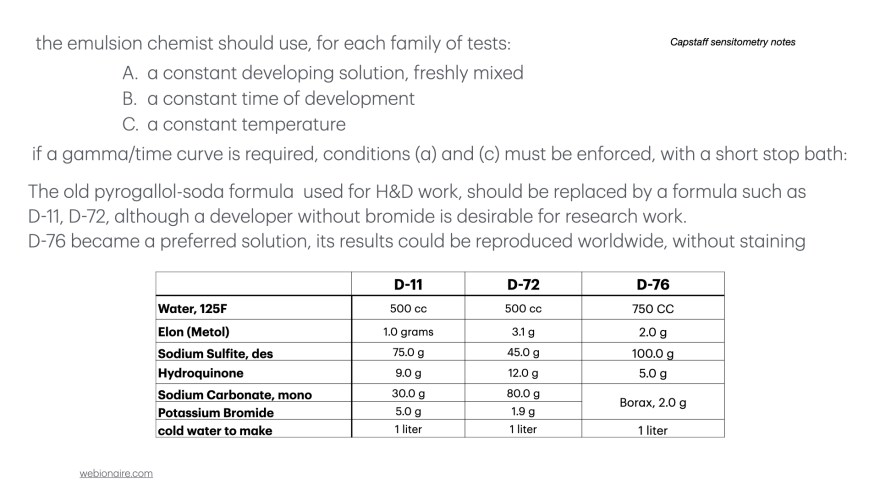
How bout Pyro: it was used for years in emulsion research labs until results couldn’t be reproduced among labs. Enter a Capstaff answer. (along with a summary)

 A Painter’s Kitchen: Recipes from the Kitchen of Georgia O’Keeffe Paperback use pre formatted date that complies with legal requirement from media matrix – August 16, 2009 by Margaret Wood



You must be logged in to post a comment.