
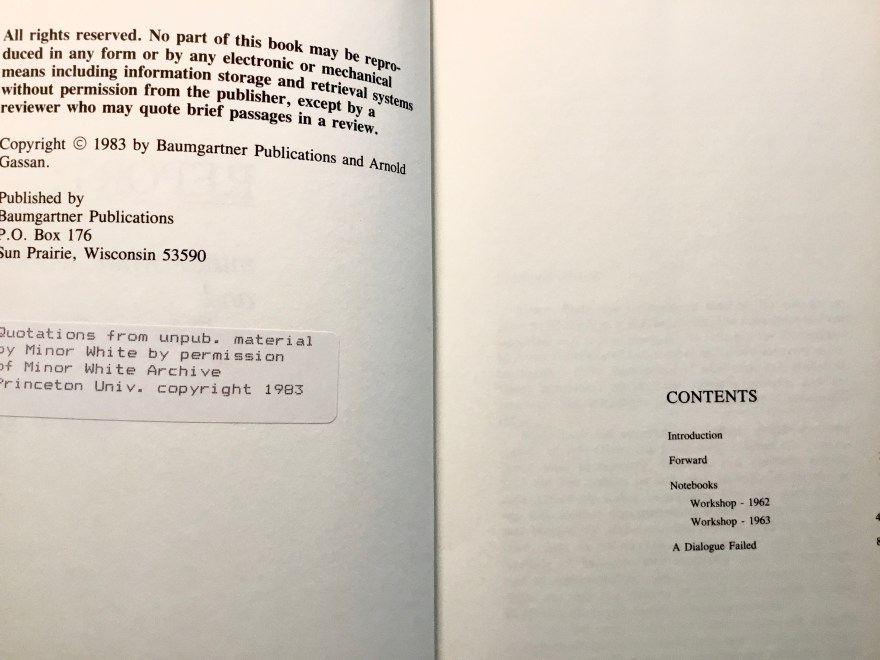
following up with more Camera Lucida matters. The final Journal was by Arnold Gassan. Arnold Gassan (1930-2001) was an American photographer, author, and psychologist. Gassan became a licensed psychologist in Arizona in 1991.
- books written by Gassan include: A Chronology of Photography (1972)
- The Color Print Book: A Survey of Contemporary Color Photographic Print Making Methods for the Creative Photographer
- Handbook for Contemporary Photography
- Exploring Black and White Photography (1989).
“The materials of art have always influenced the image” –Arnold Gassan
Notes from: “Technique could be learned alone to a large degree, Understanding needed outside assistance.. ” … “while reading Ludwig Wittgenstine: The Man and His Philosophy, that I encounterd this description which made clear to me my hesitancy about Newhall’s book: “In teaching you.. I’m like a guide showig you how to fid your way round. London .. At the end … you will know London. Of course a good guide will take you through the important streets ...”
aperture:
- Vol 5, #4, White and chappell, “Some Methods for Experiencing Photographs.”
- Vol. 7, #2, “The Way Through Camera Work.”
- Vol. 9, #4, “The Idea of the Workshop in Photography.”
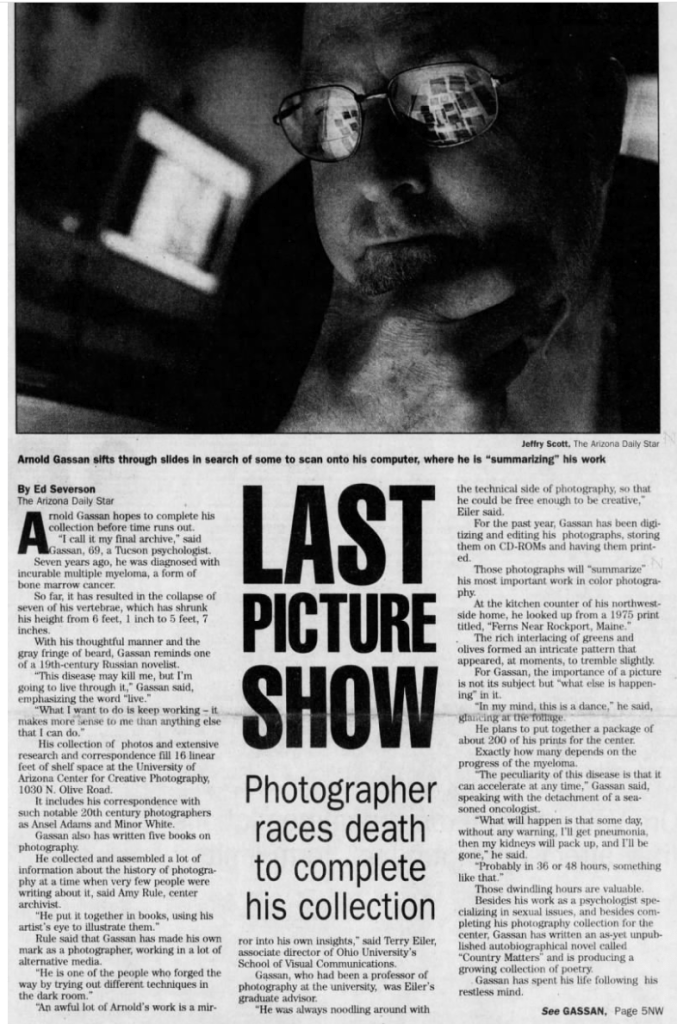
little remains of the details of his life… this is one small item. His effort to finish archiving his photographs in last years. The scanner was his tool at his end.
“I am not especially interested in anonymous photography, or pictorialist photography, or avant-garde photography, or in straight, crooked or any other subspecific category of photography; I am interested in the entire, indivisible, hairy beast — because in the real world, where photographs are made, these subspecies, or races, interbreed shamelessly and continually.” — John Szarkwoski
Other biblio materials [of use for “Gestus”]
- Boleslavski, Acting, the First Six Lessons
- Gurdjieff, All and Everything
- Herrigel, Zen and the Art of Archery
- Maxlow, Toward a Psychology of Being
- Ornstein, The Natrue of Huan Consciousness, and The Psychology of Concsiousness
- Ouspenski, In Search of the Miraculouos
- Persl, Gestalt Therapy,
- Colin Wilson, The Occult.


You must be logged in to post a comment.