camera lucida duet 

The real and the spiel.
The Joycean eyepatch–of AI. What finds we find when the word becomes the key. What hides behind the unopened doors. My searches begin closed, become openings. Sadly, the googs and googlers have reached an end state: commerce.

All travel makes more connections than we are prepared to take. Words become phrases which, in turn produce more phrases. In early periods of a field more variety is brought in as possible sets for the new setting.

Camera Lucida was one set. Visual Studies Workshop was a fertile ground. Consider the words chosen as totems for that new place in Rochester. Visual. Studies. Workshop. It could have been called: SUNY Buffalo Extension. No sauce. Nathan got it right. From that place came people. They maintained contacts as is the case in most fields. In new fields, those connections are stronger than in old fields.

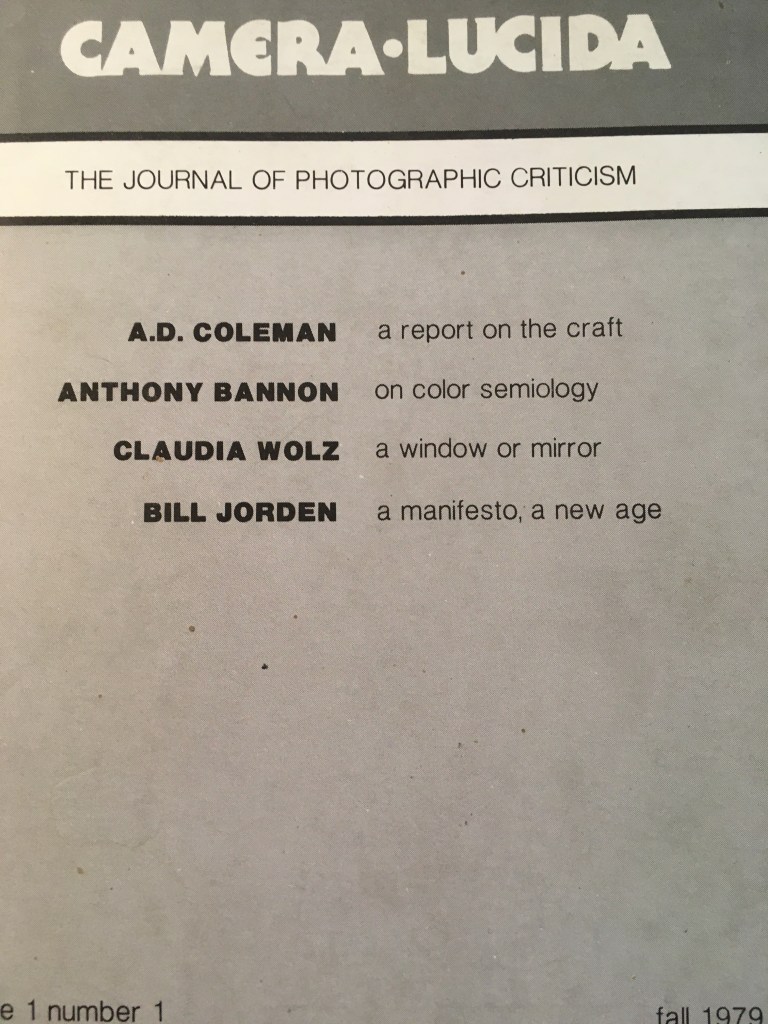
Camera Lucida, a device, book, journal. The camera lucida was a drawing aid with which Talbot failed. This failure became the path of photography. The book by Barthe became the errant irritant in criticism, producing more puss than pearl. Nevertheless, it was productive of thought when it was needed.
Barthes’s Work: Barthes’s “Camera Lucida” explores the nature of photography, the relationship between the photographer and the spectator, and the concept of the “punctum” (a specific detail in a photograph that evokes a strong emotional response). 

Further:

Talbot –dated his efforts to invent photography to his disappointing results using a Camera Lucida as a drawing aid at Lake Como in Italy in 1833?
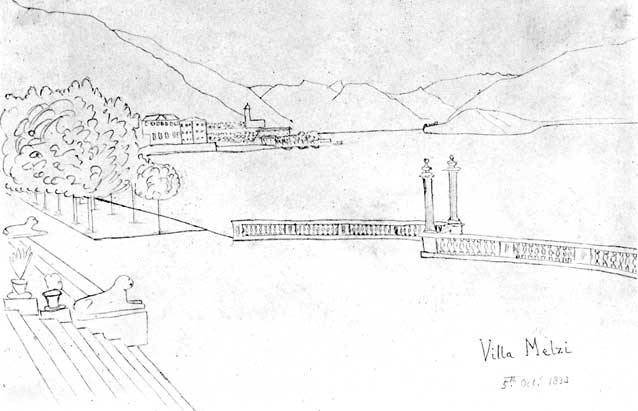
But alas, it only seemed simple, he later recalled, “for when the eye was removed from the prism—in which all looked beautiful—I found that the faithless pencil had only left traces on the paper melancholy to behold.” The would-be artist was William Henry Fox Talbot (1800–1877)

Bringing me to my searched items. The Journal of… I have the volumes. They’ve lived in boxes of similar sized publications.

MUFFOLETTO, ROBERT, EDITOR Milwaukee: Camera Lucida, 1979. Milwaukee.
Ceased publishing after Number 7, 1983
A complete set (Nos. 1-7) of the influential early journal of photographic criticism. Contributors include A. D. Coleman, Claudia Wolz, Bill Jorden, and Michael Simon, and topics include photography and therapy, an anthropology of photography, perception and photography, and more. The last issue is a double number written by Arnold Gassan, a photography instructor turned psychiatrist and student/devotee of White. It is titled, “Report: Minor White Workshops and a Dialogue Failed.” Date: 1979. Baumgartner [US]

The box traveled on its own.. Buying from dead critics photographers estates and the oughts of this century I both discover and re-discover influences if not on me directly on the world around me the immediate world of art of the dark-room entering the white room…

phrases I uttered that others published.. The world that lasts is always the world that someone else collects you need a collector an editor a publisher.. so that what you say and what you have selected is preserved by someone on some shelf…

Two parts to an ides:

  • inspriation, first idea, an initial question which may come as a doubt.
  • next, the reason for re-examination and the resulting drive


“Is history not simply that time when we were not born?” writes Roland Barthes in the very beginning of the second chapter of his book — Camera Lucida. I

In Frank’s West

Cover to uncover… picture making method. Meaning within the frame. Understanding what comes from beyond the frame.

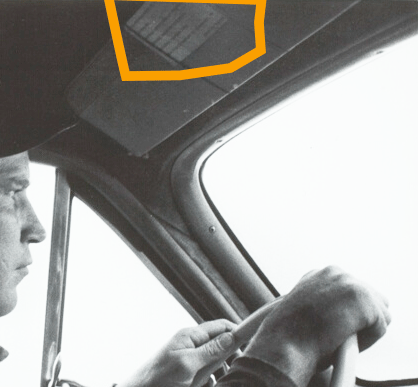
US 91, Leaving Blackfoot Idaho shows two young men picked up by the photographer. Though the men seem intently focussed on the road, the car windows are blank. A text by the English philosopher and statesman Francis Bacon is in the visor; this Frank had copied down when he visited Dorothea Lange before he set off on his journey to find the heart of America.

one aspect of “reading” for understanding is in your covering items contained within the frame… What is lost

in this instance, it is very difficult to understand the text — it cannot be read .. it is mere squiggle. What would it be?

We have to leave the frame for the content..

That text reads: ‘The contemplation of things as they are/without error or confusion/without substitution or imposture/is in itself a nobler thing/than a whole harvest of invention.’

https://www.artic.edu/artworks/87174/u-s-91-leaving-blackfoot-idaho

For the second half of Dorothea Lange’s life, that quotation from the English philosopher Francis Bacon occupied space within her day. She pinned a printout of those words on her darkroom door in 1933. It remained there until she died, at 70, in 1965 — three months before her first retrospective opened at the Museum of Modern Art in New York .

Referenced in publications

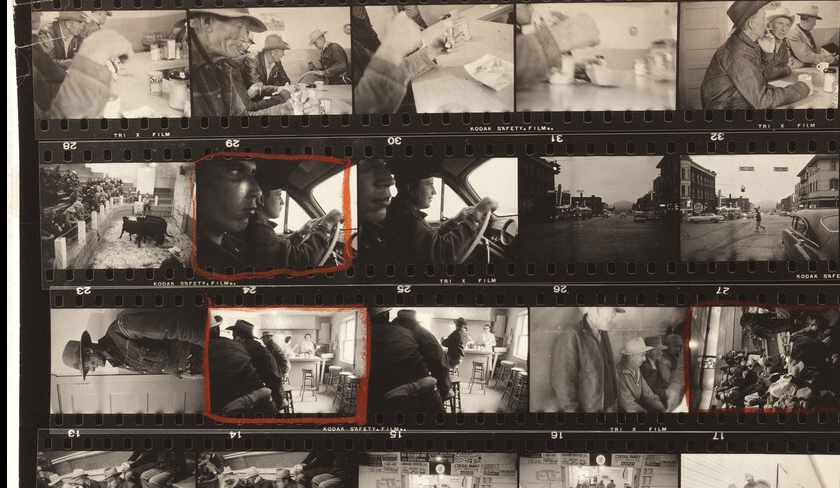
proof sheet: https://www.nga.gov/collection/art-object-page.78965.html

2 possible frames … chose the one without the space between the figures.

same configuration choice in next row of grouped figures.. make the group of one blob.. cluster into single tone pack

Robert Frank’s book, The Americans, is divided into 4 sections. Flags mark the divisions of the book.

  • Flag blowing.. Parade, 1955.. two people “looking” out of windows (First Chapter)
  • Flag hanging over stripe shirt, and… Fourth of July, Jay, New York.
  • Flag as shade… Backyard, Venice West, California.. just two pages after Bar, Detroit.
  • Tuba player… 1956, Political Rally, Chicago (Fourth Chapter)

Robert Frank (b. 1924) traveled across the United States to photograph, as he wrote, “the kind of civilization born here and spreading elsewhere.” During his nine-month journey, he took 767 rolls of film (more than 27,000 images) and made more than 1,000 work prints. He then spent a year editing, selecting, and sequencing the photographs, linking them thematically, conceptually, formally, emotionally, and linguistically. https://www.sfmoma.org/press/release/sfmoma-presents-looking-in-robert-franks-the-amer/

Read Your own Meter

Do I owe you an answer — instruction — dye transfer lab procedures. How about gossip from the past. What are you owed.. what is your google query worth?

Since I was an experienced professional color printer, am i obliged to answer your questions?

why?

why should i have kept 40 years of files, lab notes, correspondence… you ask me to show-tell, share gossip… what qualifies you to hear the answers? what makes you think you deserve answers; my knowledge, experience, effort. People on internet forum quests take 5 years to collect answers that are included in the directions for the film. These same people bemoan the death of process and product they never used. So much for market awareness at the crowded corner.

do you think you are that interesting…  

worthwhile people have made their way… and in much less time than 20 years.

ask me a question

First, one for you: do i have to answer… after all, i ran dye transfer labs, taught college classes; even more, i made specialty equipment.. don’t i owe you answers to your lazy boy questions?

most of the always amateurs have expended great effort filling out their excuses card… more time than they ever did on the action card… gossip lacks guts.

suppose you have a choice. suppose you have an encounter between two different people 

One of them has made more effort to learn than the other 

One of them thinks you owe them, the other doesn’t 

which of them do you want to give away a portion of your life .. that’s what teaching someone something is: giving away a part of your life.


why do I have to give up my life just to satisfy  your lackadaisical approach to learning … The big secret to learning to boil eggs… don’t fear the stove. make your own errors. don’t spend your life asking others — ask the water.

repair isn’t growth

The hobby of buying repairing and selling occupies the fingers .. satisfies your contribution to commerce, but exactly how creative is that …


Potter Stewart: i’ll know it when i see it.  [Potter Stewart (January 23, 1915 – December 7, 1985) was an American lawyer and judge who was an associate justice of the United States Supreme Court from 1958 to 1981.]