
Products fail by being used as merit badges, marks of distinction, instead of making art. With the online photoworld, it is enough to say you do, then hide behind a ready alibi. “You can’t see it on the web, it is too analog perfect to be digitized.” They abhor “art-speak” as they engage, mostly in “craft-speak.”
Parrots don’t print. They hate artspeak. They love craftspeak
The market for dye transfer Materials is nonexistent . it is a fantasy . they transfer materials must be made for someone who is using them intently consistently . The firms which can coat Silver sensitive Materials are reducing their small capacity or closing it completely . In 2010 there were several times more coaters than are available now . In the US, of the three firms that could’ve coded Silver sensitive emulsion, two have left that market . Both of those locations coat emulsions for dry lab photography .
For most of the 21st century dye transfer has existed as a small scale competitive conversation transacted online . very little of the discussion has involved experience based opinion .
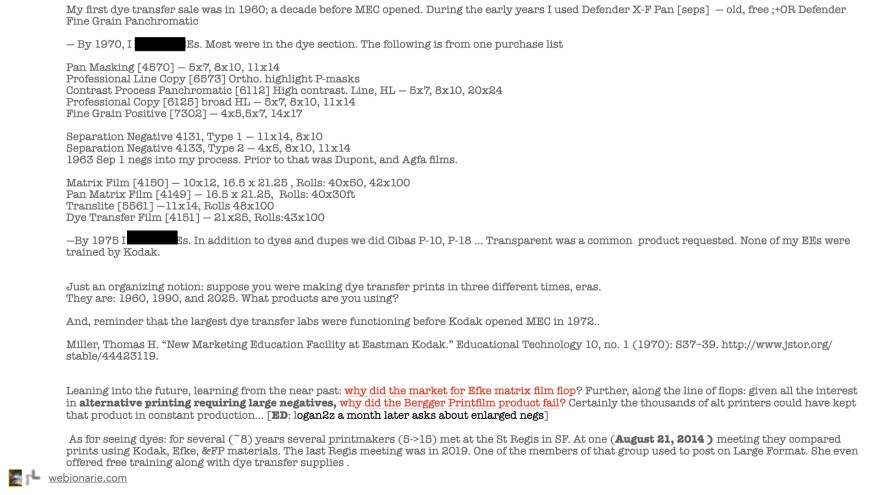
— example order from Pickle Alley days.
Why didn’t another able coater supply a version of matrix film to the still hungry marketplace after FK’s collapse? Certainly there were coaters with excess capacity along with the ability to formulate their version of the open source Browning/formulation. Even the clamor among the alt-print world for silver solutions to the “make it bigger” topic will not support a lab film. Digital negs rule, even among the darkroom adherents. Oddly, even after many complain about the inferior negatives produced using inkjet / overhead film workflow.

The question ONEIDA posed was about markets for a product once made. If a film sells, others will fill the orders.
EFKE (FK) wasn’t profitable. They couldn’t sell enough film. Matrix film was a risk that failed as revenue.
Bergger Printfilm was a toll coating based upon Efke Printfilm. It was designed, and released to satisfy the ALT photography printmakers searching for solutions to making enlarged negatives for UV sensitive contact processes.
Like AI’s arrogant children, they ignore the question in order to make a point: they know better, not just more, but more as well as better. They don’t need to read the question. Easy as Pie.
Time spent to learn:
Mr. Answerman has accumulated over two years talking about color photography, using as his merit badge knowledge of dye-transfer. This time is if he spends only 5 minutes reading and posting on each of his posts across three frequented forums. Two years is more than enough to master the process. More time than even the name-dropped heros spent.
NB: the durable dye-transfer groups — nope!
- key patent by Wey and Whiteley.
- https://en.wikipedia.org/wiki/Debye–Hückel_theory
- Russell, Chemical Analysis in Photography
- Croome, Photographic Gelatin
- Deryagin, Film Coating Theory
- Zelikman, Making & Coating Photographic Emulsion
- Gorokhseskii, Spectral Studies of the Photographic Process
- Duffin, Photographic Emulsion Cheistry
This isn’t tuesday– suppose you were learning a subject that had deep, long-time history, would you start at the end? Which end? This from the early part, that which made the thing possible was a set of references, most of which are lost on the shelves of unvisited libraries. Nonetheless, here, 1945, photochemistry sources used by the original makers of color systems:



You must be logged in to post a comment.