knowledge, when cloud was..
alive, free, everywhere.. rather than a slogan, sales pitch, secure, deadly conversion.
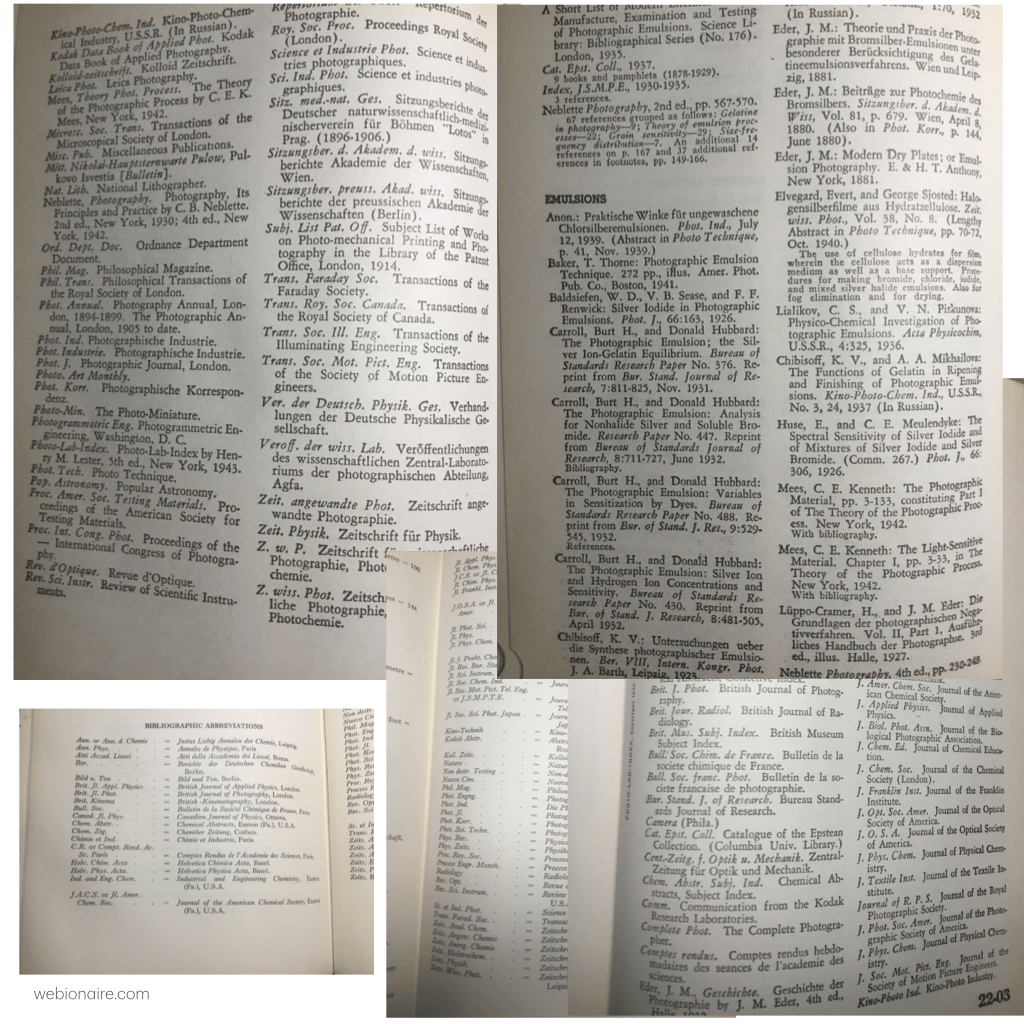

post modem .. just past the library
knowledge, when cloud was..
alive, free, everywhere.. rather than a slogan, sales pitch, secure, deadly conversion.
imagine you can travel back to the 1940s. You will be an early producer of matrix emulsions. You cannot take equipment with you, although you may take your curent knowledge, as well as being able to lookup patents issued before 2000.
Most importantly: you know it is possible, even limited to the engineering, mechanical, and chemical systems of the 40s, 50s. Always an advantage second movers have — certainty.
If I say “film” how far does that word take you — where? if you are an Internet generation film might only take you to Kodak and Hollywood.. your search might also only take you to saran wrap.
however if you know of more than one film maker and you don’t run that word on or hyphenated you may know of Ilford, Dupont, Ansco, Agfa, Defender or more. If those names are in your dictionary then you’ll understand the time travel exercise and you’ll understand the notion of film being discussed.
How does the emulsion become — what is included in the kettle, how is it mixed, how does it become a coating on the base, why doesn’t it fall off upon drying… many more questions will sprout — but they were all answered robustly even by 1940.
Every bit of knowledge needed to make a matrix film was common trade knowledge by 1941 — panchromatic films remained closely guarded insights until 1950.
There were enough solutions to the problems that engineering and industrial chemists were selecting choices for cost-market reasons.
why don’t you gather a group of three travelers around a studio table to plot your journey — I won’t be going. Safe travels.
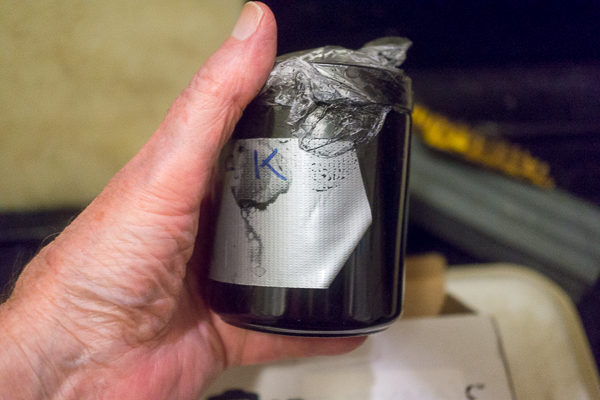
Continue reading “Time travel”End of run. The final bit of anti-halation black made for making panchromatic matrix emulsion. This washes out with a pre-soak as part of the processing of the matrix film; goes back to the 1950s method . After processing thru wash-off, the gelatin relief is clear, no black. This permits dye preview as in the “slip sheet” manner from the 50s. During transition of technology times, a manufacturer does not know which way the market will glide. Should we stay true, compatible with existing methods, or do we change product with expectation that the labs/market will adapt. Can we manage that risk: meaning absorb the cost and correct directions.
The initial Kodak relief, imbibition films, were clear-ish after wash-off. Previewing the color through a process of dyeing the mat, laying them atop the final support covered by a clear overlay (that 25th sheet) had become routine way of printing. A new matrix film should support that standardized lab method. Initially, PM did. But then, it didn’t. At first, PM relied upon a different tanning developer, and required a pre-wash to remove the acutance-black (sharpens by controlling “internal flare”). It was slightly blue, as was Defender-DuPont’s pan-chroma product. PM quickly moved away from the dye to a “pigment” dispersion throughout the coating. It didn’t wash out. Kodak also switched to a single tanning formula, dropping the specialized three part pan matrix developer. Soon after, PM got a number.
A long time ago doesn’t mean Y2K to me. 1950 is my long time ago.
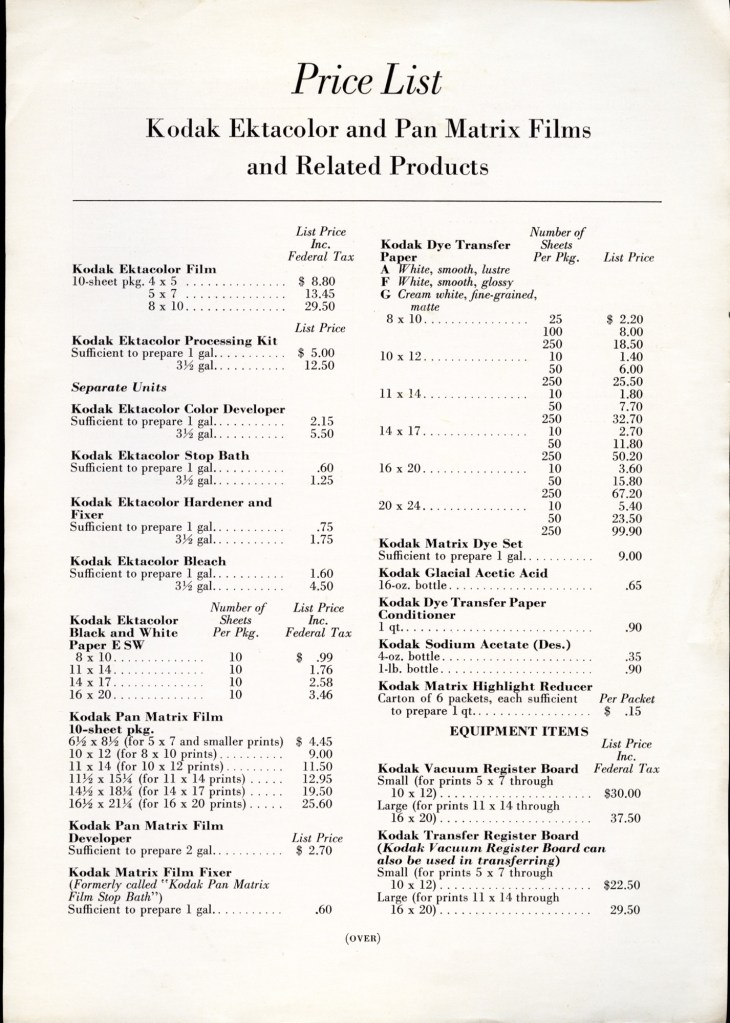
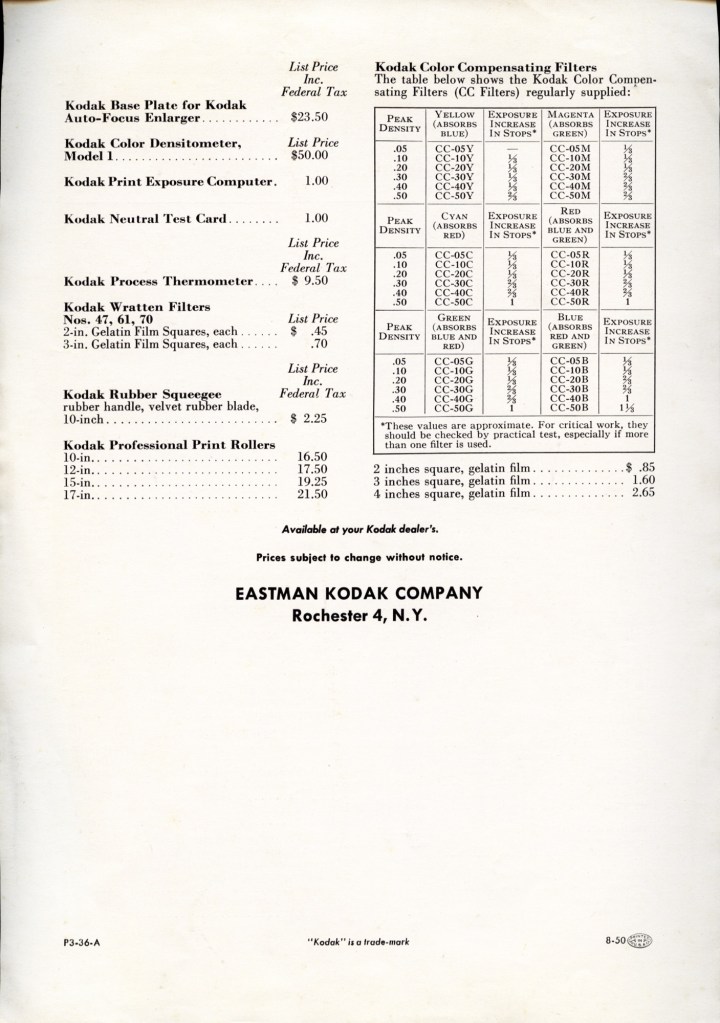
Frank, November 2000:
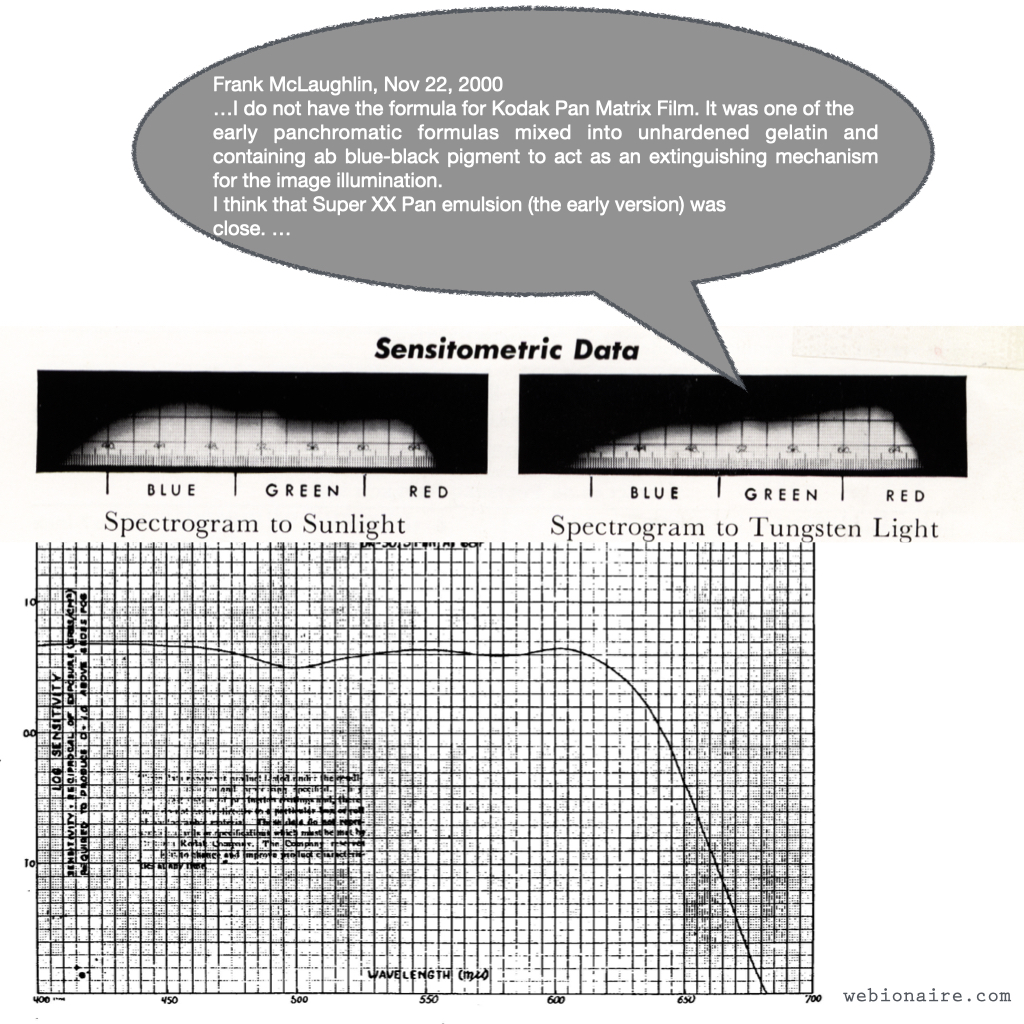
During my initial years of making separations, I used Super-XX since a contact at Kodak’s Visual Research Studio suggested my PM exposures would be comparable. They were, within a step test.
Continue reading “2018 Pan Run”
You must be logged in to post a comment.