dye transfer: one film process

Under the useless information heading comes this secret from the past. Ektapan film could be used as the (almost) only film needed to make dye transfer (imbibition) prints. It could be used to make masks, separations, and even the matrix itself; that last is the big secret.

Full disclosure: it couldn’t do all those things better than the specialized films used for masks, seps, and mats; it could serve well, well enough to be a simple solution for workshops and weekend workers to acquire the foundations of making dye transfer prints. In school, I would take students through in several circuits of the process, each pass around we would add more control, increasing the understanding of choices to make — how the image was made.

Ektapan could also be used as a collotype film. It was a nice emulsion; not just for studio photographers shooting color and B&W negatives of the same thing.

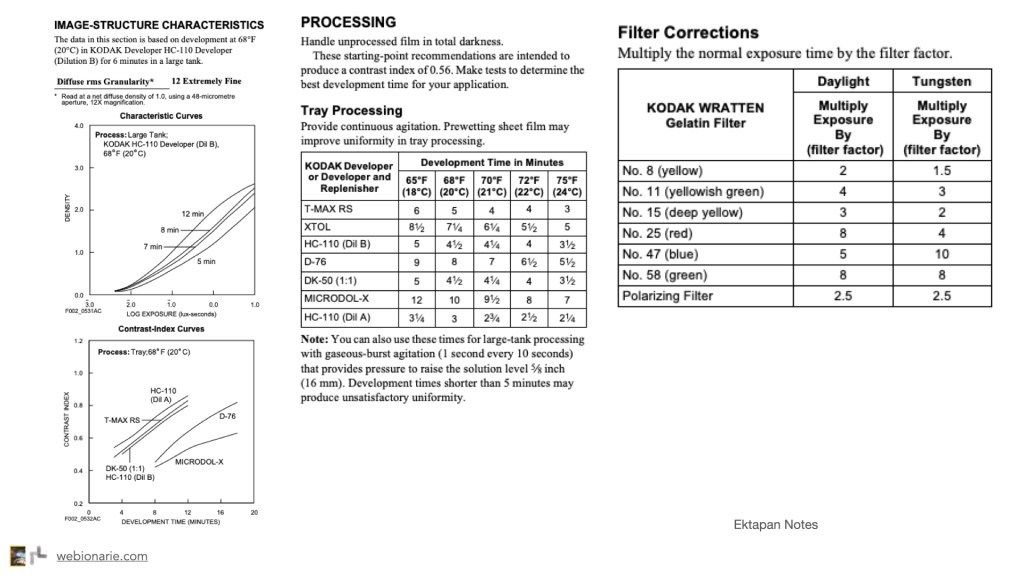
Notice the DK-50, HC-110, & T-Max RS lines.

you can also see the similarity of DK50 & HC110. dilution makes them the same!

I used the Dilution B for Seps; Dilution F for masks.

Exposing and developing (tanning) Ektapan as a mat wasn’t the same as Kodak Matrix film. Two reasons, Ektapan is panchromatic, so required total darkness for working. Kodak Tanning Developer didn’t work well enough; contrast was too low, or else way to high. So we relied upon tanning bleach method.

Details won’t help you now. I offer this to you as a point of reference; as something you can consider as an alternative way of recovering a process. Try what is at hand. Don’t wait for the perfect something from someone else.

More, another time, about origin stories. Getting beyond the now state.
Notes: Curator Links

saving me time; set of already found links. I intend to return to this page and correct, amend as interest permits. [ created: Jan 4, 2022

https://www.artcurators.org/page/Prof_Resources

https://curatorsintl.org/

https://guides.library.cmu.edu/vr/image_collections_list

https://www.metmuseum.org/about-the-met/collection-areas/photographs


What’s so hard about Dye Transfer

Back in the day of dye transfer, photography was a trade taught in the US Miitary as well as private trade schools, many of which gladly accepted GI Bill tuition payments.

Large labs, processing hundreds of prints a week, divided the work into skill layers. As someone improved they were assigned to other tasks. Prove yourself often enough and you will have made it to a secure will paid career.

jobs. skills. steps

  • load film, clean, mop
  • soup film
  • mix chemcials for lab
  • make masks/seps
  • make mats
  • manage dyes and do rollup

The last task is key to the final result: rollup. This is primarily autographic; skill of hand, eye, timing with feedback. All the previous steps come together well, or the print fails.

Most of those who fail at dye transfer do so because they lack courage. They make the task harder than it is. Not even rollup is difficult, just needing attention.

Anyone who can teach dye, can teach anyone who can learn, in about 45 hours. This assumes you can get film in and out of a camera, and in and out of chemicals.

The hardest part about dye transfer was those who sold their weekend teaching skills to timid camera counter conversationalists.

Kodak’s Frank McLaughlin used to take people through the steps over the telephone. That’s how hard it was.

Frank wrote the latter editions of Kodak’s Dye Transfer Guide, the edition I pan elsewhere. I discount it since it was incomplete, as it tried to be thorough. The editions from the 50s was thicker, better, but referenced other materials. They were usually given away upon request; they did have prices marked.

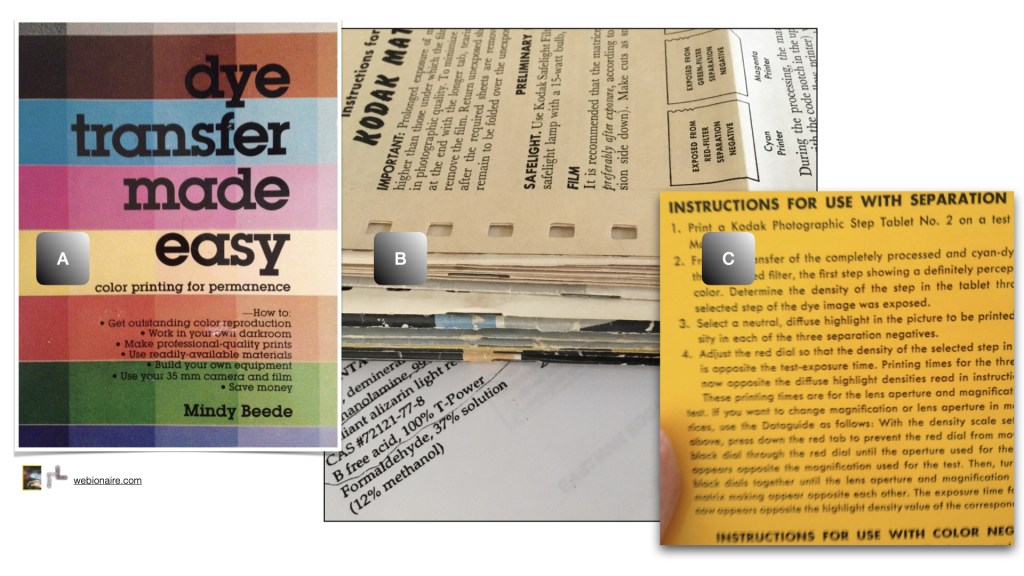
A text that was used by many during the buildout of the Silver Rush was written by Mindy Beede. She is derided by many of the “not so many” print crowd. The slow brews that make as many as 20 prints in a career. If you wanted to learn, start with her book.

learning dye transfer

A — doesn’t match the information in B, and C; however, it is available. Items B and C are from my materials collected over years as a commercial printer.