Theory of the Question

Ask a question. The response will depend upon who you are, who you ask, the circumstances, the form of the quesion– spoken, written….
the theory of the human, and the respondents theory of you–
what level of questioner are you? How much effort do they need to give to their answer. What will they gain.
How you answer on a first date, a job interview, an FBI interrogation, your chemistry quiz — all answers are based upon your assumption of an intent, and the reaction you need from the questioner.

“We don’t see things as they are; we see them as we are.”
– Anais Nin

Asking The Net

On the net, most answer to be included. Most answers are opinion, since most questions are based upon a vague or open ended topic. On a tech focused yahoo group I passed a question along.. since this group of 500+ listeners includes many former practitioners of dye transfer, I expected some open response. I did get response, but it fell into a very conventional cycle — answers without expanding understanding… The group consists mostly of hangers on, passive observers — the typical onlooker grouping. They will be happy with gossip. One site provides them talk that they will use on some other place.

net words

fools believe their knowledge complete.. assume that others aren’t as aware, don’t have as much knowledge as they have.
only fools have complete knowledge; or enough

Your Boundary

You bring your own boundary with you. Your limits limit your answer, often by providing a narrow interpretation of the question — frequently this is a view of the questioner.

Who Is The Qustioner

Is the question credible. With any “who’ there is power .. a relationship to an audience. The respondent must support their own self concept, somethimes by rejecting the question, since they don’t understand the qustioner, or respect them

Response Sequence

Q–ME

Ra.1 Jack Denman : what I know about it …
Rb.1 Andrew Cross : from what Frank M … ’98
Rc.1 Ctein : personally I think that’s a pretty silly hypothesis.
— he counters each of the prior posters questions and each answer.
This asserts his primacy of place, his experience as alpha. And completely misunderstands the question, the recent history, and of any understanding I may have. Aside: no one noticed that I had taught a recent class, perhaps, the only class in this decade, maybe this century about dye transfer.
Ra.2 Jack Denman : don’t want to quibble, (answered later parts of Ctein)
=================================
about: Ra — no experience. retired tech user. not a user of DT
Rb. — workshop trained. engineer, teacher. user of DT
Rc. — self taught. educated non-practicing physicist. writer. individual proprietor of photo services. widely known, yet unable to excel or grow a lab business


A New Leisure Suit– Hipstah

is the popularity of film among the Millenials a cigarette — the new smoking. not leisure class, rather a pleasure class activity-

a leisure suit, suited for the casual young.

Largely Forest

Largely False

Information spreads, diffuses throughout. It is spread quickly, and usually by those who did not create it. Most information, in photography forums, is hearsay. Often repeated, to the point of being so widely said, that it is believed. It is even used to substantiate a poster’s belief about the topic. It is confirmation of authority, but it is never questioned, never tested. Such a test, or doubt is hearasy in the church of hearsay. You could be banned, or blocked, or similar dire inconsequential consequences.

Just one example:

In 1975, color photography, as a print, was confined to the professiona market. Commercial work was transparency, or dye transfer. Dyes were the choice for images destined to retouching. The retail end of photography, those very many weekend businesses taking money from the newly wed, newly born — those photographers had to use paper. They shot negatives, and printed them, often in a small scale lab they owned. That darkroom, and work mode had evolved from their B&W business. The prints were on fiber paper.

Kodak’s large scale mass print process was using RC paper. How could the small didicated individual lab be converted to the faster, easier, cheaper version of printing on resin coated paper.

I remember a demonstration that was used at trade shows. It had made the rounds of the professional color labs, and was then being used at wedding and portrait trades shows. It went like this:

— the demonstrator splashed water onto the gelatin print making it form spots. At the time, the print would have swollen irrgularyly into blue spots. The correction, not shown, was to dump the print into a tray of water, then dry normally.
— instead they would be shown a very crinkled print, force dried with a hair dryer
— the RC paper was splashed with water, and wiped, and force dried. it looked fine
— they next would pour coffee or cola onto the RC print, wipe it with a squeegee and force dry. it would look fine. sometimes it would show some stain, in such a case, the print was given a running water wash, and, yep, force dried, coming out fine and victorious.

the better man won.

photos as placemats

at one such demonstration, when the audience was asked if they had any questions, I raised my hand, stood and asked:
does this really matter to those of us who aren’t making photo placemats

there were snickers, nods and smiles. A kodak rep pulled me toward him, asking if I’d like a box of the RC paper. I said yes, if it was big enough, and came with chemicals.
It was and it did.

That year the students at EXS had free paper and chemistry for several months. Several thousand sheets of 8×10 and 11×14 shiny, new paper

These methods do not go away, neither do the tales told by the gullible. In 2001 or so, the same method of sabatoging a competing product was used, this time to ruin the digital inkjet print. Some were calling them inkblots, inkstains, and so on. The inkjet print was splashed with water, and it blurred. The ink ran just a bit. Ironically the inkjet product was Kodak’s own. The demo was being shown by a Fuji dealer, this was a trade show in Chicago.

Of course the retort was that the test was flawed, since the print hadn’t yet dried, it had just come from the printer. Not actually the case. It worked with prints made up to 3 days later, then it didn’t work. No effect, even on that very suspect print.

Why tell this — why now — that is all very old stuff, ancient in this post 2k internet age. Well, because of things like this:

from Iowa … sat 2.28.15

Inkjets are fast and pretty stable just don’t get a drop of water on it! Chromogenic (C-prints) prints you could spill a coke on, just wash it off in warm running water and hang them up to dry!

like an endless echo, or psychotic game of telephone, in which the wrong information is repeated forever. forums are poor substitutes for the real world.

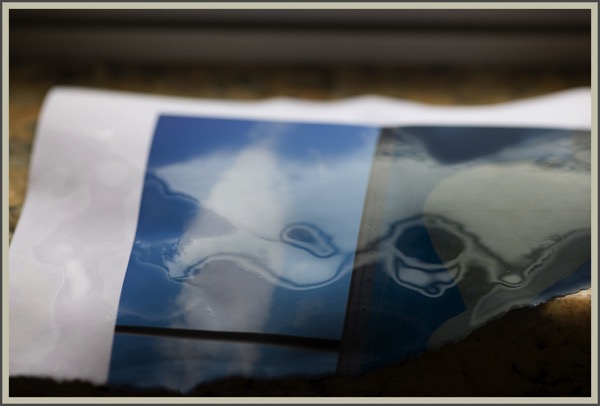
Here is a test that I just conducted. I had a print sitting on the printer stand, one that I have a better version of, so I put it up on the scaffold of demonstration, raise it to the gods of the forest nuts.
I tore it into two pieces, throwing one of them into a sink of dishes, then pulled it out and rinsed. Next, I took a picture of it on the window sill above the sink. After it dried, about half hour, it was set next to its other part. The second photo shows them both. the curly one is the one that took a bath.

Digital6548prankserDigital6551prankser
Doesn’t look that much worse for wear, though it does smell differently.

NOT RECOMMENDED FOR IDIOTS. NOT SUITABLE FOR THOSE WHO FREQUENT PHOTO FORUMS. DO NOT DO WITHOUT ADEQUATE IMAGINATION

The how it happens, and happens again is an easy question, even easier to answer. The question that most interests me, that drives my time on the dingy alleys of the forums, is WHY. What do the adherents, advocates and acolytes gain. More importantly, what is lost by those who hang out on the forums?
My reason for hosting my posting is so that it has an author, and I don’t have to beg or lie for existence. You can read or leave.

I grow my own. I live with what I grow.