The darkroom has been the recipient of electronic gadgets for decades. Many of the private darkrooms were equipped with electronic aids long before the digital upgrades. The intent was convenience, as well as ease of operation for the casual darkroom printer.
The first items were timers. After that came analyzers – darkroom meters used for judging exposure and contrast selection.
Timers
Enlarger timers, usually, control time. First ones were mechanical, much like a clock. Digital timers provided more features, including “f-stop” timing. In wet room (side) are process timers; some are multi-step, or even multi-process capable.
Exposure/ Contrast Meters
Technically they are on-easel meters. The readings are taken at the printing stage. The negative is projected onto the easel; the meter probe (sensor) is positioned on the easel to capture the light from a spot of the image.
Darkroom 21: Tron
[OFFLINE is zenLite key]
Published source, DIY build information: timers, light sources, meters
Learn by doing — but what if you’re too afraid, too uncertain, or now, just too late — all the stuff is gone. Everything is gone, except the high posters of the internet forums. They continue to chatter about a process that few of them engaged. It is used as a merit badge. Most of these posters are imposters; much like Post Exchange warriors — GIs who served by serving in the mess hall.
standardized: my dog ate it
I don’t mean to be unkind. I do mean to caution you about the internet guides who are lost, yet continue shouting follow me to paradise. The above quote is from a dye transfer group saved from the Yahoo/Egroup forum changes of the past winter. The quote (in blue) is a response from a poster found on Large Format & Photrio film-chemistry photography forums. He has more than 20,000 combined posts; using the forums as though a twitter+message system. [ his site is here: https://web.archive.org/web/20040603105530/http://drewwiley.com/contact.php ]
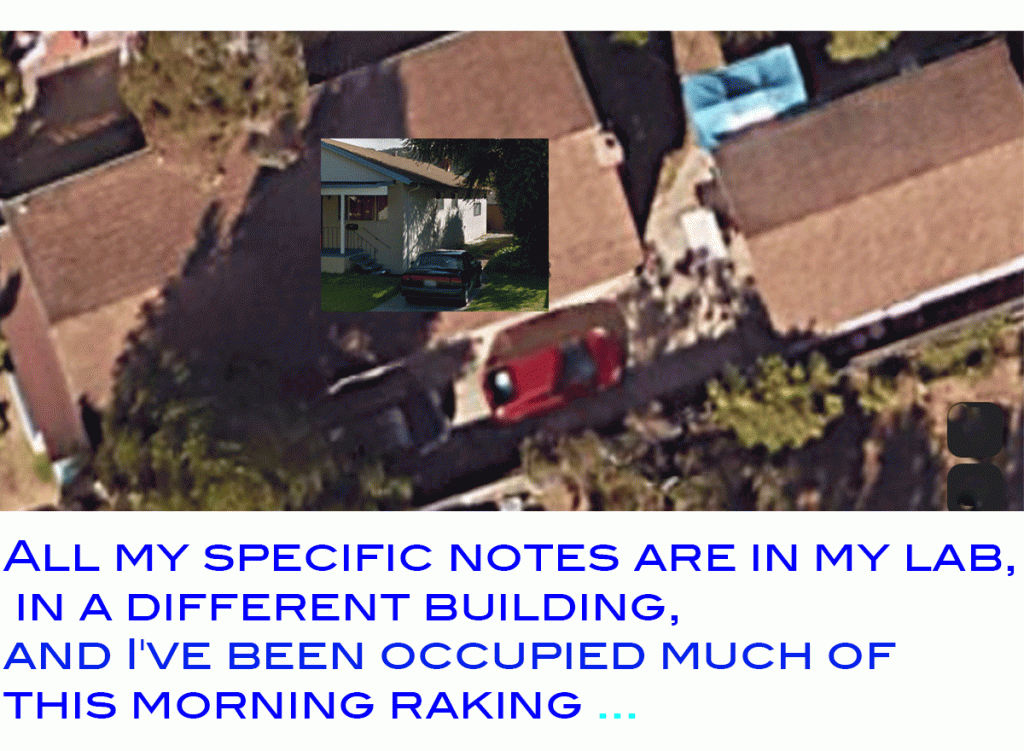
His response was to an established printer who is giving ‘Poser’ the benefit of the doubt, and has asked for details about Poser’s process specifics. The response is a standard: “my dog ate it.” My notes are in my other pocket.
The picture shows the car length distance to Poser’s ‘Lab.’ Although, by the miracle of no-one-cares he is never outed. Oddly, he is easy to locate — each of his postings has an eponymous website which is dutifully crawled by internet archive. Poser took his site offline a few weeks after making an appointment to show his work. Apparently he wanted to limit the prior knowledge of the person coming to see his work. [August 2020]
Two Places / Ways
Dye Transfer tried and died. Several times. It is not a viable commercial product. Nevertheless it continues to be held up as an elegant standard. A marker of qualitative superiority. As such, it is also said to be difficult to learn; so difficult that few have ever mastered it. Of course, that is uttered by those who stress a reprographic approach; those who made meager livings by selling tickets to a weekend workshop; most importantly, by those failures of courage.
The people who find reason after reason not to make a print; to just pick up a guide and follow it. These latter day delayers are the most common person on the forums, even the groups.io listserv. Poser will ask questions on a forum, repackage it for presentation on another, thereby, gaining ‘process’ credit. This alleviates, or it has for several years, his need to show. Poser prefers to tell, never show.
The danger to you is the same as getting a map from someone who has never travelled the area. Don’t expect that you will get further than they, before becoming lost like them.
Why hasn’t Poser learned dye transfer? For a decade he has bragged that he had. Over the past year, he has modified that stance. He was confronted, partially, on a forum, by someone who does make dyes. They didn’t call him out — she just asked him questions. Elementary ones. Ones like he can’t answer on the listserv…
He can’t learn because he is a show-off who has found it easier to splash around in the kiddie pools of the internet instead of learning to swim.
A sad thing: if this were 1980, in one week anyone who was going to learn dye transfer would have had the foundation down. Currently, the same immersive method is stretched into longer time.
First, find the guide. Don’t worry about the shoes; that comes later.
A year later [July 2021] — An update. We find the same Wiley poster using the same excuse. At least his has learned to spout the same acceptable coverup:
Ron, my notes are in the lab, but my hardening method for wash-off relief did involve ammonium dichromate. I was trying to slow down the development step for sake of consistently developing large matrices in drums, trying to economize sink space. And I got as far as concluding that wash-off relief is a realistic alternative to accomplish that. I still haven’t found a big enough block of time to do serious image printing this manner. I’m tied up with ongoing other kinds of intensive photographic projects.
Much of darkroom work is hand waving. Aligning images to build a print is part of the world of assembly processes.
Projecting a beam of light through a modulator, such as a piece of film, is the way of the darkroom. The enlarger is light and lens. We increase our control by being able to change the color and intensity of the light. These are the little pieces we build a world with.
Many Added
Here, we see a color print, made from separate BW negatives, using filters, manual registration, and RA-4 color paper.
tricolor type C printing
Notice how casual the assembly is. No film punch; no micro calipered, glass carriers; none of the carping crap posted on the Film Forum by slow moving Flim Flammers.
Many Divided
Next, Jerry Uelsman shows his method of making combination prints. He uses several enlargers, each with a negative of one element of the finished image.
Uelsmann in darkroom
There are people who use the computer to write their essays and there are people who still use a yellow pad and a pencil. They both can write excellent essays, stories or whatever. The process is the means by which you complete the image, but you don’t want it to be the end. There was a point at which the emphasis was on the Zone System that was all so technical. So you had this precise full tonal scale image, but what was the subject matter? It’s a cat or a sunset. So what? I’m committed to the darkroom, but I believe that if I had been 20 years younger when Photoshop came out with its visual options, I might be sitting in front of a computer rather than standing in front of an enlarger.


You must be logged in to post a comment.