Imbibition Notes: Matrix Punch

// Kodak directions were complete. More information was made available in the product datasheet than in the instructional guides. Labs always had access to support from the marketing group. If you were big enough, or persistent, you could talk to the research group well into the 70s; then it changed. The product was on the way out — no one wanted to say. Now, I know that the reason my contacts from the 60s called from home was that the labs weren’t supposed to be talking.

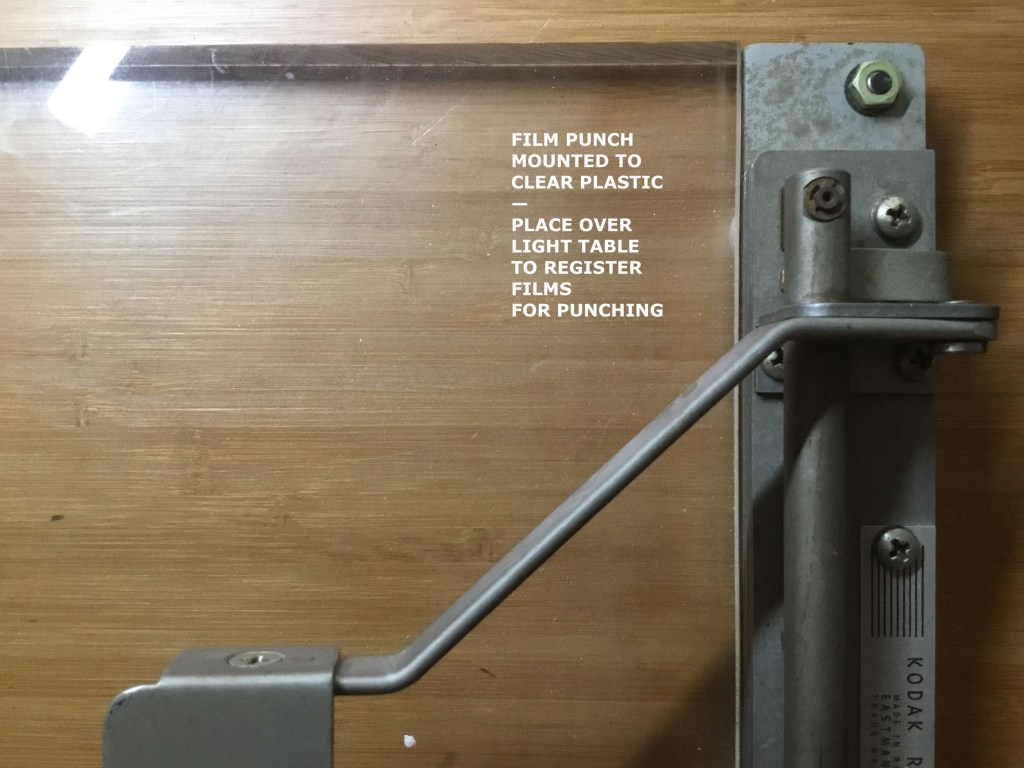
A main Kodak invention for imbibition printing was their film punch. Looks like a very complex paper punch. Not far from wrong, although paper punches aren’t always best for thick sheets of plastic like film.

Pan Matrix sheets came pre-punched to fit the Kodak Transfer table.

An early fight with Kodak was over large rolls of Pan Matrix film. They wouldn’t make it… even though we had many accounts wanting large displays from original color negatives. So, we had to devise the interpositive method — then we had talked to DuPont. And Ansco.

to duplicat today search forregister pins with a #4 x 7/16″ screw stud at McMaster or comparable

Condax’s patent for registration device and method. April 1945, #2455735

It is the Kodak Blanket, the method used from the first decade of Dye Transfer. The early guides (E-80s) showed its use. This was the time of cut-n-but registration — the form inherited from litho-press plate work. The Condax patent references earlier litho patents.

Kodak’s system for making Dye Transfer prints included large pin system. The film used couldn’t take fine punches; not if you were going to put film off and on many times, such as what happens when making real prints. Theoretical prints could be made by punching glass plates, sadly, real glass plates would snap if you punched them.
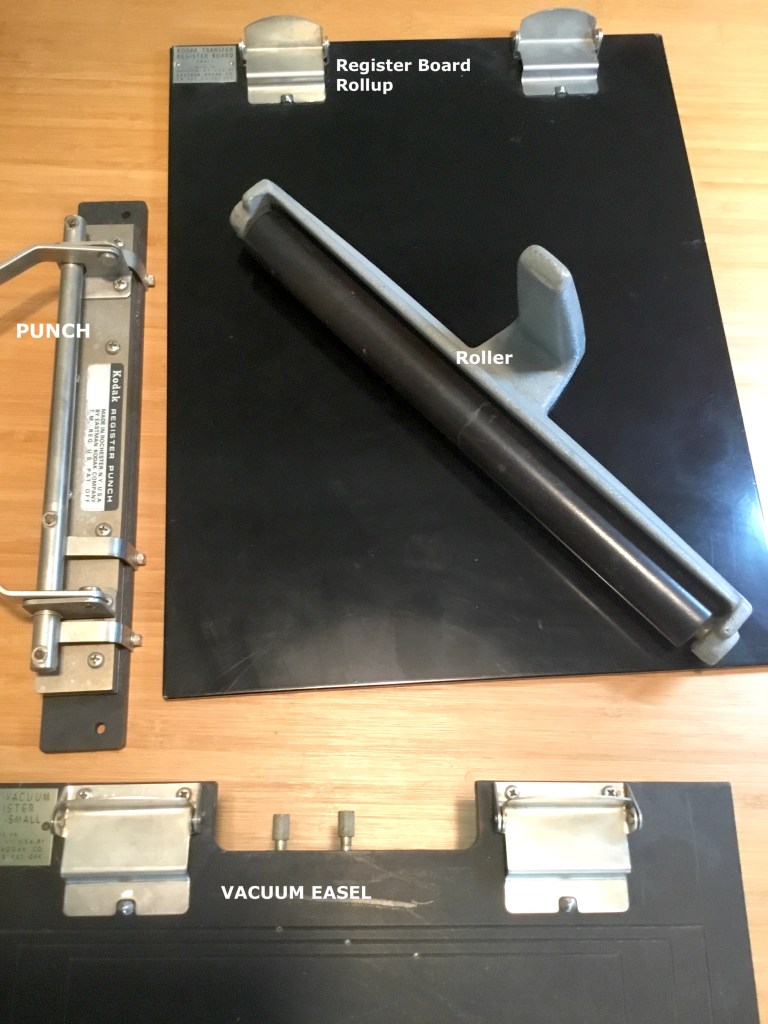
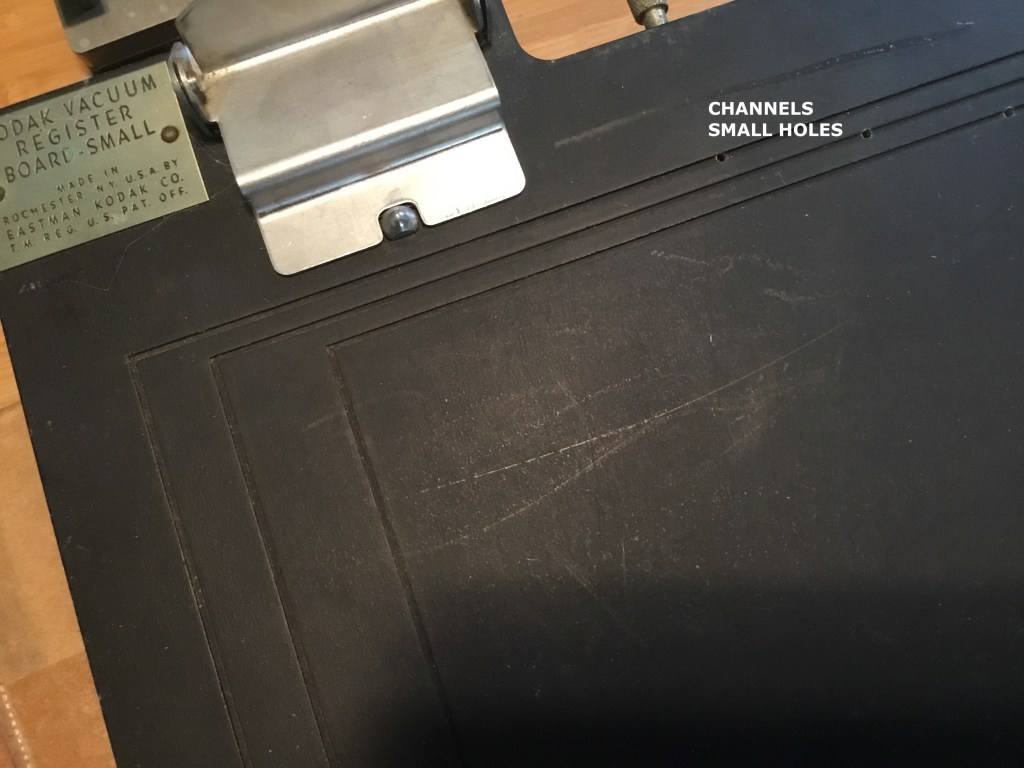
A punch for the film + an easel used during exposure + pinned transfer board + a roller for rollup of the mats onto the blank.

This was a standard set of equipment found in commercial and weekend labs. These items went out of production by 1980. From the mid 60s they were specialty items sold through graphic supply houses, not regular camera stores.

In 1968, Adolph Gasser (big San Francisco store) didn’t know about them, nor dye transfer supplies. I worked with them to make my order; standing with them to make the call back to Rochester. A long time ago. It foreshadowed much of what would come to the very small community of dye transfer printers.

nutshell: Masking

an overview of masks: what they are; what they do. Masking is selective dodging.. consider it a precise, custom, graduated neutral density filter. Masks are most often used this century to alter contrast of B&W film. They also increase local contrasts, thereby altering edge effects making a print appear sharper with more gradations. These are the “unsharp masks (USM)”

In last century, during the growth stage of masking, they were used in color processes to alter, and correct contrast and color. Masking increased the contrast of the magenta and yellow, overcoming deficiencies, impurities of colorants.

If the original transparency isn’t underexposed, and the contrast of the scene is low, no masking is required.

Films I have today for masking: Ilford PanF (120). Ilford Delta 100 (4×5 & 8×10). Ilford Ortho+ (4×5, 8×10, special roll). Note the Ilford weight. I do, and it makes me nervous, since Ilford hangs on the interest of real estate ventures in a country of short term values.

From the past; more for the Rosetta stone. Translating data sheets. Why that film/developer was made.

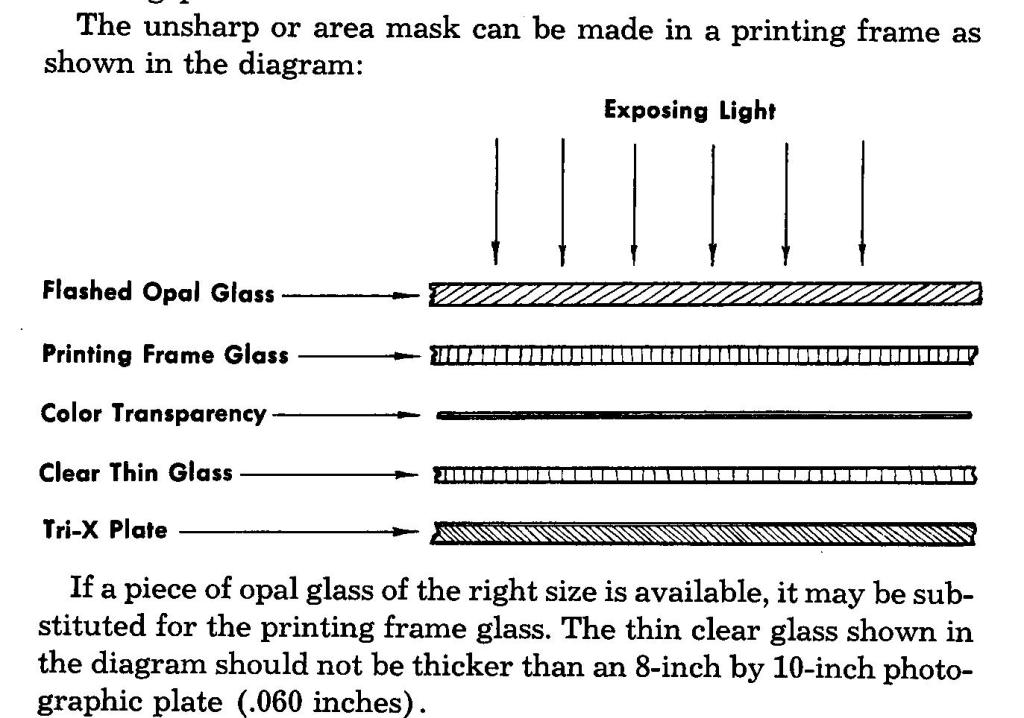
From the past, The mask film used was Tri-X Plate. Masks were made using film available. No special film.

The layout, exposure configuration was typical Kodak method used and taught for over 40 years.

Pan Masking film in Versamat — was the standard method at the end of the Kodak Dye Transfer era.

Masks should never be greater than 40%. Coated (APO) lenses require higher percent masks.

The appearance of color swatches in separation negatives is best indicator of correct mask exposure.

Most of the original guidance assumed the use of the Standard Light.


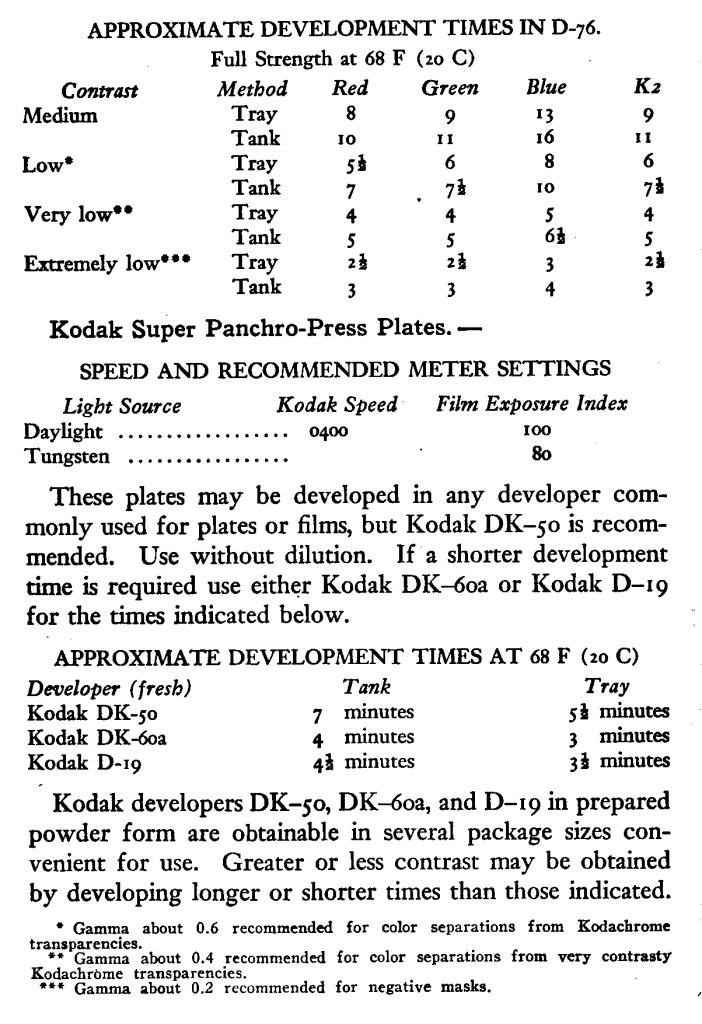
Developer for masks, like those for seps should be non-staining and not “fine-grain” solvent type. It is easy to recommend DK-50, DK-60a as best options, even this decade. For ready mix, try HC-110 one-shot. All masks and seps should be processed following a one-shot protocol. Use the mixture one time and discard. I use fresh developer for each sheet of film.

FilterUse
F- 29 RedRequired
N- 61 GreenRequired
#96 Neutral density: 0.10 / 0.30 / 1.0Strongly recommended. Equalize exposures. Reduce reciprocity differences.
#33 Magentaoptional
#15 Yellowoptional
Filters for (color) masking

Be assured that masking cannot make a color that the dyes, if mixed outside the system, cannot produce. This is why we always tried for better and better dyes (colorants). To correct all the cross-talk of dyes, six masks are needed. Contrast of masks is proportional to errors of colorants being modified.

compensate blue and green in CYAN2 masks
compensate for MAGENTA2 masks
compensate for YELLOW2 masks
the gammas must be corrected for each change in original color (transparency). If the chrome’s emulsion or processing change, a new configuration of correction masks would be calculated. [see Friedman for method ]

Not a realistic effort. Particularly since most images/ viewer sets can’t discern the improvement in real world conditions.


MASKING COLOR NEGATIVES

footnote for ongoing readers: notation on confused Large format masking board:

board note: CN[C41] film is designed for printing using a ‘hot’ light onto a color print [RA4]. BW films are more sensitive than the intended color paper. Recent discussion has much alteration discussion. What they are achieving is on this blackboard exercise.

Removing the “Orange” mask: If you want this brightest color to have a neutral hue, you need to expose, such that Dred = Dgreen = Dblue = 0.9, i.e. a uniform gray strip with D = 0.9 will be the brightest neutral color you can create. With extra exposure you can then reach all colors in the range (Dred = 0.9, Dgreen = 0.9, Dblue = 0.9) + (ΔDred, ΔDgreen, ΔDblue) with ΔDred ≥ 0, ΔDgreen ≥ 0, ΔDblue ≥ 0.

1950.. D-76 the standard developer for separation negatives. Its alternates were the DKs. See the footnote above for target gammas.

There was no magic in separation negatives. It has always been a balance between exposure types, filters, film + developer + agitation method.

I rarely used Super-XX as a sep film; only when clients required it. And on a small year, I made around 200 first prints – this, during my first 5 years working.