Finding the Print

Finding a way isn’t always direct. Comparing one thing to another isn’t always direct; however, knowing the ways of your own learning, in addition to being directed well to similarities among processes is, not merely strengthener it is broadening. You get deeper and wiser. Strength with flexibility.

This is about heliogravure — this is about dye transfer, imbibition printing. It is about ink on paper. It is about dye on paper. It is about both, because it isn’t really about them, it is about learning them; understanding what the hard parts of the problem are. About getting to the harder part earlier, so that you can survive the dull parts: the online dullards, the arrogant ignorant; the drewids.

This began with a review of Lely Constantinople’s work:

“Lely Constantinople is a photo based artist from Washington, D.C. who has been exhibiting her work nationally and internationally for over twenty years. Her photographs are held in the collections of the Anacostia Community Museum, the Smithsonian Museum of American History, as well as numerous private collections. She is also an independent photo editor, archivist, and teacher. “

Her newer work is Heliogravure, which she learned from Fanny Boucher. Ms. Constantinople could have also learned from a text; there are many. For my purpose consider that if she’d have read a book, she’d have spent pages on making negatives, exposing, etc., at last coming to something like: “ink and wipe the plate. Let’s look at how these words expand. Lucky for us, Youtube has two good examples:

ink and wipe … a longer view

in the above video you may notice the densitometer in the upper left — it seems quite abandoned, irrelevant to the key part of the process of getting ink onto paper.

And the second, shorter version of a print pull. Notice how much hand work is involved; the importance of the fingers and palms. Every printmaker knows this from experience — not even early references place enough attention on this aspect.

Fanny Boucher — short version

Dye Transfer is much the same. You could spend hours reading, knowing everything about the process. Having a full understanding of masks, separations, ph controls, etc, etc. And you will never get to the real part: dye goes into paper during transfer!

The rollup step is where the work occurs — everything else is intermediate. Important, but not so important that it should be your entire focus.

Printmaking is like making love: somewhere between the bathroom wall, and a specialty in gynecology you will find truth.

suppose you had a lab

“I find it puzzling that the dye transfer aficionados like Ctein hung up their spurs and no longer offer new prints, other than what exist from old stock they had hoarded.”

Suppose an established photographer came to you requesting $200K worth of work but you had just closed your darkroom. Meaning, you had taken the plastic sheets down in your garage basement; taken the spray hoses off the tub sink; folded, discarded the collapsable party tables. Even had packed away lenses and enlarger, making them ready for shipment or sale to people of the forumatti.

Would you turn down the request saying: “I’ve just closed my darkroom, sorry.”

Credible. Edible test time. Or do you just swallow cause it is told you by the big name dropper himself.

What is it that you don’t know. Perhaps the one-name small practitioner knew he wasn’t up to the task. His way of working wouldn’t satisfy the need of the Big Name photographer. And name-drop didn’t have the where·with·all to build a proper lab set. 

He had no way of knowing that it would take: $10K + $60K + $8K to get that toll coater to make the appropriate run of mat film. One name, also, just didn’t have the chops to make the prints. He will tell you others don’t make prints as good as his, but why then are all his prints of Rock concerts or rockets. Mostly his own work. 

It is best that he turned the request down, (if it actually occurred) since the lab that took the work is now firmly established and doing well. Well enough that they are working with project schedules more than a year away.

Eliot Porter Wars

We draw lines; we make selections, interpret them, and write history. Drawing upon sources means we sort thru the fog of distance and lost debates. What remains is a result of who wrote, why and, in response to what. This is the distance of time; remote memories remembered to meet this day’s question.

Too often, the audience wants a story to support their own; their hero should face the same problems with outcomes the reader understands and wants. We want to think we could have done that so we explain our choices with the hero’s story. Our path is the same as theirs…

We have spent all this time, a life getting something, only to find that we didn’t get anywhere.

Eliot Porter is a standard bearer of craft .. complex craft; something taking much effort, time, intense focus of energy. Something so difficult that few doubt its value. Something like Dye Transfer. Reality being what it is, those who have taken the longest to make a dye are those who consider it the hardest way to print. In some ways, they are correct. Making a dye transfer is time consuming, requiring attention to a process with many possible alterations. The key skill is energy.

So, where does this get. What is the history? Actually, what is the question?

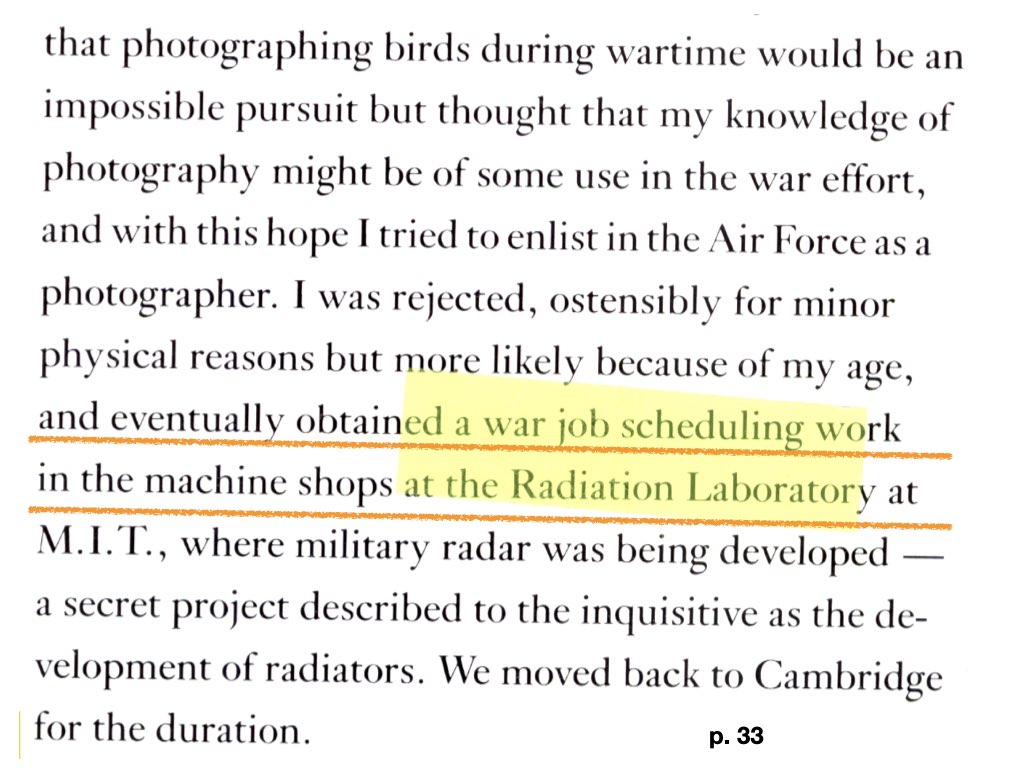
Groupings of people view Eliot Porter’s work differently. The craft forum or the artforum come to differing conclusions about the importance of Mr. Porter’s work. They also hold different versions of Eliot Porter’s time at the Radiation Laboratory during World War II.

These versions, simply, are:

  • he was a machinist (meaning he could make precise craft items in later years)
  • he was a scheduler

he was a machinist

helped develop radar

And in 1987, the fuller tale: he was a clerk who expedited (scheduled) work within the shops at the Radiation Laboratory. He did help develop radar, along with several thousand others at the Rad Lab.

We use other’s war stories to fight our wars — tell our story. But as we all know, growing up is up to us.

So, is it necessary to be a machinist, or a scheduling clerk, or a Doctor, chemist to make Dye Transfer prints?

NO. Some of my better students had to rely completely on the step by step worksheets for the ‘craft’; however, they had the harder skill: they could see what they wanted the picture to look like.

[ I am doing edits on a post on the ways of making dyes in the early years …]

for more: https://webionaire.com/2014/06/22/eliot-porter/