Will a sheet of fixed out arista litho film hold dye? A question from a few days back that I have decided to post more about.
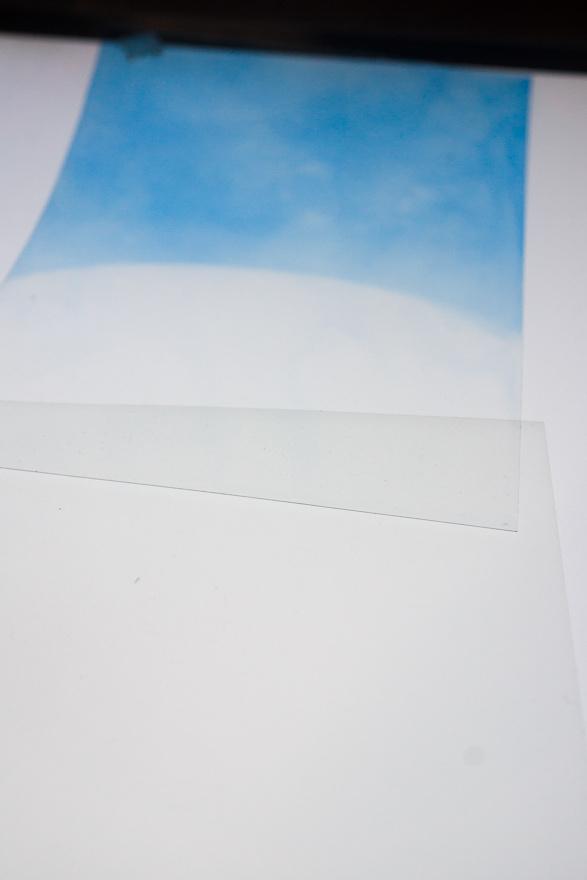
Two sheets of film; both dyed in cyan dye. The upper one with the arch of color is Kodak matrix film partially washed off. That’s what the arch is: no emulsion. The cyan is fogged, age mottled emulsion after being dyed.
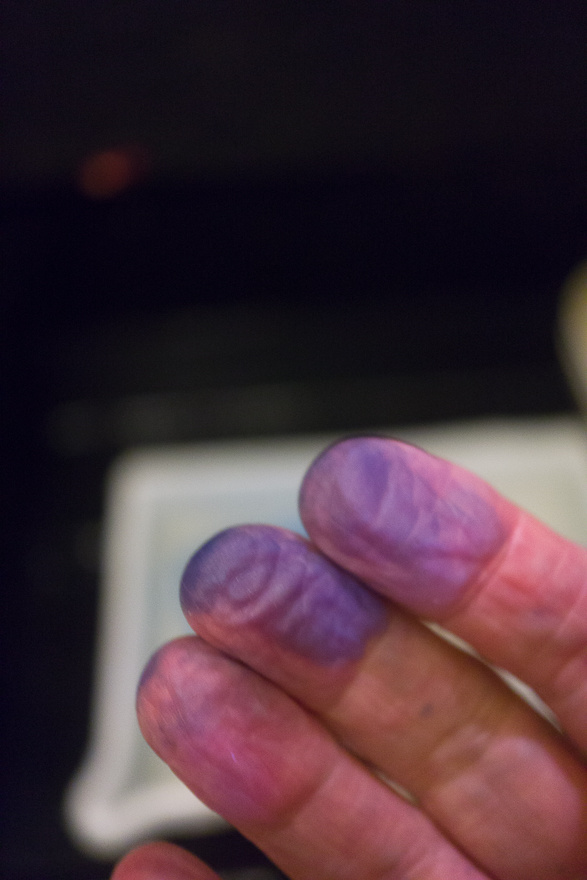
The lower, empty, blank, unstained square of film is Arista Litho that has been stained with the same cyan dye as the matrix film — stained for over 8 minutes — that stain drained off with less than 40 seconds in rinse. It didn’t base stain — there wouldn’t be highlight carry over.
This isn’t a stripped emulsion, we aren’t at film base.
What does this demonstrate?
Try it. No matter who you hear an answer from, try the experiment in your studio with your equipment. Set your own standards; have your own goals.
Why did I do this? Because I wanted to know; to confirm my memory of making matrix films from true raw, so ever many years ago. Dye won’t stick if an emulsion won’t, however, a dye sticks to ‘soft’ gelatin — gelatin of a type. It will stick to many types of colloids — collodion, gelatin, albumin, etc. It isn’t easy to get all things arranged: emulsion, dye, receiver; all compatible, durable, useable to your purpose.
The first question asked by the new member of a tech talk group. They have every reason to think the existing members have the answer. The correct answer; one which is useful. We ask for directions, thinking the farmer will answer knowingly, taking care to provide accurate instruction.
“How do I get to Baskiqs farm from here?
A: “Well, I wouldn’t start from here, if I were going.”
Which brings us to an example from our world. Can you fix out a sheet of ready available film as a support for a new coating of a dye transfer emulsion? The small, but loud response, from the large online dye forum is: No. You must strip the emulsion off; then re-sub it. Another correspondent claims that Arista Ortho film never clears of color, even after the anti-halation dye is fixed and washed out — there remains a stain.
Reason: the base retains color which will interfere with exposure. — dye transfer is exposed thru the base of film, unlike most processes. This is so that the tanned, hardened image remains on the film after being ‘washed off’ in hot water. Of course old matrix film carries fog, both visible and gel-fog – that stuff that means the matrix film is hardening differentially across its surface, just from storage, maybe pressure of being stored in a stack.
Can we test this for ourself? Sure. Fix out two pieces of film. Look -> that’s what I did.
fixed out matrix film v. ortho film base color
The Arista Ortho fixed as clear as Kodak Matrix film [4150]. Does it hold dye as the Forum formula holds? Will it stain? Can you simply put any piece of fixed out film into a dye bath to dye it? Will it dye permanently? If it did, wouldn’t that be a kick in the head to all those dye mordant kits that have been sold over the years — well, that were sold years ago, when people made slide shows.
I know the answer; have done the test — [results later ]
You need a base, an emulsion, and a way of coating it onto the base. With that, you have what you could have bought 40 years ago. You still won’t be able to make an imbibition print, however, you are several steps closer. Just make certain someone doesn’t trip you on your way.
Art is, at base, a do it yourself life, suited to those driven to try something.
reminder, the process was first devised in the 40s at a time when little of our current basic materials or fundamental knowledge had been put into place. Kodak’s version of the process didn’t stabilize for nearly 15 years.
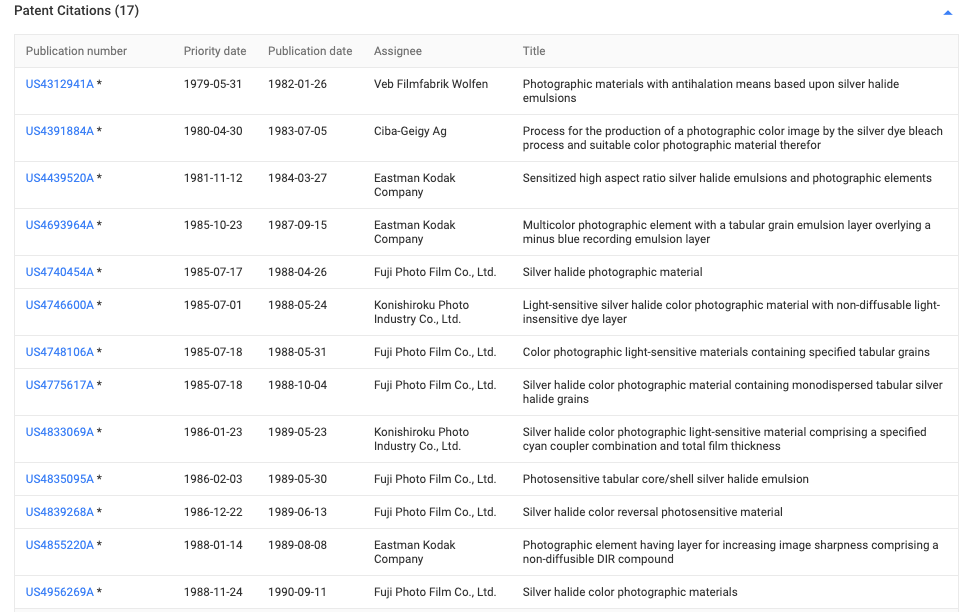
Photographic emulsions are disclosed comprised of radiation sensitive silver iodobromide grains, at least 50 percent of the total projected area of said silver iodobromide grains being accounted for by tabular grains exhibiting a mean tabularity of greater than 5, at least 10 percent of which are comprised of two opposed parallel major crystal faces, a host stratum having an iodide content of at least 4 mole percent, and laminar strata containing less than 2 mole percent iodide interposed between said host stratum and said opposed major crystal faces.The emulsions are characterized in that each of the laminar strata is comprised of a surface layer forming one of the major surfaces and having a thickness in the range of from 20 to 350 Å and a subsurface layer located immediately beneath and in contact with the surface layer containing a hexacoordination complex of a Group VIII period 4 or 5 metal and at least three cyanide ligands. InventorEric L. BellKenneth J. ReedMyra T. Olm // be sure to check the 27 ‘cited by’ items, particularly those by Kodak.
Coating – US 2761791
THE METHOD OF SIMULTANEOUSLY APPLYING THIN COATINGS OF A PLURALITY OF COLLOIDAL MATERIALS ONTO A WEB SUPPORT IN DISTINCT LAYER RELATIONSHIP COMPRISING THE STEPS OF MAKING A SOLUTION OF EACH OF SAID COLLOIDAL MATERIALS, FORMING A COATING BEAD OF SAID SOLUTIONS IN BRIDGING RELATION BETWEEN THE SURFACE OF THE SUPPORT AND A STATIONARY COATING DEVICE SPACED TRANSVERSELY THEREFROM, SIMULTANEOUSLY FEEDING EACH OF SAID SOLUTIONS IN THE FORM OF A LAYER INTO SAID BEAD AND IN SUPERPOSED RELATION TO THE OTHER SOLUTIONS WHEREBY THE INDIVIDUAL LAYERS ARE MAINTAINED IN DISTINCT SUPERPOSED RELATION, AND CONTINUOUSLY MOVING THE SURFACE OF SAID SUPPORT ACROSS AND IN CONTACT WITH SAID BEAD SO THAT THE SURFACE OF THE SUPPORT ENGAGES ONE OF THE OUTERMOST OF THE SUPERPOSED LAYERS IN SAID BEAD AND SIMULTANEOUSLY PICKS UP ALL OF SAID LAYERS AND MOVES AWAY FROM THE BEAD WITH THE SOLUTIONS IN DISTINCT SUPERPOSED LAYERS. Inventor: Theodore A Russell 1953 // it was based upon patents held by Bell Labs. … see Ilford’s US2941898A for more.
Dopants in Films – US 5360712
A process is disclosed of preparing a radiation sensitive silver halide emulsion comprising reacting silver and halide ions in a dispersing medium in the presence of a metal hexacoordination or tetracoordination complex having at least one organic ligand containing a least one carbon-to-carbon bond, at least one carbon-to-hydrogen bond, or at least one carbon-to-nitrogen-to-hydrogen bond sequence and at least half of the metal coordination sites occupied by halide or pseudohalide ligands. The metal forming the complex is chosen from periods 4, 5 and 6 and groups 3 to 13 inclusive of the periodic table of elements. The incorporation of the transition metal ion dopant and at least one organic ligand into the cubic crystal lattice of the silver halide grains can be used to improve photographic performance. InventorMyra T. OlmWoodrow G. McDugleSherrill A. PuckettTraci Y. KuromotoRaymond S. EachusEric L. BellRobert D. Wilson 1993
note: follow the patent to: WO2013032827A1 classification: G03C7/3041 Materials with specific sensitometric characteristics, e.g. gamma, density
Color Films – US 5302499
A color photographic recording material is disclosed which contains tabular silver halide emulsion grains of specified dimensions in at least two color records to enable improved speed and sharpness. InventorJames P. MerrillLois A. BuitanoAllan F. SowinskiRichard P. Szajewski, 1992
Classifications
G03C7/3022 Materials with specific emulsion characteristics, e.g. thickness of the layers, silver content, shape of AgX grains



You must be logged in to post a comment.