
my advice to you reading this; as he makes a claim ask:who, where, when. Treat him like a new friend at the bowling alley. You are investing your time in his story of success. Be aware: most maps don’t hold treasure. Maybe you don’t ask because it doesn’t matter, or you’re being polite, knowing that the forums serve as bull boards for those who are bored. A place for bachelor herds to graze.
Ask youself how long you could remain in an elevator with him. I gave him 5 mins before signaling friends it would be a short ride.
His familiar name-drop, big lab, long- time friend: Sasha Shamszad born on 11/01/1943. His lab was Ziba.
His Prints Viewed:
He couldn’t show cibachromes because they were too big and mounted, or sold. Dye transfers were a conversation, not actual. I offered to come to his studio Gallery and he declined, saying it was undergoing construction. It seems that it is always undergoing construction. He fears neighbors (you) stealing his camera equipment, even though his “loud, abusive” blue-collar neighbors might find his fully, expensively stocked wood, metal shop more useable.
>> his first print shown was his take on Golden Gate Bridge, a print in with the lower right hand corner being over dodged, or just simply enlarger fall off..
>> The print I spent the most time with was more than halfway through the box. It was a print, which he declared as a great example of Ektar’s yellow. California golden..
but since you’re not from around here.. He, continuing his assumption, that I had never been to California. That I had no knowledge of California. His assumption is frequently that he has the only key, never considering another possibility. Failing to ask; lacking situational awareness.
>>That “Ektar” print, I held at different angles, gave it the full freshmen review. The spotting was obvious; he had failed to blend the surface reflection of the spotted print. He thought I was drawn in to the print — yep, I gave it my appraisal. It was my life, looking at prints, so he had my attention for a full 15 minutes. He interrupted time with the waiting group of photographers who had just gotten up from the tables as they saw DW entering the St. Regis. They saw him, he didn’t see them, nor the signs he was told would mark our tables. Situation blindness.
Neither of the two prints I am describing would have made it out of any of the custom labs I worked with. They wouldn’t have passed quality check, let alone make it into a presentation folio.
Summary time
Why lie about your experience: because you know it isn’t enough. You know you are deficient in credentials. Exaggerating, puffing family likely means you know they too didn’t live the life you wanted. Your lie reveals the life you wanted, yet failed to make.
Drew H. Wiley (b Oct 1949
worked doing counter sales for electrical supplies, paint shops, mixing and matching color came into his resume here (his 20s), This was the time that he may have been a consultant on Mansions… the people he mentioned were in San Fran when Drew was 19. Quite the accomplishment, or standard job title inflation: salesman becomes consultant.
as teen [?1966] counter sales at hardware store [electrical skill brag]
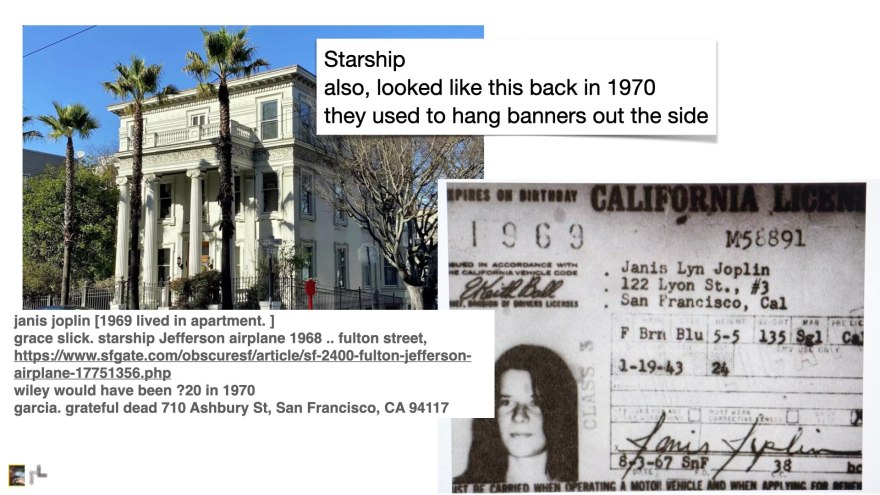
1970 -> unknown paint/hardware store San Francisco.. ‘my twenties’ [ famous rockers paint brag]
1979 “Twenty-five years ago Wiley began experimenting’ 2004 – 25 = 1979[ he was 30 doing first color]
1981 patent ciba self masking for red
1983 Drew Wiley This home last sold for $20,000 on February 2, 1983. 960 ventura st, richmond, CA 94805 .. His lab is a detached single car garage.
October 2000. Jim Browning. Welcome to the Dye Transfer Process Forum [YDT]
October 2004 Thanks, Jim, for the helpful information. Let me inroduce(sic) myself. My name is Drew Wiley. For the past 25 yrs I’ve been making exhibition prints, mostly Ciba or silver, but some C-prints, and am otherwise an 8X10 camera junkie.
March 2005, masking for Portra, and I’m still on the learning curve to improve this…I’d have to make a comparison print on my old Chromega to see if this is the case – an enlarger I now use only for 4X5 and smaller black-and-white work.
2005, I really don’t want to release my own website until summer, because its mostly just templates now. I prefer to keep a low profile, although we could all probably pull our old war uniforms out of the closet and dust off our medals in front of one another. Most of my income now is related to the architecture and design trade [meaning: he is a salesman for Truitt & White], although I’m into what you might call a pre-retirement mode, hoping to live primarily on fine art, although we all know that that can be roller-coaster!
website Created 27-Jan-2003 [active April 2004 -> Jun 22, 2003 May 17, 2014 ]
drewwileyphoto: [on wayback only] mothballed, last updated: May 17, 2014, This was just after a conflict on LFF regarding print quality. Kirk Gittings, Drew Wiley, Bob Carnie. Drew took his website offline. Registration for it expires 27-Jan-2024
November 2007 I am going to ban Michael Garelick from this group (JB) [YDT]
Large Format Forum Join Date Sep 2008
apug/photrio Joined Jul 14, 2011
Drew Wiley goes silent after he is called out on Photrio during the BH shipping thread.
He returned to LFF as salsa asked if anyone had seen Drew.
1977- 2016 After thirty nine years at Truitt & White, Drew Wiley is retiring December 16, 2016. [@67]
December 2019, Steve Meyers transferred former browning list [SMG]
8/20/20 preservationist1 [Daniel D.Teoli Jr.] banned. he posted on other groups as variant of IluvMy+[camera type] after thread derailed. topic: pigments … Wiley heavily involved
Factoids:
Julie A. Wiley (b April 23, 1966 ): Julie Wiley [https://provider.kareo.com/julie-wiley] is a Physician Assistant Specialist in San Rafael, California. She graduated with honors in 2002. Julie grew up in Portland, Oregon and started her medical training at the Berkeley Free Clinic as a volunteer medic. Having more than 16 years of diverse experiences, (at Berkeley Free Clinic) especially in PHYSICIAN ASSISTANT, Julie received her Masters of Physician Assistant degree from Samuel Merritt College and is certified by the National Commission on Certification of Physician Assistants.
WAYNE HOWARD WILEY — Wayne was born on August 6, 1910, in Newberg, OR, and died in Pacific Grove, CA on Friday, November 18, 2005. From 1948-1950 Wayne worked for the Bureau of Reclamation as a concrete inspector on the Friant-Kern Canal. From 1951 until his retirement in 1972, Mr. Wiley was Superintendent of Maintenance and Construction for the Sierra Union High School District.
[ as exercise: find what he says about Wife and Father. Inflating relations is common among many]
Lucia Wiley (1906-1998), a third generation Tillamooker, (his Famous Aunt):
she attended the University of Oregon and received a Bachelor of Arts degree. She did post graduate work at the University of Minnesota and received a Master of Fine Arts degree from the University of Oregon in 1932. She returned to Minnesota and painted frescos in the Long Prairie, MN post office, International Falls, MN post office, the Shelbyville, IL post office, the Moorhead MN post office, the Miller Vocational High School, Minneapolis, MN (“Youth marches on Toward Life of Service”), and the Minnesota National Guard Armory (“Peace and War”).
Miss Wiley did two frescos in Tillamook. The first was for the Tillamook Post Office. This fresco secco entitled “The Landing of Captain Robert Gray in 1788″ was installed in 1943. 1955, Miss Wiley left Portland, Oregon for New York City where she entered the Episcopal order of the Community of Holy Spirit. She became principal of the lower school at St. Hilda’s and St. Hugh’s school in New York
[a Parochial school administrator, not a PhD art historian. Yep, a couple murals during the Works Era.
April 2023: I was out photographing and looking for places to take the students when Drew dropped off a package for me at the Gallery….thanks Drew for braving the valleyvisitors. Much appreciated! Vaughn Hutchins.
Drew couldn’t let VH visit his house. He can’t allow you into his real world. Too dangerous; you would find out that his house, which is painted using the best of skills and materials, always needs repainting. Or, that his redwood fence, isn’t. He had to visit Vaughn at Yosemite since he had to best Vaughn’s redwood gate. Drew forgets his forgeries, others may not. Then, oh gosh, Drew recalls his recounting.
And off for the many’ith time to repaint, patch, his perfectly painted house, using specialty pro- paint that lasts decade.
Large Film Forum moves to #photrio. The online core, those posters logged onto multiple forums, carry grudges more often than information. They seem to be playing a game of Liar’s Dice — making an effort to reclaim a past they never had. They are the source of the rumor: it sounds good on one forum, so they quickly make a boast on another, gaining points in the Missing Out information war.
These cross posters, the Wileys and crew, eventually fight across the google’dexed forums: Large Format, and Photrio. Instead of cross pollinating, they cross contaminate. when drew is absent from one group, it widens participation. When he is retarded, he switches group.
Groups gather around the durable members. Over time they freeze out newcomers. The survivor mentality hardens them against change. The bullied become the bullies. Enough so that long time survivors confide: “of course we know he’s bullshitting, that’s what makes it fun.”
Without that “fun” they’d have nothing to do with the end of their days. How would you split your time? If someone tells you what they are doing, and that story is different in two different places, is that a story or a report of action.
The internet permits simultaneous actions. What does the following set suggest to you. Is he confused about what he is doing, or is he making claims to gain your respect, admiration even.
“Oh my … reminds me I gotta leave the computer and get to my afternoon experimentation with my home brew equivalent of Kodak Brown Toner. Getting a matching brown effect was easy on my first round; now I’m going to dial the concentration back and try for some split tone effects on expendable prints” at 12:15 on Large Format Forum
“Well, it sure isn’t all that bright here today either – our first heavy rains of the year. Guess I’ll spend the afternoon print spotting, plus some other minor darkroom chore, including a successful image that was metered clear down to Zone 1.” at 1:14 on Photrio
Why lie about your experience: because you know it isn’t enough. You know you are deficient in credentials. Exaggerating, puffing family likely means you know they too didn’t live the life you wanted. You lie reveals the life you wanted, yet failed to make.
the wiley fury:
— he makes a statement of possible general principal
— is asked to provide reference (ie, which patent)
— blows up. saying everyone knows. it is part of the field. he isn’t going to provide the answer it is up to you to find it
[ this occurs often enough, it should be called something other than Wiley Tantrum ]

— frequently, this is accompanied with a shotgun collection of words, interspersed with his “proof” . This is where illogical statements are made, which won’t be refuted, thereby reinforcing his beliefs. The naive reader often is also pushed away from knowledge into following along. After all, those are chemistry words he is using.
wiley’s workplace seems to have been rife with shortcuts and cranky people, if going by the number of times he threw people out of the store. And by the sudden deaths of EEs … just looking at the names of his coworkers enlightens.
has a door store vocabulary. a life as a counter talker, back office order taker provided his clickety legalesey market words. never able to bring the big close. .he couldn’t realize the distributor reps and sales agent made money with flattery…visiting 17 stores in the bay area… a few days on expense and file the orders. you were all number one at some time, or for some sales effort. probably got event passes. hooray for patty cake sales calls. Drew spent 30 years bent over the back-office desk of a softwoods and Pella doorstore.
Drew Wiley dropped out of the forums for almost a year (~2017). This was during the B&H shipping dustup on APUG/PHOTRIO.
He went silent after some noted his demeanor, and providing a context for his knowledge: his cohorts: Zack White, SR Purchasing Mgr; Joani Moore; Gary Nosti; Jack Lamon ;John Niemeier Purchasing; Drew Wiley Purchasing
[== Built of heavy vertical iron bars, some of those bars have been cut at the bottom and wrenched from slots holding them at the top to form a large gap. John Niemeier, a product buyer for Truitt & White, said that he and six other employees ride the train to work every day and use the shortcut. They do not have any plans to stop.
“The alternative is walking down a block and one block over,” Niemeier said. ==]
Drew on customer service; uses as proof of his valuable experience. This was part of his proof of knowledge about shipping photo-chemicals
even at work, conflicts find him at their center; later bragging about it.

Wherever Wiley is, you find conflict. This recent Photrio occasion begins with:

[fictional credentials / doubts of his own worth because he knows how little he’s done, other than buy stuff] your expert on color and colorant technology has no degree. Not even experience in the process names he drops as badges of skill. Dye Transfer and Pigment (carbon, gum) prints.
He didn’t make them, yet uses your lack of understanding to glow over how much he did. That stance of his changed as he was challenged more often on Large Format by drop by members who do make dyes.
If the topic involves color or inkjet printing, he will interject himself until the thread is derailed or his comments are left unchallenged. This is most notable on the Meyer’s group.io dye transfer group.
it doesn’t matter what his hearsay gossip is; he can’t tell you what to do since he can’t tell you what he did. he didn’t make the things he tells you… he may have pulled apart, even modified enlargers and copy cameras, but this was done this century… his garage wasn’t wired until upgrade about 15 years ago — he didn’t have hot water in it… and his air flow system is deficient enough that he has to process in drums outside…

With a blast, he deters your inquiry. He throws word flares which, to someone who knows, understands how little knowledge he has of why paint and ink differ. What the difference between modes of application are.
He does, somehow, know people who don’t know him. At least he knows their names. Or, more frequently, he says he talked to the “patent holder” and doesn’t have to go to the trouble of telling us.. meaning, we could get it wrong, or, more often, just let him get away with his game of liars dice. [ check the key patent names(D. Dreyfuss, Cincinnati, Ohio, and Bela Gaspar, Beverly Hills, and Gustave B. Linden, Pasadena, Calif. ) and estimate their ages when Drew talked to them.]
—never learned or made dyes, carbons, any alt prints — perhaps collected supplies and has them in storages. Yet he claims, via thousands of post, expertise enough to offer direction to the the naive — sending them out with a bogus map of Holy Land — talk about a sales job. not even a happy meal smile.
drew wiley photo finds himself at the center of trouble.. that group he references is the Dye Transfer Group.
“.. tightly guarded..”


dye transfer group — food fight among “labs” wasn’t between labs. No owners, not even employees of the large, multi-shift labs engaged in the larger fights. They were between: Ctein and Archivist1. On the former incarnation of the DT yahoo (Jim Browning) group, the contestants were Ctein, Wiley, Michael Garelick.
In the hundreds of people registered at the DT yahoo, and Group.io forums, fewer than 4 worked at a commercial lab. None of us held secrets. When I met Drew, I kept the meeting short. He was obnoxious and his work was so pasteurized it didn’t warrant further contact…

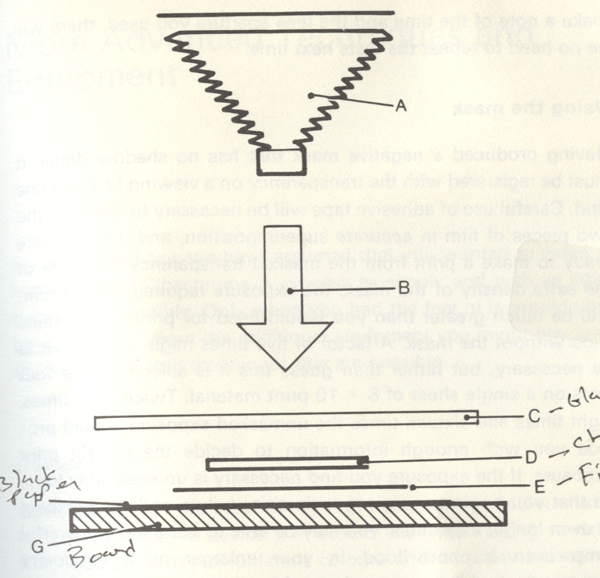
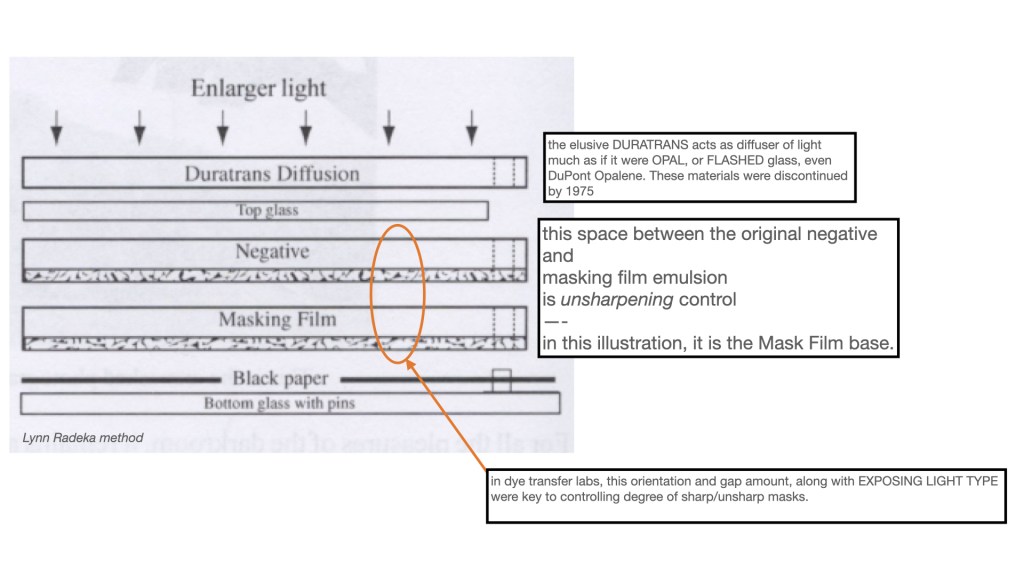
masking: the needed vs. the actual usage. Wow, even the master Name Dropper Ctein didn’t do it properly.
Yet, Wiley thinks up to 15 sheets of film were used. Likely not.
open question: Colorama
Drew had to know more than anyone, so when Large Format Forum was enthralled by Coloramas, Drew inserted himself. He had met the man who made them… and it was a secret man. He can’t name the person, since the person is paranoid. He is also the person Drew alludes to when he proclaims that the Dye Transfer group ( other groups online) have fights amongst former secretive labs and owners. Drew was at the center of several of these — along with two key participants, neither of whom worked at a dye transfer lab.
Amateurs often think that professionals must be keeping secrets, even though we worked across labs. The only secrets were fees and discounts. The workshop teachers and book sellers seemed to thrive on revelations — none of which were secrets.

That conversation was held in the St. Regis lobby. I never mentioned Coloramas, having nothing to do with them. I did mention the Worlds Fair, and Dulles airport. He can’t go into “details here” because he never learned them. He was so offensive, without work sufficiently mature to warrant extending my time with him; time spent with those other photographers in the lobby that Drew didn’t notice.
He misreads the text and the situation — study him to understand the pathway of failure.
- exaggeration. even in shoes. sometimes Red Wings are thousand dollars
- need to dominate a topic
- rewrite his past
- anger over easy question for references from a self-declared polymath
- hungry ego
- sulk response
- attack recovery
Why does he do it — the flip answer: he gets away with it. Likely he does it because he has to have control over you. He needs to impress people he regards as having, or holding power. He gets away with it because he talks about processes that you don’t understand yet hold in high value. Most of the time, he gets away with his fabrications. Those he is most likely to impress are the ones with very little experience in darkrooms — certainly not in ones dealing with clients having high expectation, in a time when there were a hundred labs within a 7 block area–






You must be logged in to post a comment.