
Copyright © 1973 by Gregory Battcock
- Dore Ashton: “Monuments for Nowhere or Anywhere.” Reprinted from L’Art Vivant, July, 1970
- Jonathan Benthall: “The Relevance of Ecology.” Reprinted from Studio International, December, 1969
- Cheryl Bernstein: “The Fake as More.”
- Jack Burnham: “Problems of Criticism.” Reprinted from Artforum, Vol. 9, No. 5, January, 1971
- Joseph Kosuth: “Art After Philosophy, I and II.” Reprinted from Studio International, October and November, 1969
- Lucy Lippard: “The Art Workers’ Coalition.” Reprinted from Studio International, November, 1970
- Ursula Meyer: “The Eruption of Anti-Art.”
- John Perreault: “It’s Only Words.” Reprinted from The Village Voice, May 20, 1971, by permission of the author.
- Arthur Rose: “Four Interviews.” Reprinted from Arts Magazine, Vol. 43, No. 4, February, H:l6\:l,
- Harold Rosenberg: “Art and Words.” Reprinted from The New Yorker, March 29, 1969. Copyright e 1969 by The New Yorker Magazine, Inc.
- Seth Siegelaub: “On Exhibitions and the World at Large: A Conversation with Seth Siegelaub.” Studio International, December, 1969
- Lawrence Weiner, Daniel Buren, Mel Bochner, Sol Le Witt: “Documentation in Conceptual Art.” Arts Magazine, April, 1970
- Robert Hughes: “The Decline and Fall of the Avant-Garde.” TIME, The Weekly Newsmagazine; copyright e 1972 Time, Inc.
- Les Levine: “Les Levine Replies.”
The Operational Word is: NEW
Gregory Battcock, Dore Ashton, Jonathan Benthall, Cheryl Bernstein, Jack Burnham, Joseph Kosuth, Lucy Lippard, Ursula Meyer, John Perreault, Arthur Rose, Harold Rosenberg, Seth Siegelaub, Lawrence Weiner, Daniel Buren, Mel Bochner, Sol LeWitt, Robert Hughes, Les Levine
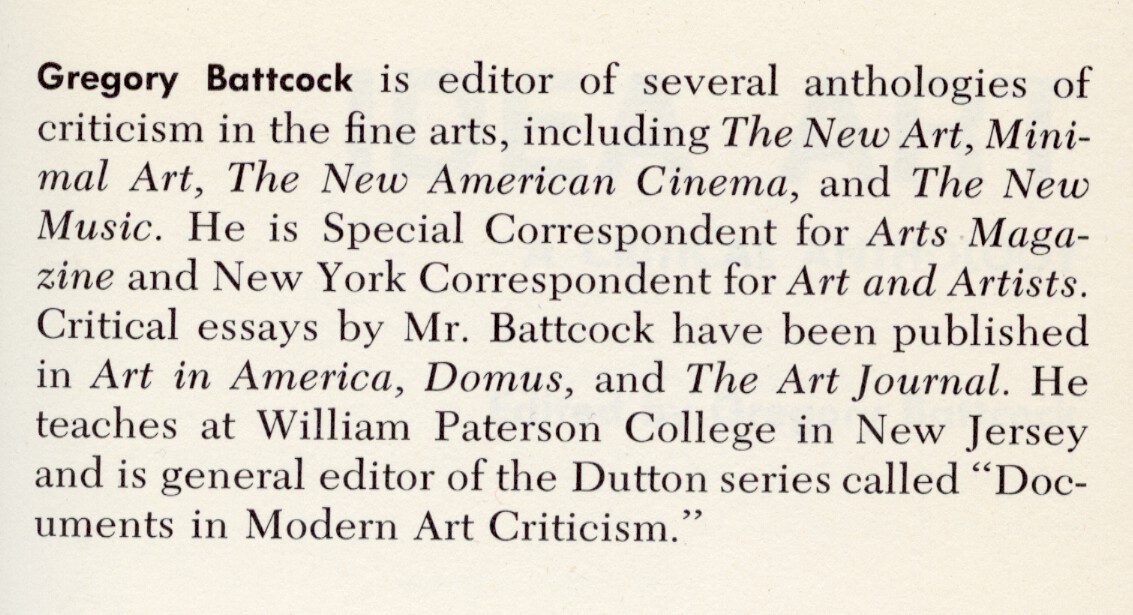
Critical anthology of pivotal texts edited by Gregory Battcock. Essays “Monuments for Nowhere or Anywhere,” by Dore Ashton; ” “Art in the Service of the Left?,” by Battcock; “The Relevance of Ecology,” by Jonathan Benthall; “The Fake as More,” by Cheryl Bernstein; “Problems of Criticism,” by Jack Burnham; “Art After Philosopy, I and II,” by Joseph Kosuth; “The Art Workers’ Coalition,” by Lucy Lippard; “The Eruption of Anti-Art,” by Ursula Meyer; “It’s Only Words,” by John Perreault; “Four Interviews,” Arthur Rose [Robert Barry, Douglas Huebler, Joseph Kosuth, Lawrence Weiner]; “Art and Words,” by Harold Rosenberg; “On Exhibitions and the World at Large: A Conversation with Seth Siegelaub”; “Documentation in Conceptual Art,” by Lawrence Weiner, Daniel Buren, Mel Bochner, and Sol LeWitt; “The Decline and Fall of the Avant-Garde,” by Robert Hughes; and “Les Levine Replies,” by Les Levine. “By 1970 it was clear that a new type of art was emerging in the New York and European art worlds. Quickly labeled Conceptual Art or Idea Art, the form encompassed an extraordinary variety of works. What they all seemed to have in common was a rejection of the ‘bourgeois’ aspects of traditional art. Works of Idea Art frequently did not actually exist as objects. Rather, the remained ideas; often, what did exist was only some kind of documentation referring to the concept. The chief purpose of this anthology is to present in a direct way some of the action, diversity, and rationale behind Idea Art. And it attempts to do so by presenting the students and educator with some of the original and important theoretical documents that helped set the direction of the new artistic emphasis.” –– from book’s back cover.

You must be logged in to post a comment.