the paper arrived this past friday. I had some other work to get out before getting round to some tests of this paper. It came from Los Angeles, the distributor/importer. Packaging wasn’t good, but I never expect B&H packaging to be as good as Freestyle. Although, since this was a drop ship order, I had hoped they would send it packed as though they understood how to pack light sensitive paper.
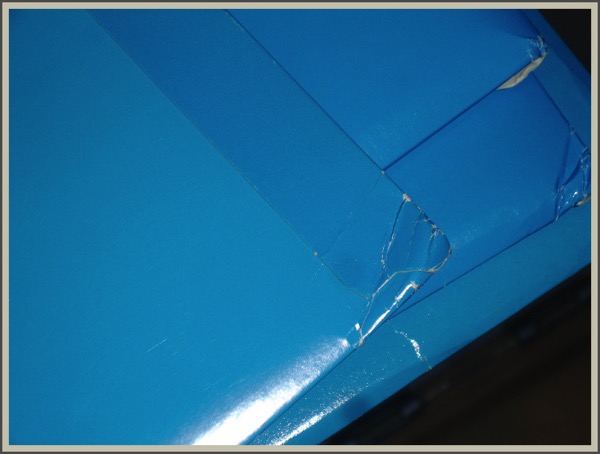
It just came in a blister pack — as though it were a catalog, or other advertising material intended for perusal and discard. This is what happens in shipping:
Can’t blame the carrier, these breaks and folds are because the packing doesn’t hold the contents tightly. It wasn’t even a padded envelope. I don’t know what I will do if the paper turns out to be a winner. Seems dangerous to consider ordering a large quantity that may not be packed properly for shipping.
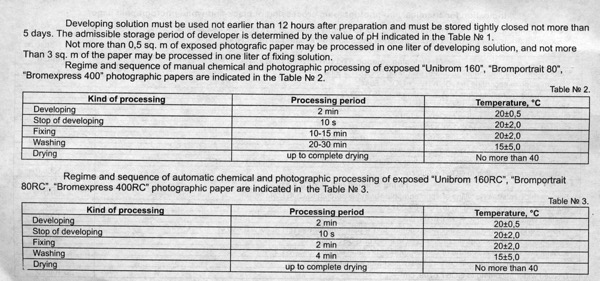
Included instructions. They also include formulas for developer,stop, and fix baths. This is thorough tech data.
natural light occurs in three times, two times, daylight and night, are stable times, not static but limited in amount of change once they’ve taken hold of the day. exposures can be tested, and settled upon in either daylight or nighttime, it is during the third phase of the day, that of dusk and dawn, these are the times of great change. your meter will fail you, even as the light will.
being a technical talk that carries information as it raises questions about who you ask; how much attention they pay, even to themself. They have a solution, but they don’t recall it; they don’t expand upon the sources given them by simply using google. Or, they don’t go to the specialist boards, where the problem is small, the answer easy, including the “diy, make one yourself” complete with schematic and parts list.
A vactrol is an electronic component that was used in equipment designed when discrete was a word for separate components on circuit boards. That was during the time darkrooms were springing up across suburbs as well as small studios around the country.
Vactrol was a trademark of Vactec (1960s) for their analog optoisolators. These are a light source (neon lamp) directed at a LDR(light dependent resistor) sealed inside a ‘can’ — The resistor (LDR) changes values as the light source changes intensity. The neon bulb ones have been superseded by LED versions for decades.
“the slow reaction time, and the fact that a resistor is easy to integrate into analog circuitry, makes the vactrol a nice control device for analog modular stuff.”
“Beseler Dichro 45 no light” OR “delay in timer-lamp on”
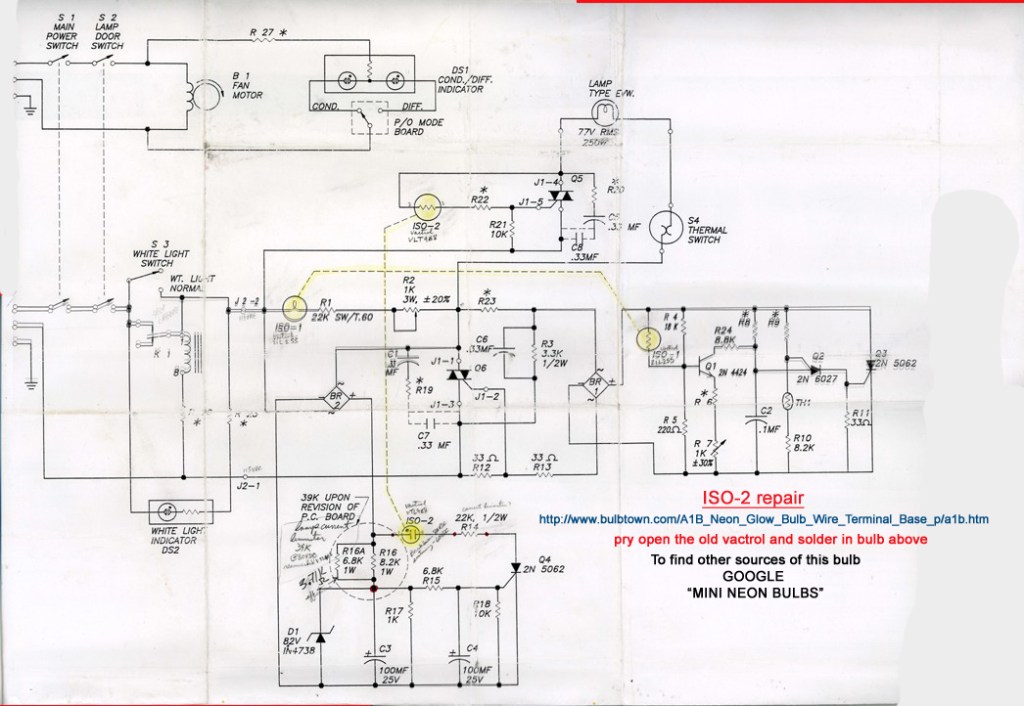
Is the problem heard on darkroom question boards. Two models for color printing: The Computerized, and the S. The vactrols were used to isolate the voltages and signal paths in the colorhead electronics. The Dichro (computerized) is a ‘closed loop’ system intended to maintain continuous color readout; even having memory modules to store settings for different emulsions or, ‘color gradings.’ More than a neutral, or flesh reading.
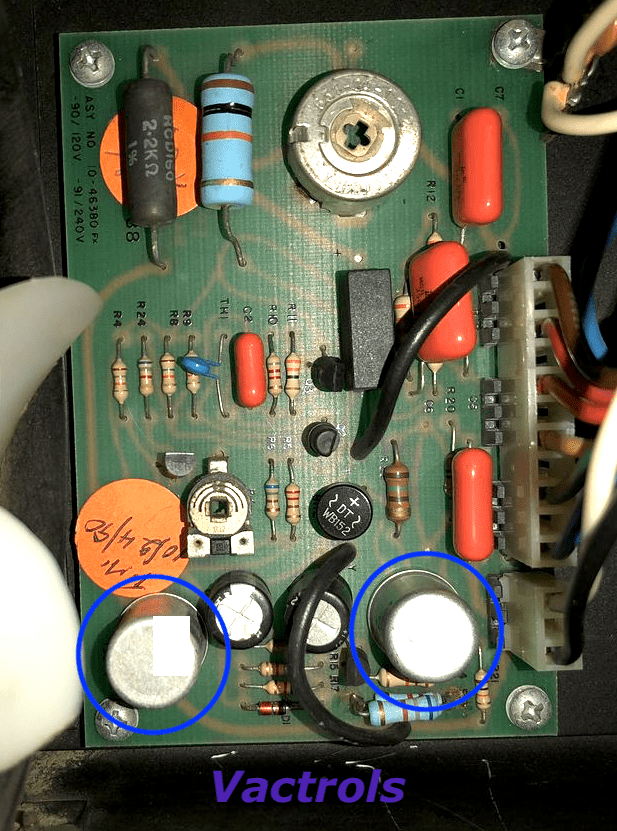
Looking at the board you will see two ‘silver cans’ — these are the likely problem. They should be labeled: VACTROL VTL 9B8. There are datasheets on the specialist boards for these items. They were superseded, in most applications, by VTL-5C3.
circuit board
The replacement is an upgrade; it is longer lasting than the original vactrol; in fact, much of the board can/should be upgraded with more recent components. Capacitors and connectors used in last century’s boards were rarely the best grade available. Upgrade using the VTL-5C3.
•Two-digit number — the max size of the negative it can accept (e.g. 23 is 2cm x 3cm, 66 is 6cm x 6cm, 45 is 4×5 inches, etc.) •M — electric motor to raise and lower the lamphouse •C — Beseler colorhead (filter drawer type) •R — Resistrol unit (variable voltage regulator) •X — Rear support truss (extra reinforcement) •AF — Automatic focus •B — Beslite (flourescent cold-light head) •AG — Beseler-Agra colorhead (continuously variable filter type)



You must be logged in to post a comment.