
Time of first appearance as estimator of developing time for that emulsion in that developer.
In re-working information about Deep/Thick vs Thin emulsions… da-net posers made me do it.
Deeper dive into Time-Temperature of photography.
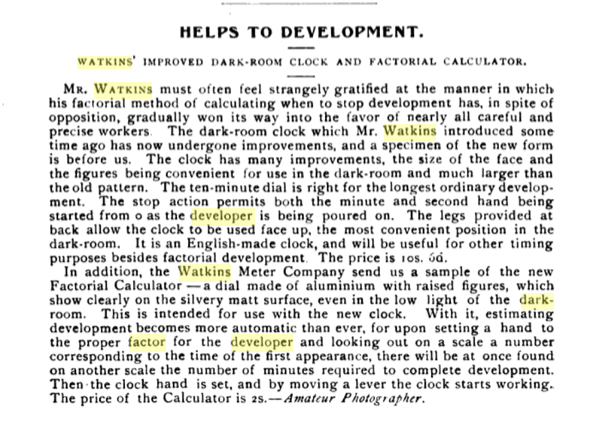
- Watkins
- Sheppard and Meyer
- Clerc, section 400, the influence of temperature
- Clerc, section 380 & 381, watkins factors, & combined factors
How Does It Work?
Developing is a process of saturating the emulsion; surrounding the exposed material with fresh developer, then moving exhausted developer. This main process is agitation. The key part of the emulsion is the gelatin. Think of the emulsion as having depth, as well as surface. This emulsion, whether film or paper, has to absorb the fresh developer– this takes time. An induction time. How fast the exposed silver begins developing depends upon the strength (developing power) of the developer. It is affected by temperature, emulsion, etc, but the main factor was the developing agent(s) used.
The watkins method is mainly of use with emulsions suited to development by inspection. It is of great use in making lith negatives, or, somewhat, in making lith-prints. Sadly, in a developer containing two developing agents, the temperature coefficient loses significance when temperature varies much from 20 C.
| Developing Agent | C |
|---|---|
| Metol | 1.25 |
| Paraminophenol | 1.5 |
| Ferrous oxalate | 1.7 |
| Pyrogallol | 1.9 |
| Metol-hydorquinone | 1.9 |
| Hydroquinone | 2.2 to 2.8 |
| Catechol | 2.8 |
Some developing agents change activity with temperature — hydroquinone loses activity at low temperature. (Jacobsen, p.67)
Temperature coefficients vary slightly with emulsions. Concentration of developer has little effect.
The temperature coefficient of a developer is the increase in speed of development for a 10F increase. A TC of 2 means that a developer works twice as quickly at 75F as it does at 65F — typical Coefficients from the mid-century were: 1.8 for MQ developer(D76), for fine-grain developers (D23), and 2.3 for super-fine grain developer.
Note: pyro and amidol do vary by amount of grains per ounce. Bromide alters the pyro factor.
Compensating Timers
Temperature control is better than a compensating timer. Keeping agitation in line, changes of developer is more important to critical processing than is time-temperature duration. Build tray rockers, insulated, water-jacket trays with lids instead.
But, if you are interested search: Tundra. DLG. ProcessMaster.
[file]


You must be logged in to post a comment.