Developing Film –

The deeper dive into the way film develops. While learning, try to avoid the post holes..the forums, which may have had good larger intent, but now are often fights between amateurs over who has a claim on meaning.
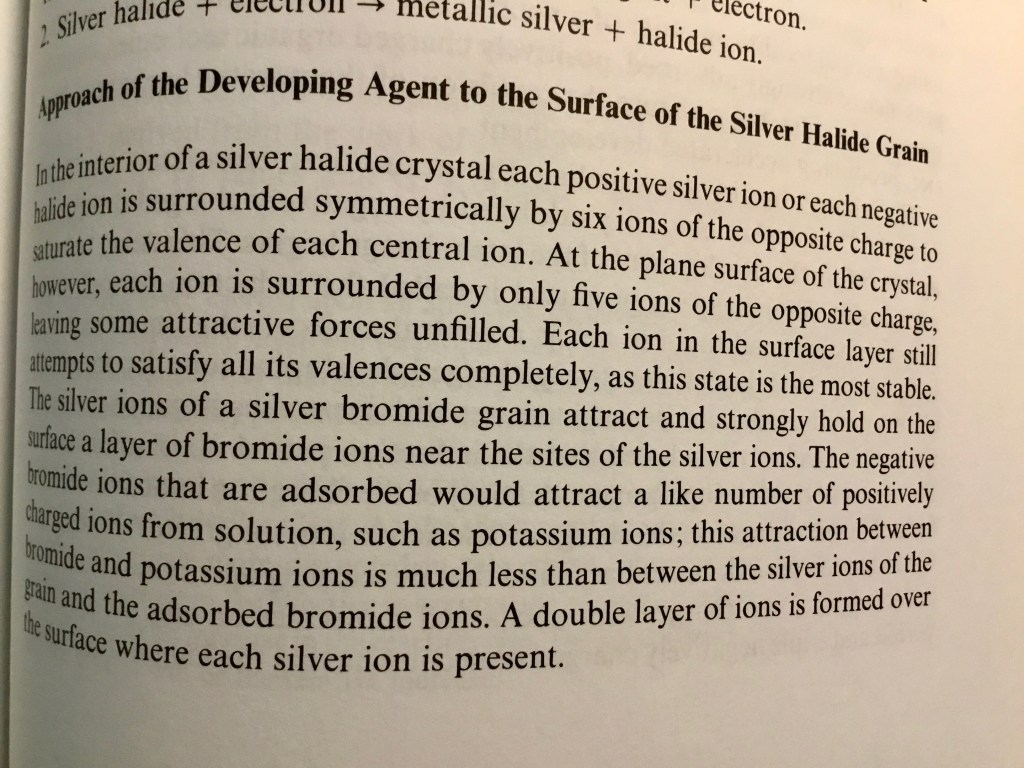
from Haist

L.F.A. Mason:

  • approach of the developing agent to the surface of the grain.
  • adsorption of the developing agent to the grain surface
  • transfer of an electron from the developing agent to the latent image sight
  • conduction of the electron through the latent image speck
  • combination of the electron with a silver ion from the grain
  • deposition of the silver atom to enlarge the latent image
  • movement of other silver ions through the train toward the latent image site, leaving pits on opposite side of grain surface, where bromide ions are liberated

That is the way to developed silver, no matter how the magic soup is concocted — the magic brew never makes a silver bullet — merely a speck of silver and residue. This process proceeds in three dimensions: from the top of the emulsion downward. Like a sponge absorbing water. The agitation cycle, particularly the initial portion is the key to smooth development. In with the good chemical, out with the exhausted chemical. The breath of life for a silver born image.

More… about emulsions. The magic of gelatin.

Gibson: Rodinal + Tri-X

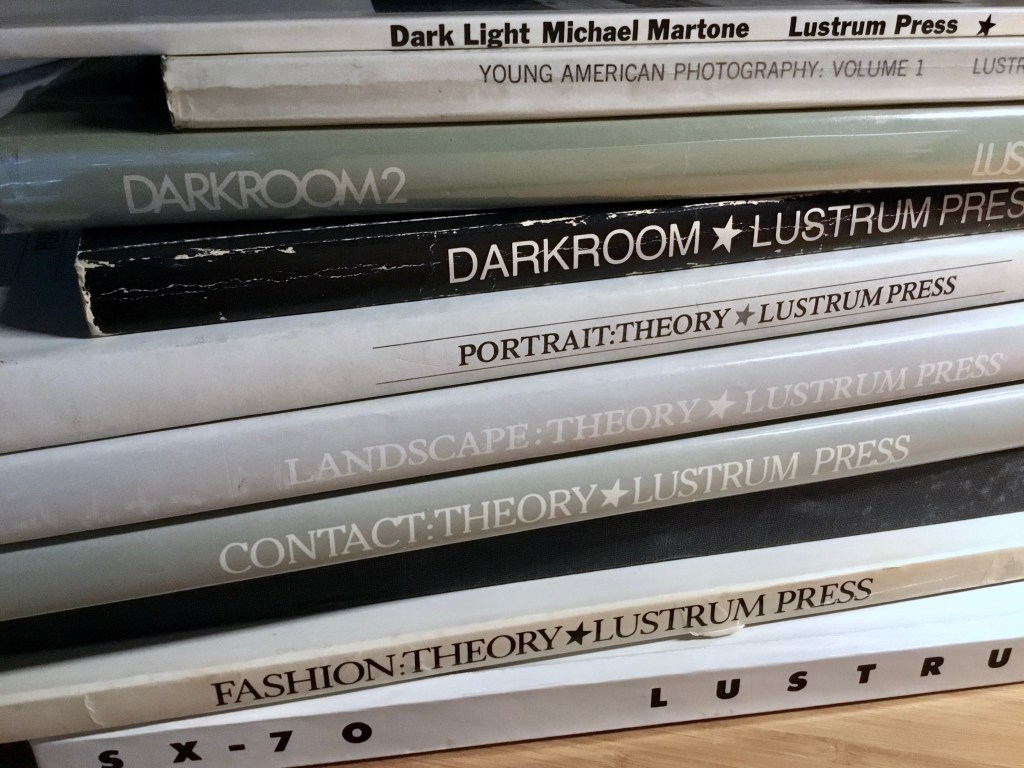
Venerable members of the silver brigade. Marched photography from the hallways to the white walls; from the basement to the main gallery. Art words began to be understood, and refined by photographers during the 60s and 70s. Ralph Gibson was a promoter, a vagabond, a troubadour for photography. Mainly the book, that area he mastered, and mentored through his Lustrum Press.

A mix of techniques, craft skill along with image skills. The walkway and the walk. Path and walker.

“The reason I publish under Lustrum is the same as my attitude towards the frame,” Gibson says. “I want all the credit, all the blame, complete and total autonomy.”

Ralph Gibson’s early method was using Tri-X shot at 100 to 400, processed in Rodinal 1:25 for 11 minutes, agitation by rolling tank on its side 10 seconds every 90 seconds. He printed using Brovira 111, Nos. 4 and 5 in Dektol 1:1 for 2 to 3 minutes. No toning. Dry between blotters.

That was then. These days digital. Lustrum thrives as does Ralph Gibson (at 83, b.1939 – ).

Digital Color— at Leica Gallery Los Angeles on January 17 (2019), the day after his 80th birthday—features images created entirely with digital cameras”

“Digital responded to the way my eye sees the world in a very emphatic, ineluctable way,” Gibson says. “Very few people get a chance to reinvent themselves when they’re 75.”