Foma: RETROBROM Sp

New emulsions are new distractions. They often lead to the same place over a broken trail, which is why I spend very little of my time with them. There are more excuses than bullets in the darkroom. I tested many papers and developers about 5 years ago, and over the years I have printed on papers from nearly a dozen companies. None of them solved all problems nor, more importantly, presented new ideas. Nothing increases vocabulary by providing a variant spelling.

Foma is a favorite paper maker. I particularly like the hand feel to their papers; this makes the time spent in the studio satisfying.

To test a paper, I make use of a simple, easily reproduced setup — this allows me to compare papers. I use Stouffer step wedges (uncalibrated). I also setup my enlarger the same, even though I make a ‘contact’ print of the Stouffer TP120, the same lens and distance from the contact frame mean my exposures reveal how the paper will print negatives typical to my work.

Foma: retro edition

A new paper is an unknown; but not a complete unknown, since the main emulsion companies publish a paper Iso(P) and iso(R) of their papers. [See the reference for what this means.]

According to the datasheet this paper has a paper iso(p) of 100; this makes the paper about the speed of Ilford MG 4 Filter. With that information, I can check my notes for exposure settings in my darkroom conditions for a IMG 4 filter; set the enlarger to that as an initial point and, make a first test exposure. Done.

I will test this paper in two different developers: Dektol (1:1, my standard), and Fomatol PW (1:1, my standard). The Foma PW developer is vary slow acting warmtone developer.

The time for Dektol was 2 minutes; time for PW was at first 5 minutes — this was increased in later tests to 7 minutes.

The test with Dektol went well — I wasn’t satisfied by the Fomatol version, so I ran them again with newer developer package. This gave me much better depth of tone with 6 minute development time. Better.

Dektol gives a neutral range of tones. Highlights showing the characteristic of this paper. To take advantage of this ‘retro’ look, the image needs middle value meaning, since that is where the distinctive color of the paper will be.

Not the case for Foma PW developer. Retrobrom paper in Foma PW is another rich brown tone paper. The brown is ‘woody green’ in my estimate. It is not ‘green’ toned — for whatever reason, Foma describes it as having a green tone, which among several online pieces I’ve read, keep the author from trying the paper.

At this stage, I am ready to print. Testing done; about 6 hours, including drying, evaluating and write-up. I will also try this with lith printing… but won’t report additionally.

These techday notes are not fulfilling enough to me.


REF:

* the ISO-P rating gives the speed of the paper: double ISO value means half of the exposure time. Unfortunately exposure meters that are calibrated in ISO-P values are hard to find. This ISO-P value has nothing to do with the ISO rating of your rolls.

* the ISO-R rating gives the grade of the paper: ISO-R divided by 100 is equal to log(D), which defines the contrast behavior of the paper. E.g. Ilford Multigrade IV has an ISO-R range of 130 for grade 1 and 90 for grade 3 (see details in data sheets, that come with the paper). The higher the ISO-R value, the lower the contrast of the print.

Fomatol PW review on webionaire.

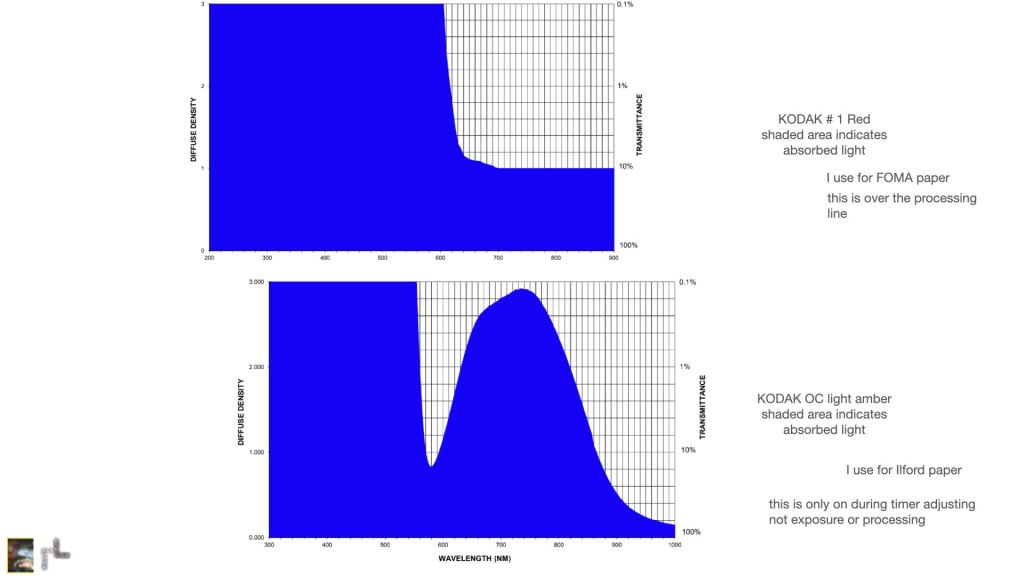
Safelights: check them. use them sparingly. I don’t hang them from the ceiling, since I have never had to find anything on the ceiling. I use them as task lights.
Characterizing Paper: Labnotes

Packaged developers can be modified. In the 1970s the following chems were used as addenda to Kodak, Ansco, Ilford print developers:

  • Hydroquinone, 4oz
  • Potassium bromide, 1-4 ounces
  • DuPont BB solution, or Kodak Anti-Fog No.1, also AF No.2
  • Elon (Metol), 1 pound
  • Sodium Sulfite, 5 pounds
  • Sodium Carbonate, 1 pound
  • Borax, 1 pound

Webionaire Posts about Foma …

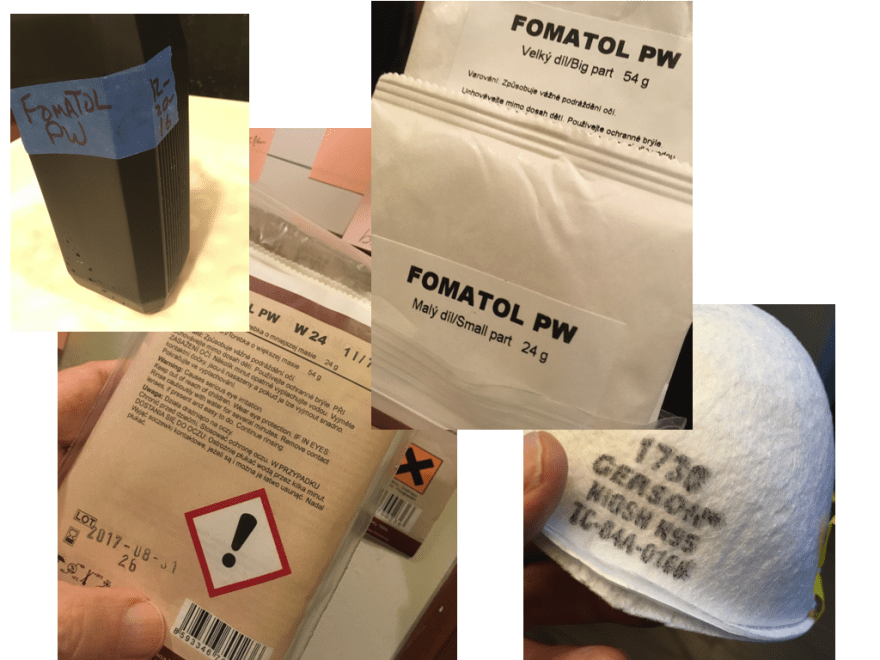
FOMATOL PW: warmtone developer

FOMATOL PW .. MIXING (2017 directions)

Fomatol PW is my standard warmtone developer. I’ve mixed from scratch, bought magic potions, changed proportions many times of the 50 years in the darkroom. This is the developer that satisfies my need. The disadvantages are availability and storage life; it does not have a long shelf life, even unmixed. As a working developer it is slow acting and exhausts quickly. The tray life is just hours. It outlasts an amidol developer, but it is not Dektol (D-72) my other common black-and-white print developer.

My typical developer is Dektol for proofs and edit prints. After selecting work for finals, I use a two tray method of image tuning. Fomatol PW and Moersch SE20C CATECHOL .

The english instruction sheets seem to be a source of wide ranging opinion about the developer agents, as well as the use of this developer. In going thru past notes, downloaded pdfs and, a few online posts of others, I think the product has changed. This change may be because of environmental regulations throughout the world.

At first, it was: “Specially formulated, glycine-hydroquinone” developer.” More recently, it is: “Specially formulated positive developer.” According to the US retailer Freestyle, it does not contain hydroquinone: no need for special shipping tags.

Mixing Fomatol PW

The only odd part of mixing is in understanding that “Big part” means the heavier bag. Both bags are the same size, but are different weights. Mixing directions are otherwise vary clear and simple to follow.

Using Formatol PW

Early directions gave development times based upon dilutions of 1+1, or 1+3; currently, directions are for undiluted stock. Sometimes I use it at 1+1, and have tested it at 1+3. Diluting this developer increases the times into the ‘lith’ timesphere (7 to 17 minutes) without ever getting a strong black. Using this as a stock developer is expensive, but it is worthwhile for my work.

Stock for 4 to 7 minutes using Fomatone, or Retrobrom Sp papers.

Links:

Foma

Freestyle

if it is glycin based? I don’t think it is anymore (since 2016).

see my post on glycin

//TBD. ansco 130 notes : see this

Labnotes: shaping negatives

If changes to development time (rates) controls density peak and range, then highlight density control is achieved readily; a direct relationship exists between development and highlight densities. While controlling shadow separations is not as simple. Shadows are dependent upon the characteristic of Film-Developer mating. Working the exercise of making parametric curves illustrate these points.

The general formulation of developer: Reducing agent, preservative, accelerator, restrainer, solvent.

Restrainers make controlled development (reduction) possible. They can also alter the (size) color of silver in the print. Potassium Bromide making that “Dektol Green” tint. DuPont BB was often used to produce Blue Black (cold tone) of Brovira, Kodabromide papers. Kodak Anti-Fog No. 1 can be used as replacement, or as addition to potassium bromide. Restrainers (aka, anti-foggants) alter contrast of the image. More AF increases contrast of the print.

Characterizing Paper: Labnotes

Packaged developers can be modified. In the 1970s the following chems were used as addenda to Kodak, Ansco, Ilford print developers:

  • Hydroquinone, 4oz
  • Potassium bromide, 1-4 ounces
  • DuPont BB solution, or Kodak Anti-Fog No.1, also AF No.2
  • Elon (Metol), 1 pound
  • Sodium Sulfite, 5 pounds
  • Sodium Carbonate, 1 pound
  • Borax, 1 pound

1970s papers:

CONTRASTKODAK & GAFAGFA
very low contrast11
2
NORMAL grade23
34
high contrast45
5
very high contrast (bang)6
paper grade Rosetta.. convert to LER, ISO(R)

Paper brands:

  • Kodak Medalist (F1 -4), Kodabromide (F-1-4)
  • Agfa Brovira (111 -1-6)
  • GAF Jet (GL 1-4)
  • Ilford Ilfobrome (IB 0-5)
  • GAF Cykora (GL 1-4 ). an old warmtone friend
  • Agfa Portriga Rapid (111 1-4) the most used warmtone paper during Peak Silver printing age.

Contrast Control by Developer Dilution:

Brovira was processed in Dektol 1:3, this produced softer acting developer as adjustment to the higher contrast of Agfa Normal. Dektol (most paper devs) can be used at range of dilutions, that is, straight (stock) up to 1:4. Paper/developers of the silver age changed print tone, going browner (warmer) with increasing dilution. This was due to change in concentration of Hydroquinone/ Elon (metol) ratio. Ilford papers (2024) are built to resist such alterations. These changes make the paper less affected by developer exhaustion or mishandling in the small volume darkroom..