JOBO Patents

Many have expired. JOBO wasn’t generous in their search for prior art, particularly on reels and water jackets.

Hobby men bragging about their tool raised the question. Germany or China: who do you think is their favorite maker of things mechanical? As always, consider their fear of foreign languages.

When searching, use :JOBO LABORTECH.

idpublication datetitle
US-4448365-A1984-05-15Film developing spool 
FR-2503403-A11982-10-08DEVELOPMENT DRUM FOR PHOTOGRAPHIC EMULSION MEDIA 
DE-3941492-A11991-06-20DEVICE FOR DEVELOPING PHOTOMATERIAL 
DE-3208968-A11983-09-22
Device for developing photographic paper 
EP-0076869-A11983-04-20Device for the development of photographic material in a rotatably driven cylindrical drum 
US-4473283-A1984-09-25Arrangement for developing photomaterials in rotatable drum 
DE-3101706-A11982-08-26Device for developing photographic material having a rotating drum 
DE-3143635-C21983-10-27Discharge device for treatment liquids of a device for developing photographic material 
DE-3113465-A11982-10-14Processing spool for holding a photographic film strip in spiral form 
DE-3102074-A11982-08-19Device for developing photo material having a cylindrical drum which is driven to rotate 
JOBO Patents

Key personnel: Helmut Petsching, Walter Kremer, Rainer Bernhardt, Johannes J. Bockemuehl-Simon

2010 “insolvency”

Some Past concerns

  • Jul, ’08 [among first posts on Forum] “I think the tempering part of my Jobo CPP-2 is busted.I’ve noticed that lately it doesn’t seem to warm up the water.
    Anything I can do to fix it?”

  • Aug, ’08 “The fabrication of parts was discontinued in November of 2006,and Omega-Satter USA took over the assets of Jobo photo processing products. I have no idea where you would get a “repair.” The usual fault was the circuit board, which was easy and cheap to replace some years ago. Now, whatever parts you can buy is dependent on wherever you can find them. After using a Jobo for some time you will realize that it would not be the end of the world if it gave out, and lots of film people have never used one”

  • Sep, ’23 “when you want a reliable machine working for 30+ years, you have to pay a certain amount of money.Also if you consider that the JOBO products are produced in Germany with highest environmental standards and protection + social standards for the workers (none of that is given in China).

  • Sep, ’23 “I have a CPP3 Jobo unit that is not working properly right now. the control panel is not operating and I am told by Cat Labs who sold it to me that its probably the fuse. Problem in this unit some genius in the factory decided to put the fuses in the guts of the motor unit and taking it apart is not a user friendly issue. I am being told a new motor is going to cost me $3000 to replace which is 2/3 the cost of the machine when I bought it. 

Making up HC-110

was it a key. who knows who knows what they know.

HC-110 entered the stream as an addition to dye transfer printing. My view. It appeared in literature distributed to the avid darkroom “enthusiast.” — what we called the Dentist Darkroom. Over time, Kodak taught the duo Super-XX and HC-110 to the weekenders and small, part-time printers. The reputation grew thru repetition. This century, with a sense of failing industry, HC-110 held onto its claim of mystic value by being difficult to make, hence, it would be a catastrophe for it to disappear. The value of association plays background to this.

Dye transfer, large shops, had multiple lines. The small ones could use HC-110; however, the large, deep lines would never be taken over by HC-110, so, DK-50 remained.


Enter the gossip track…

IN A SLIP OF THE LIE, HE TOLD THE TRUTH.

Back to HC-110 original style. MSDS sheets aren’t required to list every ingredient, just hazardous ones, and with trace or trade secret ingredients exempt from being listed. I know someone who didn’t formulate a personal batch; but he had access to a major research lab, and the right background to do it. It was tricky. Certain ingredients aren’t ordinarily available.]] photrio. He probably meant to say he knows someone who DID make it. The reason he makes the claim is to bolster his standing among those of little standing.

final state of ausi — info being sent to chemists.

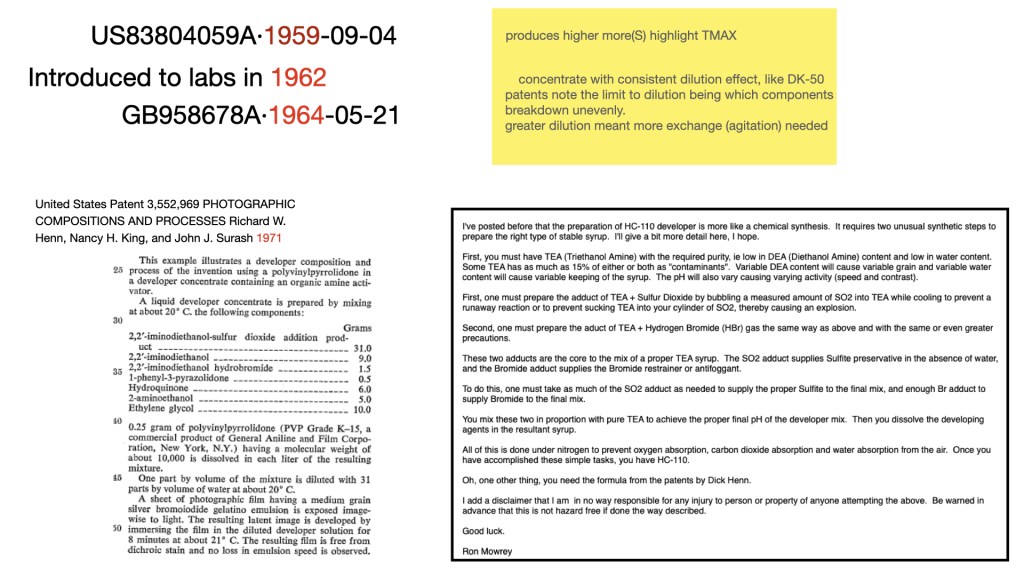
Of course, all this work was for the Old HC, the syrup, not the current HC-110.


The patents tell more. The 1959 patent is about concentrated developers. The motive is for reduced storage space, faster mixing as well as modifying gammas of film without resorting to multiple developers. The 1964 patent provides information about dilution effects. Dilution reaches a limit, which is why Kodak listed the few dilutions they did. Patents do tell a story to those familiar with reading them.

agitation changes shape of curve. Same film, & developer(DK50 1:1) difference is agitation scheme.

I used HC-110 after using DK-50. I began making masks and seps with DK-50 — after the HC syrup disappeared, I returned to DK-50. My lab films are Ilford: Delta, PanF+, FP4+, and Ortho Plus. These films provide what is needed to make masks and separations for color and BW procedures.

Avoid the forums (my recurring theme) — use manufacturers first; then check with old texts. Use google books. Most important: try things, keep notes. Be certain to follow the information of those who have done more than repeat overheard counter-talk.

Once the syrup hit the water, its main purpose is lost. Once the syrup left the manufacturing, the major value of those researchers was lost.

for the Syrup, (kodak Honey) version. HC-110 thick is gone, only thin remains

Characterizing film+developer combination isn’t as time consuming as re-formulating a compounded chemical like HC-110. Falling back to DK-50 from HC-110 is a few hours effort, not days, certainly not the months expended trying (and failing) to compound the Aussie HC-110.