Regression toward the Meme

This house resolves: WE are here to pound our chests and leave unchanged, more committed to selling merch in halls and always online.

Regression to a meme… a degraded conversation makes any exchange seem fulsome, even though it is not wholesome.

finishing with surrender as victory: “We have to agree to disagree…” debate tactic of the novice grown confident by absolution from funders happily using you as front men to the children’s chorus.

?why do we have to agree…. the debate wasn’t needed. You came with your fixed opinion. Held my stage, but didn’t listen, learn. I gave you attention along with an audience. We end where we began in awareness and knowledge. Except.

absolutes negate. How long was the earth flat?

Putin or ?; T-bag provides tiny version of Putin’s argument.. history from the attacker. Explanation of a long ago childhood trauma wouldn’t be evidentiary in Kirk’s court of aggression, yet serves well as reasoning for excuse of bully boy-friend… the acceptance is over anticipated wealth .

All is subject to a business based on bathroom deals and toilet paper contracts.

loser: agree to disagree — cry uncle and reset another game. Back to were we began, except you have been given a stage and audience.

You won. T-shirts and mugs available. “Prove me wrong” is a slogan not evidence. Catchy enough, even in the Ketchup free state.

===one with facts, one with accusations impossible to prove wrong. The winner is always the one most available for interviews.

This educational model aimed to cultivate well-rounded individuals equipped with the knowledge and skills necessary to engage in public life, think critically, and pursue moral and intellectual virtues [wikip]

  • Middle ages AD 500-1500
  • Renaissance: 12th C and 15th 16th
  • Age of Enlightenment  1687-1789

// chuckroast [boast]etc

[more posts along these times/tunes are in the pot]

Discourses on Art

Book by age, or by contents. How do you choose the text for your table? Mine is filled and emptied by whim; by wandering among the stacks. Like a sleepwalker without slippers. Old books are kept not maintained. They become overlaid with marks upon readings. Reynolds is an old text without many current readers. I never spend more than a frew minutes with it, although it draws me in enough times over the years to remain on in the main stacks.

Joshua Reynolds. [1723- 1792]

Further:

Additional ballast from the “other”:

  • The ONLY ABSOLUTE TRUTH is that there are NO ABSOLUTE TRUTHS (Feyerabend) 
  • I define postmodern as incredulity toward metanarratives … (Jean-François Lyotard)
  • Finally, if nothing can be truly asserted, even the following claim would be false, the claim that there is no true assertion. (Aristotle)
  • If anyone thinks nothing is to be known, he does not even know whether that can be known, as he says he knows nothing. (Lucretius)
  • And isn’t it a bad thing to be deceived about the truth, and a good thing to know what the truth is? For I assume that by knowing the truth you mean knowing things as they really are. (Plato)

Why Didn’t You Make Dye Transfers

Everybody loved dye transfer. Nobody made them. Why? This century, this time span one and all bemoan the death of a friend they never knew. Never even visited.

  • supplies were a phone call away
  • documentation was available free, or for minimal charges
  • workshops were held at getaway photo shops.
  • several colleges held courses
  • trade schools were in major cities, or by mail-order

A simple enough question . with likely very few answers — honest, introspective responses.

The obvious response: there aren’t any materials . What about when there were — why didn’t you buy the Efke film? Assuming you were an adult in 1990, why didn’t you buy Kodak dye transfer material ?

And for those of you who did buy the materials: why didn’t you use them ?

Continuing along this expansion, for those of you who bought Materials and took a workshop, why didn’t you use dye transfer as your print process?

If you were drawn to dye transfer enough to buy the materials and take the training, why didn’t you expand your skills and become a die transfer printer?

Why do people buy beyond use : compulsion vs obsession. The ownership vs the authorship. Do they believe themselves stewards?

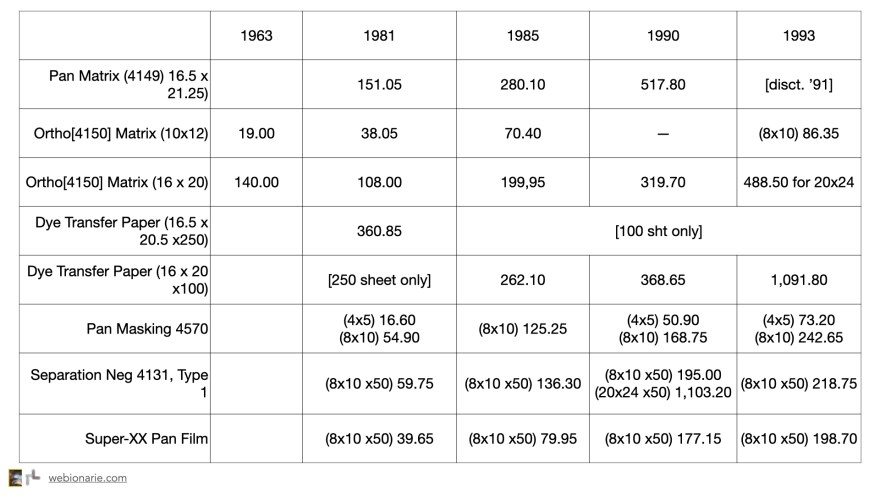
Catalog prices for some Dye Transfer supplies. These are the retailer list price. Labs paid much less.

Consider: Giffen vs Veblen goods. The professional depended on the supplies. The hobbyist didn’t. 1981 was a break year for Kodak’s process. By 1986, the decision had been made to let the process run out the clock. During this time, the larger labs had a decreasing dye transfer business. It was maintained as a prestige factor attracting interest but resulting in few projects. Small specialist labs grew in the eighties; even the best known added other processes to their sales brochure. “Now, the finest Black and White from the finest Color Lab.” — 1987 —

Kodak chose not to license, nor sell the process[ 1981,2] . Wonder why? In their final run of product, the only supply sold completely was Tanning developer. Nope, not even all the matrix film was sold. Not even the Pan Matrix. So it goes…. much of the film and paper was held in store for years.

and then it was recycled. The Fotokemika branded Efke matrix film also saw few buyers.

Maybe there is a market for the Coffee Mug, the Trucker Hat, the Film Vest… not the film… Sell the tchotchke, maybe the tattoo, no need for the mats and blanks.