Robert Frank ( November 9, 1924 – September 9, 2019 ), June Leaf (August 4, 1929 – July 1, 2024)
success feeds through interaction . it’s a very fortunate artist who gets to share their life fully with another .
steidl’s ink factory –One form of the atelier. [ g-d couldn’t spell-find ] Home to book forms of both Robert Frank and June Leaf. August 2026 that is changing — [ jul16 steidl news ]
The group can be small, but it must be . In an ideal artworld every0ne is an artist. Your daily minimums are fullfilled by nearest. The scroll unrolls — you mark out portions with increasing fluency.
The days when the group was a photo lab are gone. The print dryer doesn’t exist.
work unrolls — The harder part of working is finding others to work with not on your work but on the work they make that makes your work .. their work amplified their life.. The coral reef.
Worlds, manners of stimulation — tiktoking between observation and conception — construction and marshalling.
Steady-state studios over decades in New York and Mabou proved art accumulates within a space. Physical memory. Leaf: “I have discovered that thought is infinite” 1975 — “It is impossible to do the same story every day.” She worked daily, relying upon visual intuitions, much like Robert. Her first training was physical as a ballet dancer. “When I see a drawing it’s like a locomotive or something powerful into which I just put back the machine.” Along her craft path, she learned and built a forge. She builds her drawings/paintings as sculpture. As if forging a multipart art world.
Art has no singularity — all is wireframe. The lucky live within an accepting world that nourishes … Artists do more when living with other artists …
Fn, [own] because of so many uses of “hyper-personal” use by Foster. Master’s degree in 1991 from Brown University.[Looking closely and nudging others toward a shift in perception have become life’s work for Foster ] ~b. 1965
Judd’s red book, Writings, is a table regular. Taking breaks by flipping thru books from the shelf is my way of avoiding news of non-art-world. One turned down page held a big question mark bookmark. It was from Judd’s 1963 reflection about Josef Albers’ book. About how expensive it was. How beautifully made, along with it owing much to Chevreul who had made so much influence on Impressionist painters.
some passages: Albers: “We study this first, not as a surprising or entertaining illusion but to make eyes and mind aware of the wonders of color interaction; second, to learn to utilize color deception in creative color performance.’ “The book Interaction of Color is a record of an experimental way of studying color and of teaching color.”
Judd observes instance of Albers’s teaching: Albers wants to emphasize that “color [is] the most relative medium in art.” A color can be made to look different. The class is shown examples of this.““Then the class is invited to produce similar effects but is not given reasons or favorable conditions. It starts, therefore, on a trial-and-error basis.” .. and: “The information taught to art students is even more relative than color. It is highly circumstantial and transitory. But at any one time, specific knowledge of some kind is necessary. Usually, though, it is being formed at the same time that it is necessary. Techniques and information are vital if there is an artistic use for them and completely useless if there isn’t.
finally, my margin-marked item : … Albers’ particular view of color is indicated by a qualification to a harsh study in black and yellow: “Despite its lack of an harmonious or pleasant appeal…” He goes on to say it is useful anyway. [Judd’s writing ] AND my takeaway lesson.
Aspect
Michel Eugène Chevreul
Josef Albers
Primary Focus
Color contrast and its laws
Relativity of color perception
Theoretical
Methodology analysis of color interactions
Experimental and pedagogical approach
Key Work:
The Principles of Harmony and Contrast of Colours
Interaction of Color
Impact on Art
Laid foundational principles for color theory
Expanded understanding of color use in art
Expending time with my shelf is what I do instead of asking the passing webstream. I had to review Chevreul. Very glad I did. Not because it will help my art, instead because it raises questions about how much some people contribute to general knowledge as they pursued their curiosity of “sense” world.
from wikip “Chevreul became the first scientist to define the concept of a chemical compound and the first to formally characterize the nature of organic compounds; he is consequently considered a founder of modern organic chemistry … and … Chevreul’s study of textile dyes while director of the Gobelins Manufactory in Paris led to color theories that “provided the scientific basis for Impressionist and Neo-Impressionist painting”
The cruel gap  between knowing and doing ..
those who know it all have little left to learn; if learning was a pleasure, little pleasure remains
july 2026: am changing what, why I use the net as writing surface.
“Intelligent individuals learn from every thing and every one; average people, from their experiences. The stupid already have all the answers.” ― Socrates
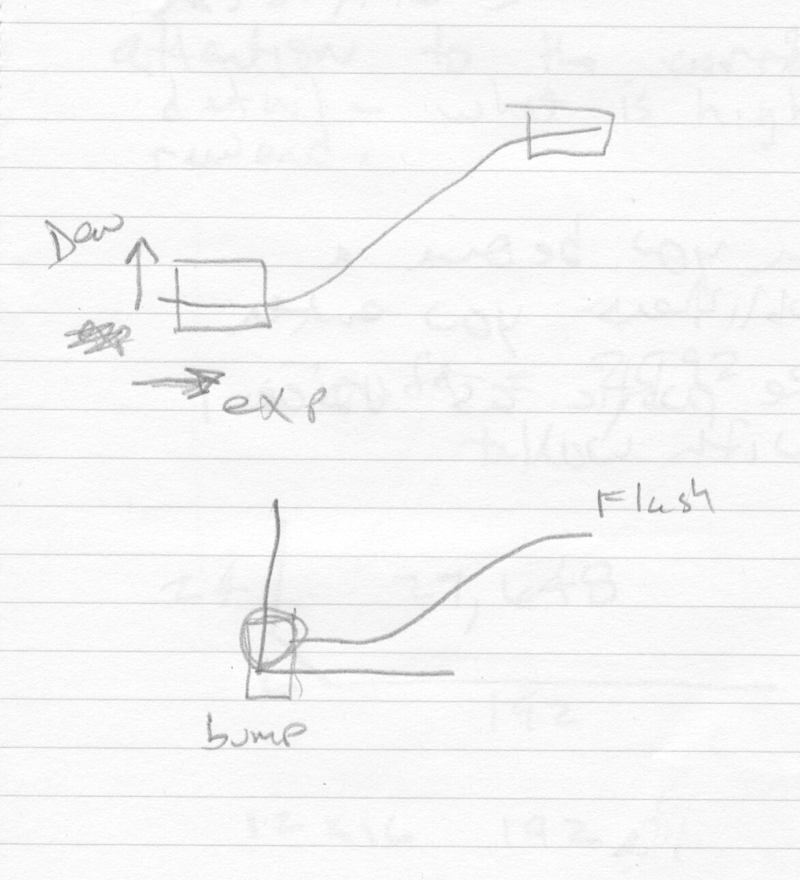
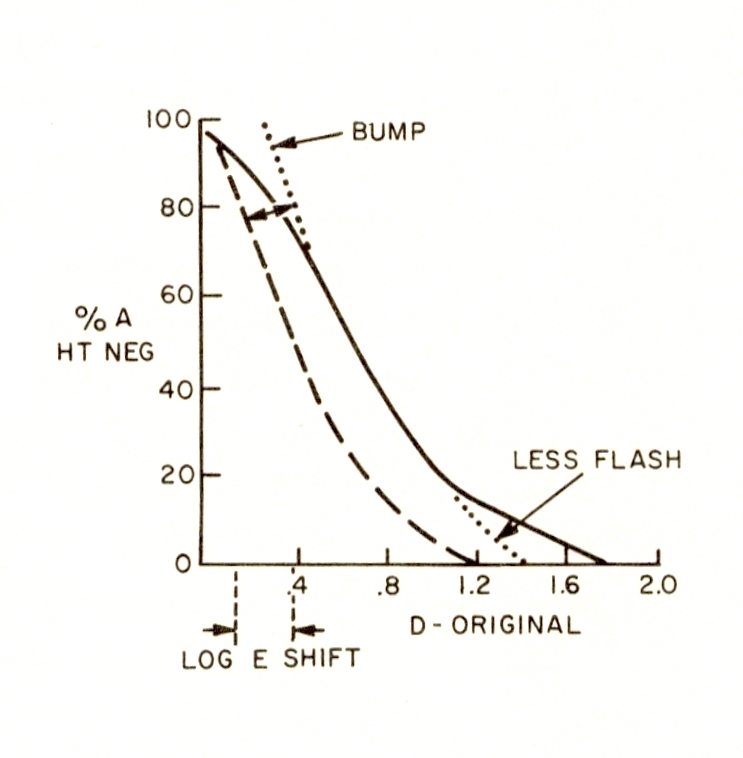
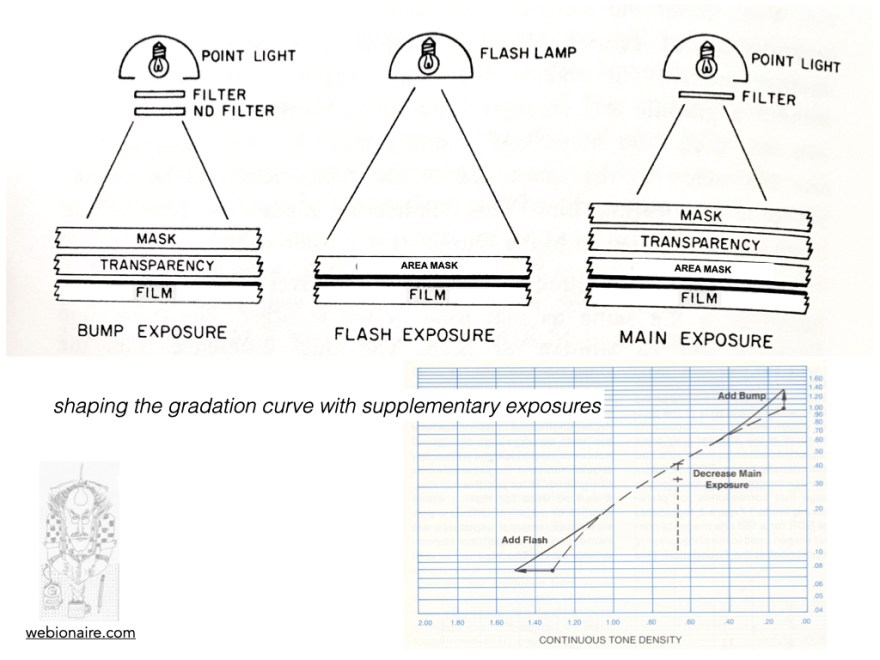
one of the optiquals… using light for means, by means other than image-formed pattern. Sometimes the H&D curve is more bendable than others. More details follow…
:the mysterious Q is called upon from the shadows as explanation for almost any effect. What does it explain? Do you use it… that other light; that other exposure summation. Think weeding … sometimes it makes tea.
Photography is a simplified form of drawing; let the thing draw itself.. the law, rather, the principle of exposure holds for most of the time. Like all real things the exposure rule varies. This variance provides confusion or useful options, even if you don’t know the names of the various effects. Reject before using is a rule of turds. Well known, widely influential resources gain stature by passing along their approach; their dictionary, complete with conceptual restrictions takes hold.
if not controlled, at least understood — edge of distinction —
More importantly, how can you use exposure effects in control of the image. How to manage the different points of the curves. Tone-bending, by using effects discovered and refined by early photographers building out the field of light sensitive surfaces.
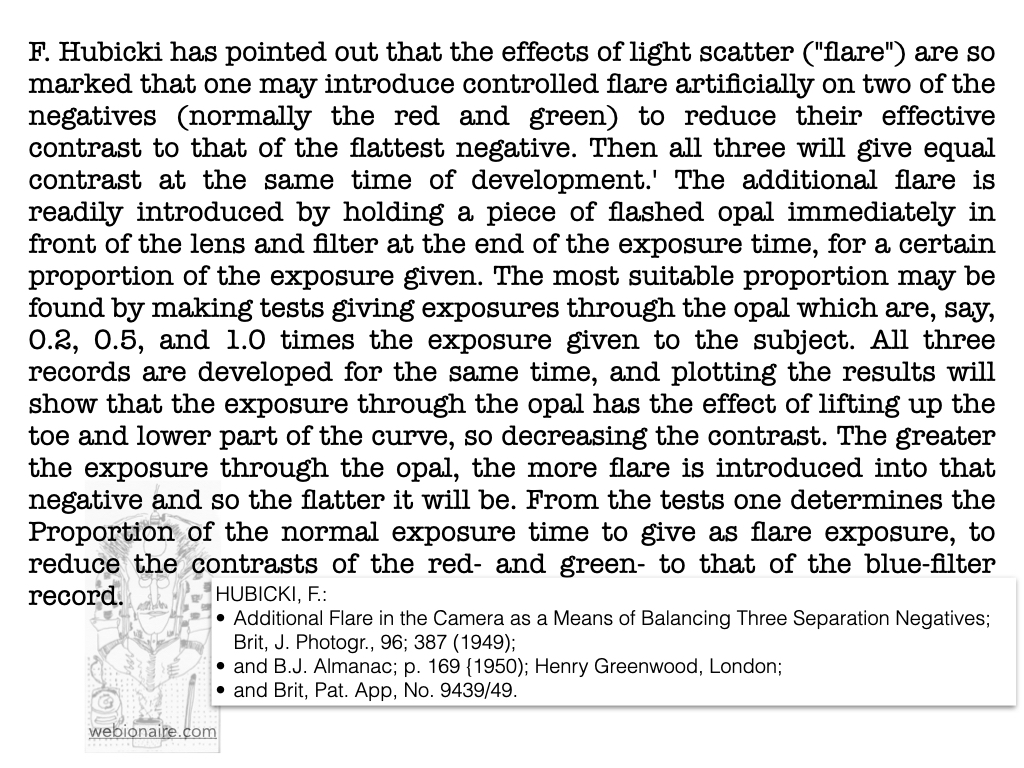
Flash and Burn characteristics of the enlarger. The slide-set introduces the concepts of controlling some of the HD shape by means of altering single contrast emulsions, such as films. All dye labs had full understanding of these principles. Some of the information carried over into the fixed grade BW darkrooms.
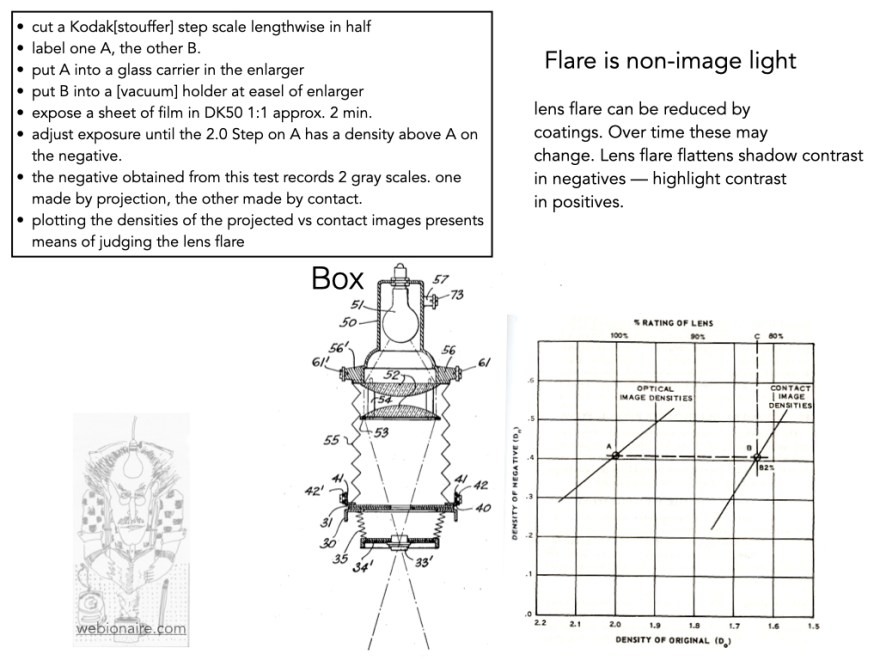
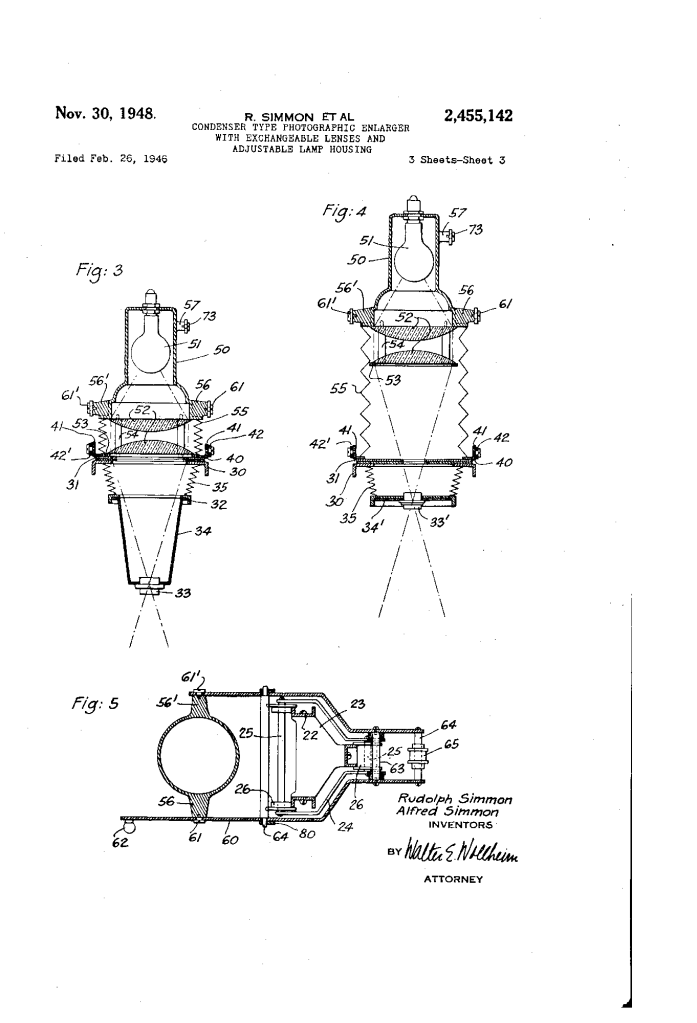
Early darkroom lamphead patent for a condenser enlarger. 1948
Flare up. The other words, effects found upon deeper reading into the the literature of exposing silver materials. If you were a designer of systems, or an extremely inventive user, these terms, often named after their initial discoverer, will take you along the full path of the characteristic curve; enough so, that you could begin to design exposure making and measuring systems.
Flare: The worst element in photography. The projected light that escapes around the image and causes fog and distortion of the original image. — Bob Pace.
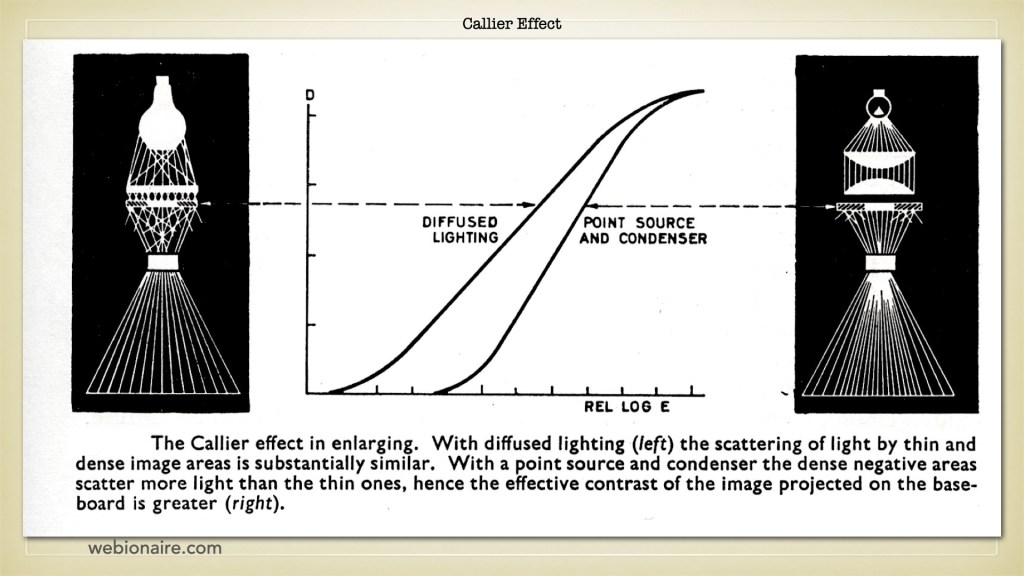
callier: Pierre Chavel and Serge Lowenthal, “Noise and coherence in optical image processing. I. The Callier effect and its influence on image contrast,” J. Opt. Soc. Am. 68, 559-568 (1978) AND C. Tuttle. 1926. “The relationship between diffuse and specular density.” J. Opt. Soc. Am. 12, 6 (1926), 559–565
villard: Jenkins, R. L., & Farnell, G. C. (1972). Internal-Image Formation and Related Photographic Effects. The Journal of Photographic Science, 20(5), 167–173. https://doi.org/10.1080/00223638.1972.11737692
sabattier: Woodlief, Thomas Jr. (1973). Carroll, Burt H. (ed.). SPSE Handbook of Photographic Science and Engineering. New York: John Wiley & Sons Inc. p. 428
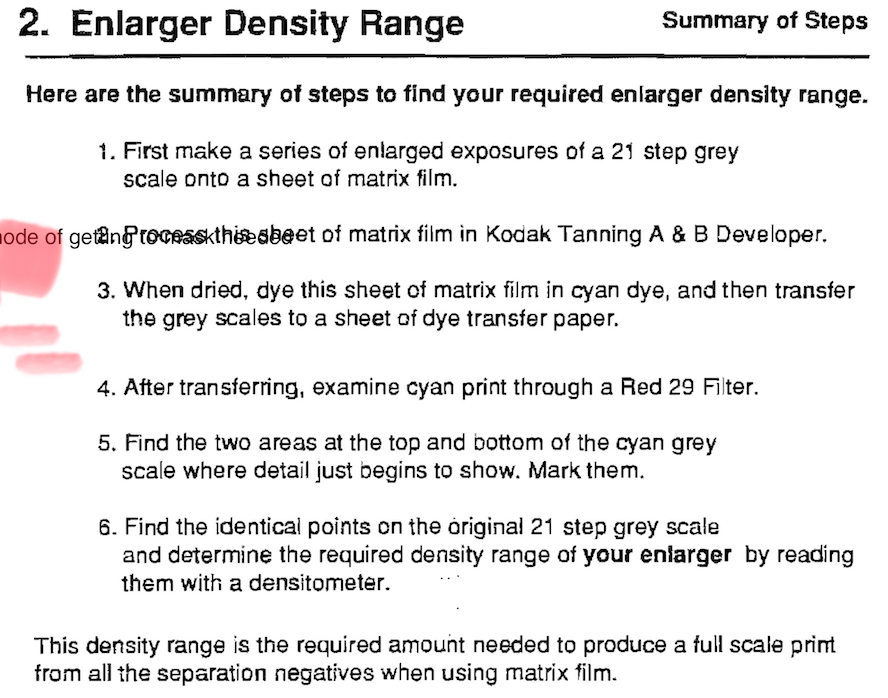
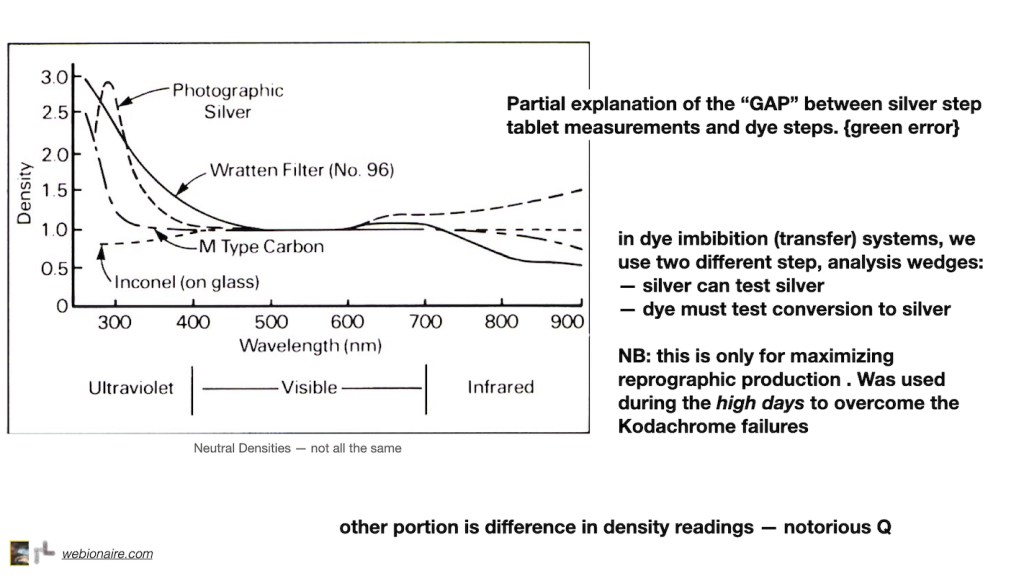
Using means knowing the difference between a silver contact and silver projected image in common darkroom printing. Dye-transfer is BW made complex by the number of steps; permutations seemingly beyond understanding. We learned the difference between silver testing and color, dye testing. The AIM, targets used had effects that could confuse ones initial learning — without luck, or well directed starting information it could seem a fools burden… pushing snowballs up a volcano.
Become alert to difference in response between instrument reading and material action: measurement may not predict fully, accurately. What you measure may not be what you get — refine, or re-define. Dyes aren’t silver; this meant that what we tested changed by stage of the process; was it silver, or dye stage material.


You must be logged in to post a comment.